
Remember me
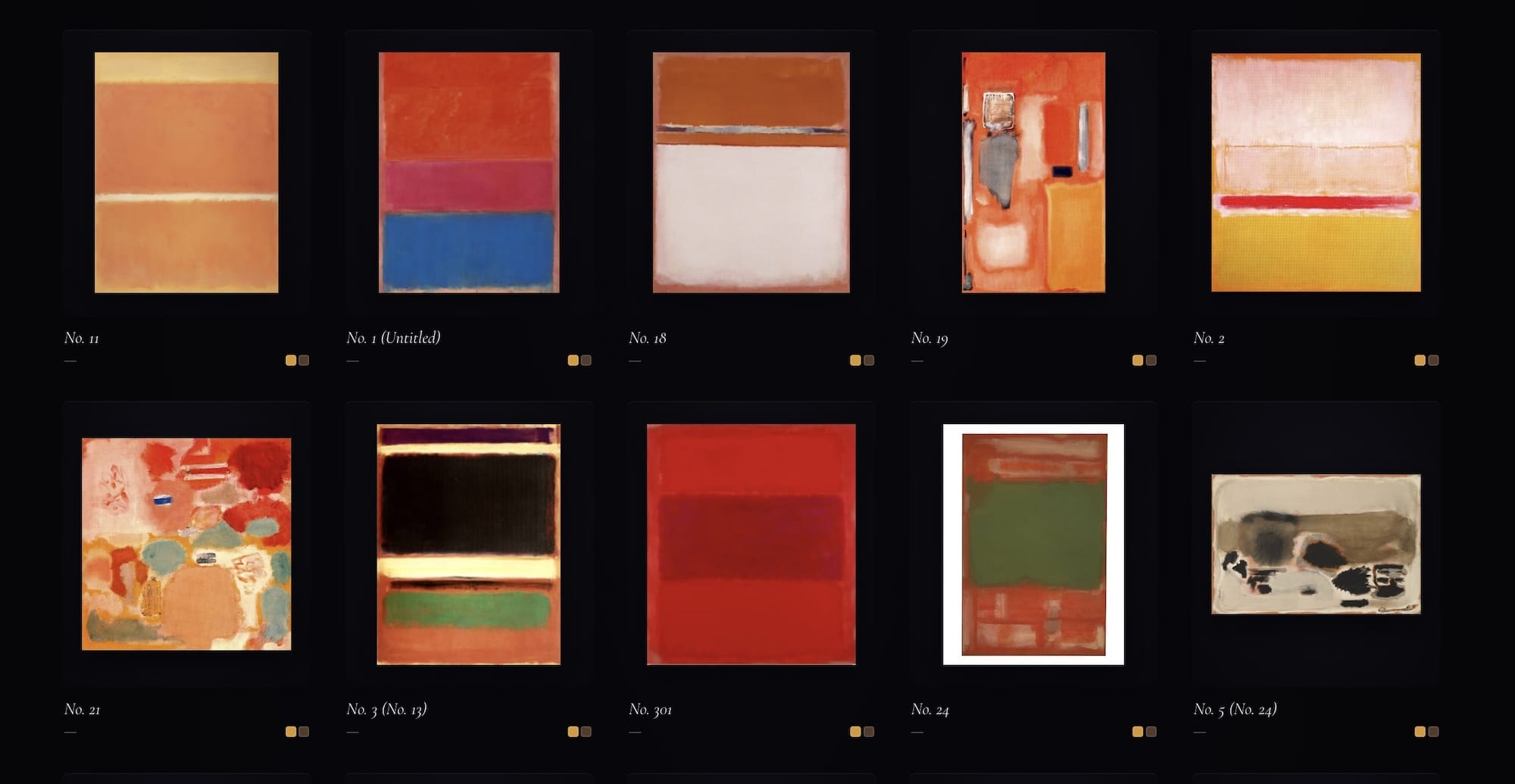


Mark Rothko is known for his “color field” paintings, a genre that was coined in the 1950s to describe his work specifically, along with peers like Barnett Newman and Clyfford Still. These works are generally characterized by their total abstraction and emphasis on clearly delineated areas, or “fields,” of different hues. One might also think of Josef Albers’ seminal series titled Homage to the Square, which delved into the virtually infinite relationships between colors.
For Rothko, canvases were often very large, measuring upwards of 10 feet. The works inside the Rothko Chapel in Houston, for example, are architectonic, commanding the viewer’s complete attention and inviting us to slow down and truly immerse ourselves in a contemplative space. Even on social media, a new generation is discovering the artist’s meditative works as an antidote to visual and information overload. His oeuvre also forms the basis of a project called Current Rothko by New York-based designer and creative director Joonas Virtanen.

On the elegantly simple website, type in any location in the world and the algorithm will produce a Rothko painting representative of the weather there. Currently, the catalogue contains 89 paintings, each of which are tagged with a color register, brightness, temperature, and mood so that the search engine can match them to the conditions of specific places at any moment.
Virtanen has sourced many of the images from WikiArt and WikiMedia, plus fair-use image databases from major institutions like the National Gallery of Art, MoMA, Tate, and others. Rothko’s work remains copyrighted, as artworks generally enter the public domain after 95 years. Access to high-quality imagery is therefore limited to what Virtanan describes as small “capped” previews that could never be reproduced at scale.
While each image is accompanied by the title of work, the designer acknowledges that the platform is a work in progress, and details such as dimensions and medium would enrich the experience. In the meantime, since I began this article, Chicago has transitioned from 77 degrees and clear with “No. 5/No. 22” (1950) to a cloudy, humid 81 degrees with a chance of “Black on Maroon (Seagram V)” (1958).
For another art historical twist on the weather, check out Virtanen’s Plein Air weather visualizer. And you’re in New York City, you might also get a kick out of his subway status tool, Tangled Lines.


Do stories and artists like this matter to you? Become a Colossal Member now, and support independent arts publishing.
Hide advertising Save your favorite articles Get 15% off in the Colossal Shop Receive members-only newsletter Give 1% for art supplies in K-12 classrooms