
Remember me


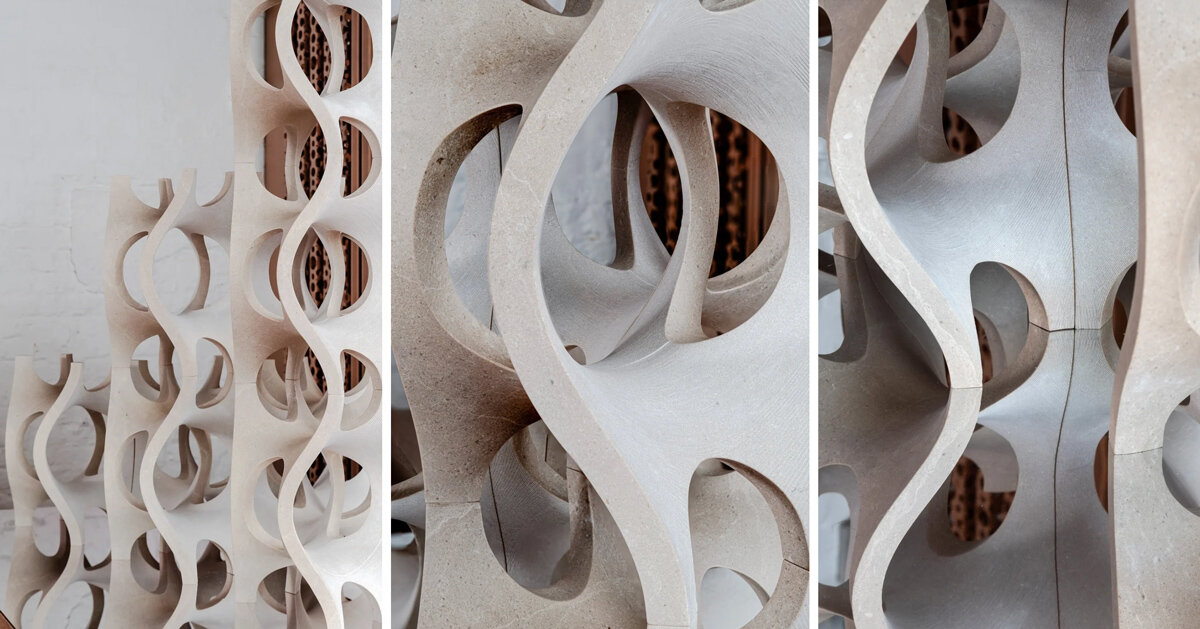


Fluid Stone is a modular stone installation by architect and interdisciplinary designer Vlad Tenu that investigates how computational design and robotic fabrication can expand the use of reclaimed stone across product design, interiors, and architecture. Produced by Cereser Marmi and presented during Clerkenwell Design Week in London, the project reuses quarry waste to create a reconfigurable construction system based on digitally generated geometries.
The installation consists of ten interlocking limestone modules robotically carved from reclaimed blocks of San Sebastian limestone. Sourced from material typically underutilized during the quarrying process, the stone is repurposed into modular components that can be assembled in multiple configurations. The resulting system forms porous surfaces capable of functioning as decorative objects, furniture, interior partitions, or, at larger scales, architectural screens and facades.
The project applies geometries derived from periodic minimal surfaces, mathematical forms found in natural microstructures, to investigate more efficient methods of material distribution in stone construction. Rather than relying on material mass alone, the system achieves structural performance through geometry, allowing relatively thin stone elements to form self-supporting assemblies while reducing material use. The modular approach combines structural behavior, material efficiency, and spatial organization within a single geometric framework.

Fluid Stone Installation on display at EH Smith CDW 2026 | all images by Neil Perry unless stated otherwise
Robotic Fabrication Redefines Structure and Ornament in Stone
Fluid Stone also examines the relationship between digital fabrication and stone construction. Robotic carving enables the production of highly articulated components in which structural performance and surface expression are developed simultaneously. The project revisits the relationship between structure and ornament, proposing a contemporary interpretation in which geometric articulation contributes equally to both architectural performance and visual identity.
Originally developed from research initiated by interdisciplinary designer Vlad Tenu at the Bartlett School of Architecture in 2009, Fluid Stone forms part of an ongoing investigation into computational geometry, minimal surfaces, advanced fabrication, and material innovation. Presented alongside a panel discussion featuring representatives from Materials Council, Arup, and Cereser Marmi, the installation explores the future of stone construction through circular material strategies and digitally enabled manufacturing.

Fluid Stone reuses reclaimed quarry waste as a modular building system

ten limestone modules form the reconfigurable composition

each component is carved from reclaimed San Sebastian limestone

robotic fabrication shapes the stone into interlocking geometries