Why FIFA Spends Millions On World Cup Grass | Big Business
Transcript
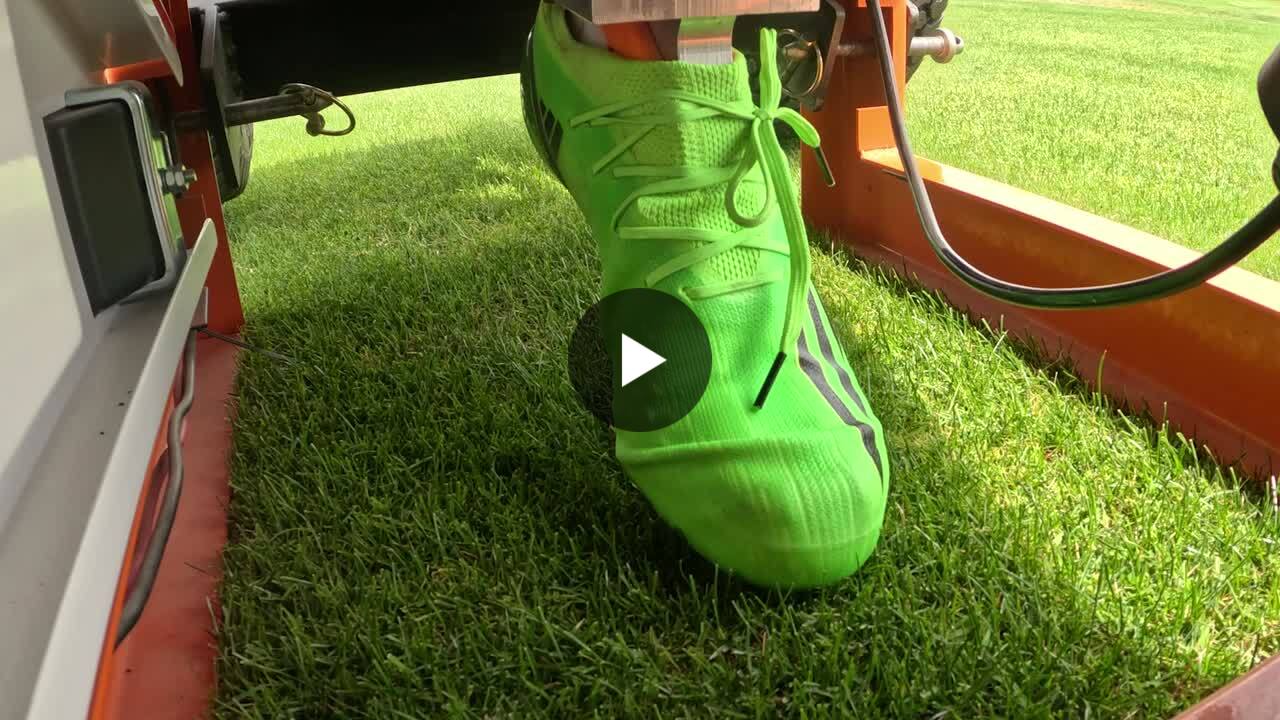
This 3D printed foot is helping scientists solve one of the world's biggest logistical challenges, making the grass pitch feel the same at every stadium. We're simulating 168 LB soccer player, which is the average weight of the last two men's World Cups. Here at the University of Tennessee, turf grass researcher John Sarokin has spent the last seven years preparing North America to host the world's biggest sporting event. A World Cup pitch is one that's going to be uniform, consistent, aesthetically pleasing and hopefully not talked about at the end of the game. But that's easier said than done. The 2026 World Cup will be played across 16 cities in Mexico, the United States and Canada with different climates, elevations and stadium designs, all of which affect how grass grows and performs. Gas is a living Organism. You abuse it will die. And once the tournament begins, there are no do overs. The field has to withstand weeks of matches. Wow. Remaining safe, consistent and camera ready for billions of viewers. Around the world. That's why FIFA has invested more than $5,000,000 into John's grass testing operation. So how is World Cup grass created? And what does it take to keep 16 pitches tournament ready across three countries? It's a month before the 2026 World Cup kickoff, and John and his staff of more than a dozen researchers are still busy in their Tennessee lab. Since 2021, they've run more than 170 tests to solve a crucial problem. How do you make a field in Vancouver lay the same as one in Miami? All World Cup fields have to have a natural grass surface because FIFA wants every pitch to feel the same. So when a team plays in Miami, for instance on bermudagrass, and they go to their next game in Boston on blue rye, it's going to be the same feel afoot. To make that possible, John invented the Flex device, a kind of crash test dummy for soccer fields that measures how firm, consistent and safe a surface really is. All 16 stadiums will have one of these, as the robotic cleats slams into the turf. Sensors measure how the surface responds. And we can go across an entire pitch and look at 77 locations and come up with like a heat map and look at the variability of that surface. If one area is too soft, too hard or too slippery, stadium crews can adjust the field before players ever step on it. The players are going to get hurt no matter what sometimes. But we want a lesson. That likelihood that it's a result of the interaction with the surface keeping players safe is only part of the challenge. The ball has to roll and bounce the same way too. Even small differences in the grass can change the speed of the ball or the angle of a bounce, something Argentinas players complained about after a 2024 game in Atlanta. So they use this machine to fire soccer balls at the turf at different speeds and angles. Recreating everything from a simple pass to a shot on goal. Comes in at a 17�� angle and we don't want to come up at more than 14�� angle and as it goes in, so as we launch it, what we would normally have is high speed cameras, radar guns. The measurements help crews fine tune how each field is mowed, watered and maintained so the ball comes off the surface at a consistent speed and angle. But keeping the grass the same gets a lot harder when there's no sunlight. The hardest climates and conditions are going to be the indoor stadiums, right? We have to rely on 100% grow light situations because there's going to be no sunlight to help them grow. Without natural sunlight, the grass can weaken, recover more slowly and be less resilient throughout the tournament. To tackle that problem, FIFA helped build this multi $1,000,000 research facility. Show FIFA built a a simulator Dome that has grow lights to simulate those five stadiums. So we can grow grass inside with LED lights to simulate the sun. Each of these 12 bays mimics a different World Cup stadium. Some recreate fully enclosed venues like Allana's Mercedes-Benz Stadium, while others replicate partial sunlight conditions, like at Sofi in Los Angeles. That helps researchers see how different grasses perform long before they're installed in a World Cup venue. They track things like ball bounce and root health, while soil probes monitor what's happening beneath the surface. And just like at a real World Cup field, they can simulate wear and tear. If you look down instead, it's got a roller. Then we put soccer cleat studs on it. And when we go back and forth on the grass, we can simulate the cleat Marks and the traffic. And this is how we simulate traffic under individual plots. The goal isn't just to figure out which grass grows best, it's still learn how each field should be managed, such as lighting and treatment schedules, and how the pitch will recover between matches. After years of research, the team landed on a game plan. Kentucky bluegrass and ryegrass for cooler climates and indoor stadiums and Bermuda grass for cities with warmer weather, which should be modded a slightly lower height and it and it grows different than the cool season grass, but they're very common grasses. Might have on a golf course, home loan or sports field anywhere, but we've just intensified the management to make it fit for for World Cup soccer. The actual game pitches are grown on 11 farms across North America. They're planted on top of plastic sheets to protect the grasses roots so they can be transplanted into stadiums. What happens is the roots hit that plastic and they don't penetrate the plastic, so they grow laterally. This is an example of a small piece of the sod going on plastic. So this is the green grass on top. And you can see the abundance of roots on the bottom because they couldn't go into below that plastic. So you haven't stressed the plant by cutting off its roots. Harvesting enough for one pitch takes about a day. You roll it up off of the plastic and you can cut it like a pizza, and all those roots are intact. Refrigerated trucks arrive at farms in the middle of the night to avoid traffic after being harvested. In North Carolina, one pitch is hauled 12 hours N to New Jersey. It's headed to MetLife Stadium, home to the World Cup final, which will make it the most scrutinized field in the tournament. In 2020, two 1 1/2 billion people watched the Cup final, roughly 18% of the entire world population. Once the convoy of 27 trucks arrives, workers spend 2 days installing the pitch on top of a base layer of sand, using Rakes and asphalt rollers to level and stabilize the surface. So is it rained? That sand can drain really well. The following week, a Zamboni like machine will inject millions of artificial fibres deep into the sand. So the natural grassroots can intertwine with them. They come in with the machine and stitch in these fibers. They act like rebar to stabilize the sand. 95% of the surface is going to be natural grass, and those fibers are below the canopy of the grass. So when a player runs and slides, they're not touching any of the fibers. There's a lot of layers that go into it, kind of like a parfait cruise mode. Daily Monitor moisture and reroll the surface after every match. So if you watch a World Cup game, you'll see just before the game they'll have the sprinklers on and water the whole field and get the grass wet. They'll turn the irrigation on again at halftime just before the players come out, get the grass wet again and that helps the ball skip so it doesn't bounce too high. And it helps with the performance, playability of the game, the speed of the game and the quality of the game. And some of John students will be there helping manage the fields in person. We've had a student that started working on this as a high school student. Now he's a freshman at the University of Tennessee. And this summer, he's gonna go work in Houston for one of the host cities. And that's the nice thing about this is the people that are all involved love what they're doing. It's not work for them. This is a passion.