
Remember me


It may seem small among the decisions people have to make as they face the end of their life, but what happens to their bodies can make a significant difference to the final cost inflicted on the environment.
In many Western countries, cremation is the most common method of deathcare – chosen by about three-quarters of Australians – but it’s arguably the most environmentally damaging.
Sustainability certifiers PlanetMark found a typical gas cremation releases a plume equivalent to 125kg of carbon dioxide. That includes methane, nitrous oxides, sulphur dioxide and other volatile organic compounds and particles. If you have mercury tooth fillings, they get vaporised too. Other industry figures suggest the emissions could be higher.
It is about the same amount of pollution as driving a Ford Ranger from Melbourne to Canberra.
Traditional burials, the other common choice, leach chemicals into the ground when deeply buried bodies and treated timber coffins break down. After-burial site maintenance can also release greenhouse gases.
“Basically the entirety of our history as an Australian society, we’ve only really done two things and that was seen as entirely sufficient,” says Dr Kate Falconer, an Australian death law researcher now based at University College Cork in Ireland.
But Australians are increasingly open to alternative farewells, according to Dr Domenic Trimboli, an architect and urban planner at Curtin University, who has researched funerary practices and spaces in Australia.
“Many people, regardless of age, had thought about what they wanted to have happen to them, and there was definitely a curiosity about alternatives.”
Cleaner optionsMinimalist natural burials and alternative methods can be gentler on the environment.
In a natural burial, there is minimal preparation or embalming. The deceased is usually buried in a natural-fibre cloth shroud or biodegradable coffin at a shallow depth, and decomposes into the surrounding soil over a decade. It results in negligible release of greenhouse gas and returns the body to the earth.
New cremation technologies are also taking off. Aquamation, also known as resomation or alkaline hydrolysis, is a cremation-like process that uses water rather than fire. Immersed in an alkaline solution, the body breaks down within hours, leaving the bones to be powdered and returned to the family — a more “pure” decomposition than gas cremation, which mingles the coffin and body as ash.
Though not widely available outside the US, terramation – human composting – is being considered elsewhere, including Australia, where the independent MP Alex Greenwich this week introduced a bill to NSW parliament to allow the process. It involves placing the body in a coffin-like vessel alongside organic material, microbes or fungi. The body is slowly turned into compost.
Sustainable casketsWhile alternative deathcare methods are slowly emerging, traditional methods can be made more sustainable.
“Smaller decisions on a larger scale, I think, would make a really significant difference,” Falconer says.
Take coffins. “I don’t think a lot of people realise how bad coffins are,” Falconer says.
“A lot of coffins might be wood, but they’re often coated in lacquer, they’ve got plastic linings, the handles are all plastic … as a rule [coffins] are generally imported.”
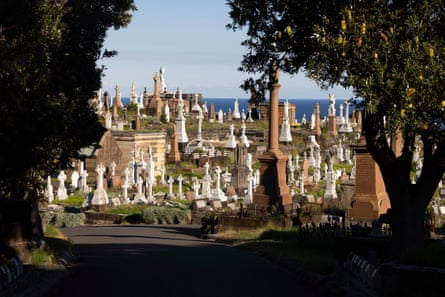 The biggest impediment to more sustainable deathcare is a tendency for Australians to leave funeral decisions until after a loved one dies, says Kate Falconer. Photograph: Jessica Hromas/The Guardian
Swapping a lacquered coffin with plastic parts for untreated pine, cardboard or wicker basket reduces emissions from a burial.
PlanetMark estimates a mahogany veneer coffin with plastic handles and lining leads to more than 170kg of emissions if cremated.
By comparison, a natural burial with a cardboard coffin and rope handles emits less than 10kg. A biodegradable bag had the lowest emissions of any vessel in the PlanetMark analysis at 0.3kg.
Trimboli says some of the alternatives don’t cost much more than cremation.
“There’s no reason that over time that can’t become a lot more competitive, if it’s not already,” he says.
Industry practices are changingIt’s not just consumers who are seeking more sustainable funeral options. Efficiencies in energy use, mindful waste reduction and repurposing materials used during funeral services can all reduce costs for the industry too.
Sharyn Moll, a former funeral director and national councillor for the industry peak body Funerals Australia helped develop an industry sustainability guide that was published last year.
“A lot of the call [for sustainable practices] is actually coming from the industry rather than from the public,” Moll says. “Every business needs to try and be more sustainable, so it’s just good business really.”
Have the conversationFalconer says regulatory ambiguity and inconsistency can make it hard to have nationwide impact, but the biggest impediment to more sustainable deathcare is a tendency for Australians to leave funeral decisions until after a loved one dies. “The tiniest of decisions has significant environmental impacts.”
Executors forced to make quick decisions and dealing with grief often default to traditional burials or cremations.
“If people insist on having what they see as a ‘standard’ funeral, then that’s what we have to give them,” Moll says.
“What the industry would really like to see is people becoming more aware of what’s available, what’s out there, so they can think all that through, talk with family about it, so when the time comes, they already know what they would like.”
Comments (0)