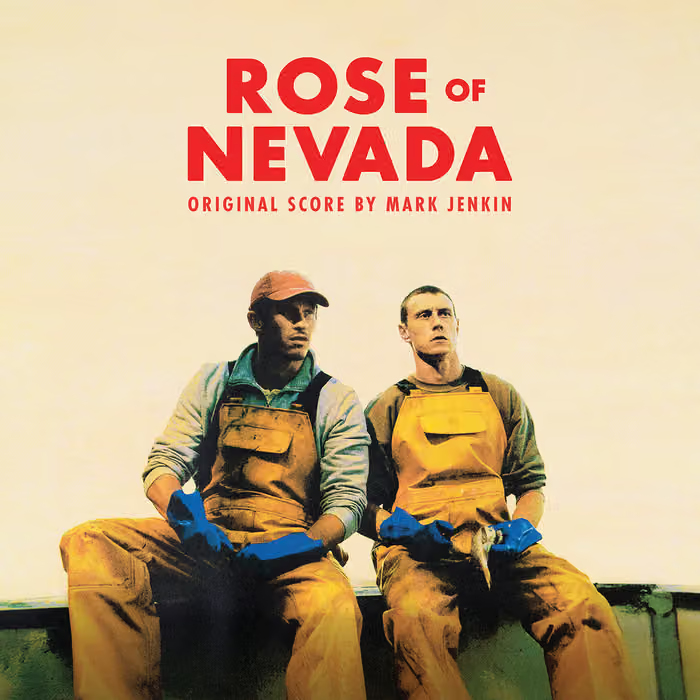
Mark Jenkin is an auteur to an extent rarely attempted by filmmakers. He writes his films, with Mary Woodvine, directs them, shoots them with a clockwork Bolex camera. His previous feature films, Bait (2019) and Enys Men (2022), created a new sub-genre of hazy Cornish psychedelia – a meeting of Don’t Look Now, Penda’s Fen and Wycliffe. Jenkin’s achievements behind the camera obscure his work as a composer. He created the soundtrack for Enys Men, and now for his most recent film, Rose of Nevada (2025). That involved composing, engineering, producing and performing, uses guitar, synethsizers, percussion, loops and effects.
Rose of Nevada is a strange, sad, beautiful film about a faded Cornish fishing village. The eponymous trawler, long missing, reappears in port and, when three local men go out on a fishing trip, they seem to return 30 years earlier. It is a haunting and brilliant piece of work. Jenkin’s 16mm style is utterly distinctive, giving his locations a hyper-reality that seems to project us past surface appearances and considerations, allowing us to see what really matters. His Cornwall as a ‘thin place’, often the way it seems to those who can see past the tourist overwhelm.
A soundtrack is a strange format, and it is easy to feel that you’re missing something if you haven’t seen the film it belongs to. The soundtracks that break through and have a life beyond the screen are relatively rare, and special as a result. The Rose of Nevada OST has an overwhelming atmosphere that expands way beyond the screen, and envelops the listener, like an incoming tide. Jenkin uses swelling, repeated electronic sounds on tracks such as ‘Cornish Affirmative’ and ‘E Bow An Howl’, which feel like the experience of being mesmerised. The sound pulls you under with a multi-pitch tone that constantly pulses and shifts, leaving nothing to hold on to. The album begins with the hollow tolling sounds of ‘Kneebone Barton’ – an underwater bell perhaps, or the clanging rigging of a ship, fading into infinite reverberation. Then they return as deep rumbling notes, echo-locating in a space without physical boundaries.
The tracks vary in tone, but the pace of the album is consistent. Jenkin’s music is slow in a way that connects us to natural, rather than human timescales. This is the sound of the sea, and of the disconnections we encounter if we try to make sense of it through our own needs and concerns. ‘Through the Gaps Pt. 1’ is a high, shivering piece. The beat driving ‘Are We Fast?’ sounds like someone beating a giant, water-filled container with a stick, while the sea rushes in and the VHF radio refuses to connect. Neither track will be hurried, drawing us deeply into their textures.
Rose of Nevada is serious music, conceptually coherent and powerfully performed. The quality of Jenkin’s composition deserves to be acknowledged outside the context of his acclaimed film work, as well as on the screen where this soundtrack contributes an essential level of psychological disruption and eerie resonance to a fine piece of work. You don’t need to see the film to understand the rationale behind the music, which is complete in itself.