
Remember me







Did you know that Truthout is a nonprofit and independently funded by readers like you? If you value what we do, please support our work with a donation.
A new documentary explores a growing body of scientific research documenting the wide range of gender and sexual diversity found in the animal kingdom, from pregnant male seahorses to matriarchal monkey troops. Second Nature, directed by queer filmmaker Drew Denny, is narrated by Oscar-nominated actor Elliot Page, who says he joined the project because “I was so moved by it and found it so affirming as a trans and queer person.”
Learning about animal life beyond binary concepts of sex and gender was life-changing, Denny shares about her inspiration for the film. “I finally felt in my body, for the first time, that I belong here on Earth, just like anybody else.” Featuring interviews with evolutionary biologists and eye-opening footage of the natural world, Second Nature is now showing in major cities across the United States.
TRANSCRIPTThis is a rush transcript. Copy may not be in its final form.
AMY GOODMAN: This is Democracy Now!, democracynow.org, The War and Peace Report. I’m Amy Goodman.
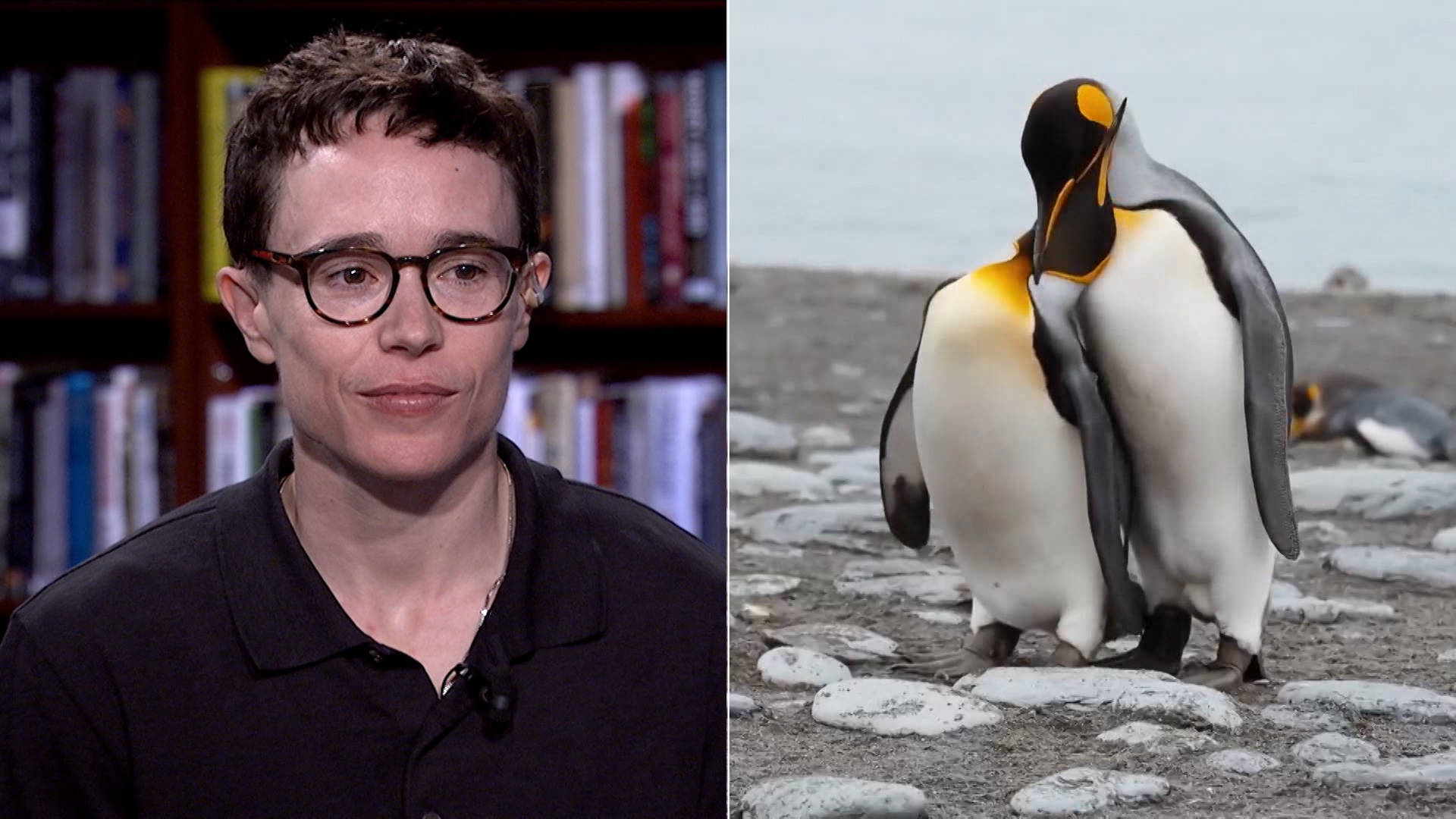
“Everything you didn’t learn in high school biology.” That’s the tagline of a remarkable new documentary challenging some of our most deeply held assumptions about biology, gender and sexuality. It’s called Second Nature, narrated by the Oscar-nominated actor, the author Elliot Page, and directed by Drew Denny. The film explores a growing body of scientific research documenting the extraordinary gender fluidity and sexual diversity found in the animal kingdom, from same-sex penguin parents to sex-changing fish to pregnant seahorse fathers to primate societies where traditional notions of dominance and gender roles simply don’t apply. This is the film’s trailer.
ELLIOT PAGE: There are approximately 8.7 million living animal species on Earth. For centuries, we have been told that when it comes to gender and sexuality, all of these millions of species follow a certain set of rules. But what if this narrative fails to capture the full spectrum of life’s diversity?
PATRICIA BRENNAN: Homosexual behavior in nature is one of the best-kept secrets. It’s absolutely everywhere.
JOAN ROUGHGARDEN: Not only do many species illustrate homosexuality and gender multiplicity, they also illustrate sex transition.
JOSEPH GRAVES: Biologists now know sexuality is fluid, and that all of that is normal.
FRANS DE WAAL: I don’t know any species where homosexual sex or gender-nonconforming is a taboo or cannot be done, except when it comes to humans.
JOSEPH GRAVES: There have always been scientists who have been willing to stand in opposition to the existing worldview, and there are consequences for that.
PATRICIA BRENNAN: I was completely unprepared as a scientist to deal with this.
AMY PARISH: We learned what we learned in school, and we want to believe that it’s true. And it’s messy to now say, “Oh, it wasn’t really that way?”
JOAN ROUGHGARDEN: I realized it can’t be the people who are defective; it’s got to be the science.
MARCELA BENITEZ: If we understand same-sex behavior better, we’re also going to understand different sex behavior better. We’re just going to understand the sexual lives of animals better.
ELLIOT PAGE: There is endless diversity in nature. And the old stories we’ve been taught deserve a second look.
AMY GOODMAN: That’s the trailer for the new documentary Second Nature, the film partly inspired by the trailblazing work of trans evolutionary biologist Dr. Joan Roughgarden and her groundbreaking book, Evolution’s Rainbow: Diversity, Gender, and Sexuality in Nature and People.
Related Story
Everyone who cares about bodily autonomy should fight for trans health care.
The film arrives amidst ongoing attacks on transgender rights, censorship of school curricula, and attempts to ban LGBTQ-affirming books. But the film is less interested in politics than the wild, rumpus, raucous world of animal sexual and gender diversity. But perhaps there’s a lesson in there for us humans, too.
For more, as we mark the end of Pride Month, we’re joined now by the film’s director, Drew Denny, and executive producer and narrator, Elliot Page. Elliot Page is an Oscar-nominated actor, producer and author of his memoir, Pageboy.
Drew Denny, Elliot Page, welcome to Democracy Now! Elliot, talk about the significance of this new documentary, Second Nature, why you got involved with it.
ELLIOT PAGE: Gosh, I mean, I got involved because I was so — just I was so moved by it and found it so affirming as a trans and queer person. I mean, quite frankly, I felt very silly for not assuming this all to be true already. And what just was so exciting to me was how well made it was, of course, how informative it was, but also just how funny and expansive. And it’s one of those things that even if I wasn’t involved, I’d be telling everybody to see. So, yeah.
AMY GOODMAN: I want to go to a clip from the film Second Nature. This is about seahorses.
ELLIOT PAGE: Perhaps one of the fiercest challengers to our assumptions about sex roles is the seahorse. It’s the males who take on one of the biggest chores of procreation: pregnancy. After a mating ritual, female seahorses deposit their eggs into the male’s pouch, where he fertilizes them. About 30 days later, he gives birth to up to 1,000 baby seahorses.
AMY GOODMAN: Pregnant male seahorses. Drew Denny, just a little introduction to this incredible film. Talk about how you got involved and why you directed this.
DREW DENNY: Thank you so much. First of all, it’s a huge honor to be here. I’ve been so inspired by your work, and you’re one of the reasons I went into journalism and became a documentarian. So, thank you.
I decided to make this movie because I grew up in Texas being told that females are naturally inferior to males and that queerness is simply unnatural. In my public high school biology class, students were invited to walk out of the class if they were offended by evolution, but none of us girls were asked if we were offended by sexual harassment and assault that we survived at school, and none of us queer kids were ever asked if we were offended by the relentless bullying that we faced every day.
So, it wasn’t until I grew up and read Dr. Joan Roughgarden’s book and learned about gay penguin dads and birthing seahorse dads, for example, and genderqueer chimps and our other closest relatives, bonobos, who are matriarchal, that I finally felt in my body, for the first time, that I belong here on Earth, just like anybody else. And it may sound silly that it’s the queer animals that did that for me, but that’s what it — that’s what it took.
And I love that you shared the seahorse dad clip, because I think it’s just a great example that proves that all of these binaries we’ve been told are just natural law are completely false and made up by humans.
AMY GOODMAN: Let’s go to another clip from Second Nature about reef-dwelling fish, the bluehead wrasse.
ELLIOT PAGE: Bluehead wrasse can change from female to male. There’s one male in the group. In the same day he dies, the largest female starts to change her behavior. She stops making estrogen and starts making androgens. Ovaries that produce eggs turn into testes that make sperm. Then that fish is the male of the group and can procreate with the remaining females. So, if you’ve been diving on a coral reef, you have seen sex-changing fish. And the phenomenon of sex change in animals is not rare.
AMY GOODMAN: Bluehead wrasse, clownfish changing sex from male to female; albatross, penguins and swans parenting in same-sex pairs; bonobos, as you said, Drew, who are just as closely related to us as chimps, as matriarchal, same — having same-sex sex every day. Talk about this and the groundbreaking trans scientists that inspired this.
ELLIOT PAGE: Yeah, I mean, Joan Roughgarden and all this investigating she’s done and discovery has just led to, I think, one of my favorite lines in this documentary, something she says, in terms of looking at nature as if it’s some sort of cisheteropatriarchal structure is absurd, and that this, you know, gender binary that we’ve created is nothing but a “quaint little myth.” And I think, you know, her work and this documentary really, really shows that what we have been taught in school in regards to these structures — men being superior, women being inferior, you know, submissive, or what have you, it being this, yes, heterosexual existence — is just completely false. And I think what’s so wonderful about this documentary is it really illustrates, you know, why that information has been so suppressed, and how important it is for us to all learn about this, and how it’s only expansive and, you know, exciting, all of this information.
AMY GOODMAN: I want to go to the golden lion tamarins.
AMY PARISH: The golden lion tamarins are an amazing species for many reasons. This is a species where females have harems of males. So, we call that polyandry —
JOAN ROUGHGARDEN: Yes, polyandry.
AMY PARISH: — where one female has a number of males as a mate, and they live together in a group. She mates with all the males in the group. All of them have a chance to sire offspring.
JOAN ROUGHGARDEN: So, the males are unrelated.
AMY PARISH: They’re unrelated, yeah.
JOAN ROUGHGARDEN: Yeah.
AMY PARISH: We think it might have evolved because this is one of the few primate species where females have more than one baby at a time. They tend to have twins. Each baby is 25% of the mom’s bodyweight at birth, so there’s no way she can carry them around herself. So the babies travel with dad, and they just come to mom to nurse after they’re born.
JOAN ROUGHGARDEN: So, in order to produce the brood, you need males.
AMY PARISH: Yeah, and they’re playing a really important role here as caregivers.
JOAN ROUGHGARDEN: This is a fabulous case, polyandry. It’s not the incidental byproduct of anything. It’s a full-fledged social system.
AMY PARISH: That’s right, yeah. This kind of polyandrous species, it really helps us to understand the variety of mating systems.
AMY GOODMAN: So, that’s Dr. Joan Roughgarden and Dr. Amy Parish. Drew Denny, talk about the backlash against these scientists.
DREW DENNY: So, unfortunately, each of the scientists in the film has faced severe backlash from their research. So, Dr. Amy Parish, who you just saw speaking, was one of the first people to publish that bonobos are matriarchal. And people lambasted her. They said she had a feminist agenda. And they suggested that it wasn’t matriarchy; it was, in fact, strategic male deference. Now, one of the reasons Amy hypothesized that bonobos were matriarchal is because the females commit acts of violence against males, including biting their penises in half. And she asked, “What kind of strategy is that?” Not a good one, and that no one has ever suggested, in a patriarchal species, that it’s strategic female deference. We’re just assuming that patriarchy is the norm, and anything other than that must be a really brilliant strategy by the males.
AMY GOODMAN: I want to go to one more clip, and this is the clip about baboons, in the new documentary Second Nature.
AMY PARISH: There is a very famous scientist from Stanford University named Robert Sapolsky, whose groundbreaking research on baboons in Kenya was featured in a National Geographic documentary. Baboons are known to be quite violent, particularly the alpha males. Robert had a situation where he was in the field, and the baboons in his group discovered a garbage pit behind a hotel, and so the baboons are really excited about this wealth of free food. But it was only the roughest, toughest males who could feed in there, because they were all fighting with each other over access to this food. And so, all of his alpha males were the ones who were feeding there, and not the other baboons.
Unfortunately, they caught a human disease by eating the half-eaten food. They caught tuberculosis, which is fatal for baboons. And so, the baboons were in the really unique situation of losing all of the alpha males at once. What were left were the low-ranking males and the females.
What happened next was absolutely revolutionary. They forged a new society. It was a society where males didn’t have to fight as hard to get in. Males were nicer to females. It’s much more peaceful. It’s much more calm, less stress. They’re all getting along much better. Today, many years later, it’s still organized in the same way, so that new social system lasted.
AMY GOODMAN: A clip from Second Nature. As we wrap up, in these 30 seconds. Elliot Page, what you want people to take away from this? And I should say that you’re going to be here starting on Friday at DCTV, our beloved Firehouse Cinema, where Democracy Now! used to broadcast from, with all sorts of scientists doing Q&As.
ELLIOT PAGE: Gosh, well, I mean, I hope this film, for everyone, but, you know, for queer and trans people right now specifically, could make you feel — one feel less alone in this world and more a part of this world, when we’re told we’re, you know, not natural or something’s wrong with us, or what have you, and to learn about all this information that’s been, you know, purposefully kept from us. And —
AMY GOODMAN: We have to leave it there.
ELLIOT PAGE: Oh, sorry, sorry.
AMY GOODMAN: But people got to see the film. Elliot Page, Oscar-nominated actor, producer, author of memoir Pageboy, and Drew Denny, Second Nature. I’m Amy Goodman.
An important fundraising appeal: 24 Hours to raise $22,000Truthout is one of only a few platforms for justice-oriented, grassroots journalism. Today, as political censorship from the right intensifies, we have no choice but to ask for your help.
We are fundraising right now to cover our basic operating expenses. If you can support Truthout with a one-time or monthly donation, you will make a significant impact on our work. Anything you can do makes a difference — we appreciate your support.
This piece was reprinted by Truthout with permission or license. It may not be reproduced in any form without permission or license from the source.