AI Learning Day explores how digital intelligent platforms empower teaching and admin - Xi'an Jiaotong-Liverpool University
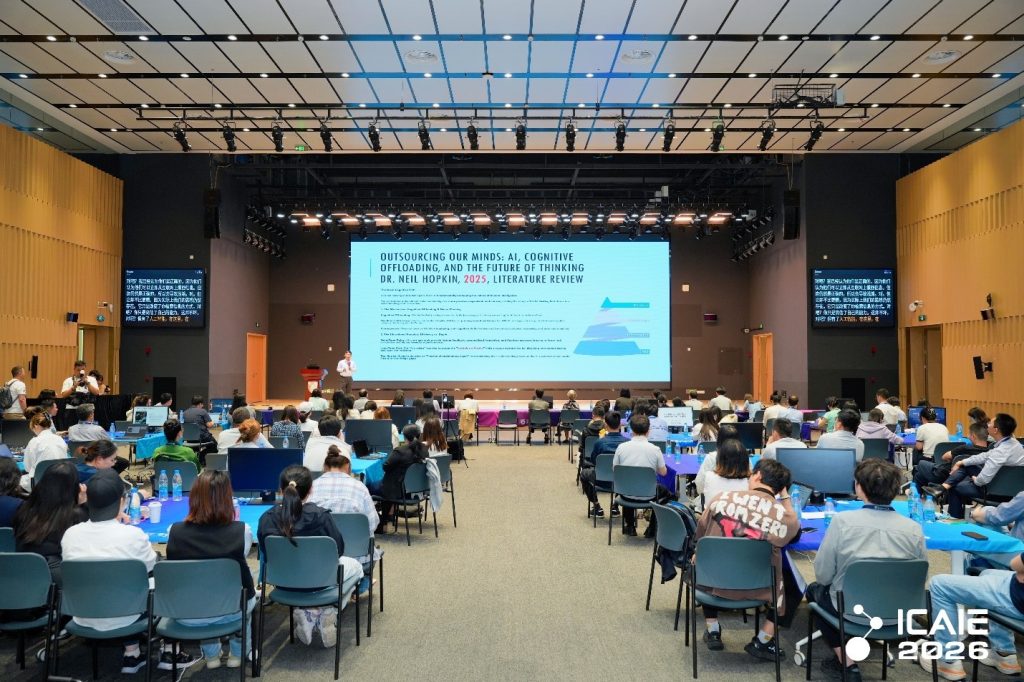
On 13 May, XJTLU’s Centre for Knowledge and Information (CKI) held AI Learning Day at XJTLU Entrepreneur College (Taicang). Themed “Empowering University Teaching and Administration Through Digital Intelligent Platforms”, the event brought together experts, scholars, and practitioners from inside and outside the University to discuss how AI is reshaping education, and to showcase XJTLU’s latest achievements in AI-enabled teaching innovation and digital administration.
Dr Xin Bi, XJTLU’s Chief Officer of Data and Director of CKI, spoke on “cognitive offloading” and what it means for education. Drawing on Daniel Kahneman’s dual-system theory in Thinking, Fast and Slow, he explained that because cognitive resources are limited, people default to fast, intuitive thinking (System 1) over slower, effortful reasoning (System 2). In the AI era, he warned, over-reliance on external tools risks weakening memory, analytical reasoning, and independent judgement – fostering what he called an “illusion of explanatory depth.”
“We must be careful not to let AI become a substitute for human cognition,” Dr Bi said. “Education shouldn’t just help people finish tasks faster. It should build cognitive endurance, metacognitive skills, and the ability to solve complex problems – with humans leading and AI supporting.”
Dr Xin Bi
Kaile Zhu, a teacher at XJTLU Affiliated School, shared his experience of relearning how to teach in the AI era. Using design-themed classroom examples, he showed how AI helps overcome the limits of traditional teaching resources and reshapes the teacher-student dynamic. “Students are no longer passively waiting for answers – they’re exploring and creating proactively. Teachers are shifting from knowledge transmitters to learning facilitators and context designers,” he said.
Dr Miaomiao Liu, from XJTLU’s International Business School Suzhou, introduced a “multi-agent AI tutor” built for Year Two marketing students. The system combines intent and cognitive-level classification to offer personalised support across module learning, research guidance, internships, employment, competitions, and student activities.
Natasha Atmadja, a student from the School of Advanced Technology, presented a multi-agent collaboration system that uses separate agents for translation, summarisation, and task allocation to help multilingual teams communicate and collaborate more smoothly.
Best practice: digital platforms in administration
Qian Wang, from the Campus Management Office, demonstrated the smart campus service platform, which uses AI agents and no-code tools to streamline vehicle applications, meeting room bookings, and infrastructure projects – cutting manual workload for service tickets by 45%.
Jun Wang, from the Library, presented data-driven transformation efforts spanning resource evaluation, contract management, reader services, and AI-powered academic search. “Data is the foundation of AI applications,” she said. “The Library is moving from a traditional resource provider to a partner across the whole learning and research journey.”
An interactive exhibition ran alongside the event, with teams from the Library, University Marketing and Communications, the Museum, Learning Mall, the Management Information Technology and System Office, and the College of Industry-Entrepreneurs’ Digital Transformation Research Centre showcasing AI applications in social media, cultural experiences, administrative tools, and data visualisation.
Content provided by Management Information Technology and System Office
Translated by Xiangyin Han
Edited by Xinmin Han