
Remember me



 Brad Mills-Imagn Images
There’s an idiom that gets thrown around in soccer that I wish we would adopt here: talismanic. A talismanic player is particularly important to his team, especially for intangible reasons. Sometimes the club’s talisman is the best player on the squad, but not always. He’s the captain who marshals the defense, or the creative passer who ties the team’s attack together, or a veteran forward who always seems to find the crucial late goal.
We don’t really have a word for this kind of player in baseball. We have club icons, cult heroes, and players with veteran presence, but referring to a player as a talisman implies actual mystical powers that only the team and its fans can truly see.
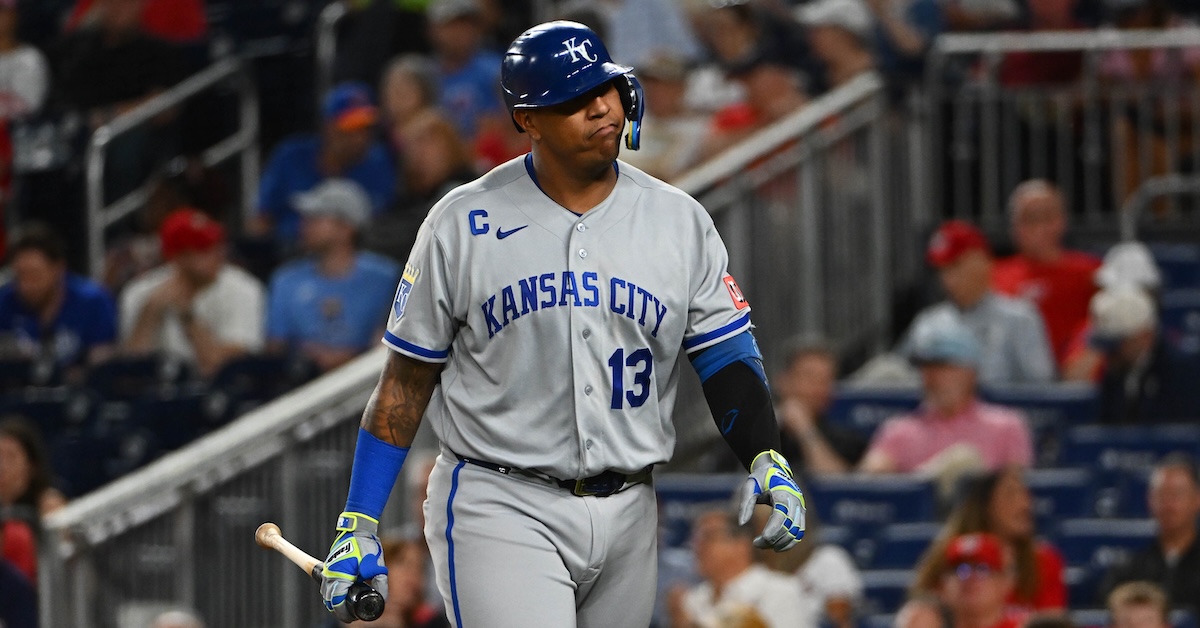
If any baseball player of the past 20 years is his club’s talisman, surely it’s Salvador Perez.
For more than a decade, Perez has been the face of the Royals. He was a key player on all three of their 21st Century playoff teams, and his steady leadership has been of tremendous value to the organization over that time.
I have no reason to doubt Perez’s intangibles, but empirical study is less kind to the Royals’ captain.
Speaking holistically, Perez is (or has been) very good at two things. First, he was a terrific thrower from the catcher position. Once we got catcher arm strength data, Perez was near the top of the heap. Second, he has excellent raw power for a hitter who doesn’t strike out very much.
You Aren't a FanGraphs Member
It looks like you aren't yet a FanGraphs Member (or aren't logged in). We aren't mad, just disappointed.
We get it. You want to read this article. But before we let you get back to it, we'd like to point out a few of the good reasons why you should become a Member.
1. Ad Free viewing! We won't bug you with this ad, or any other.
2. Unlimited articles! Non-Members only get to read 10 free articles a month. Members never get cut off.
3. Dark mode and Classic mode!
4. Custom player page dashboards! Choose the player cards you want, in the order you want them.
5. One-click data exports! Export our projections and leaderboards for your personal projects.
6. Remove the photos on the home page! (Honestly, this doesn't sound so great to us, but some people wanted it, and we like to give our Members what they want.)
7. Even more Steamer projections! We have handedness, percentile, and context neutral projections available for Members only.
8. Get FanGraphs Walk-Off, a customized year end review! Find out exactly how you used FanGraphs this year, and how that compares to other Members. Don't be a victim of FOMO.
9. A weekly mailbag column, exclusively for Members.
10. Help support FanGraphs and our entire staff! Our Members provide us with critical resources to improve the site and deliver new features!
We hope you'll consider a Membership today, for yourself or as a gift! And we realize this has been an awfully long sales pitch, so we've also removed all the other ads in this article. We didn't want to overdo it.
That second attribute is really his carrying tool. Perez famously led the league in home runs in 2021, and he has eight other 20-homer seasons in his career. He just passed Ivan Rodriguez for seventh in career home runs by players who primarily caught; I expect him to be in the top five by the time he retires.
Unfortunately, the rest of Perez’s game leaves a lot to be desired. He has the fourth-lowest career walk rate among active players, which plays into his career OBP of .299. He’s one of the slowest runners in baseball, which is especially problematic for a right-handed hitter who hits the ball hard and doesn’t strike out a lot. Perez is fourth among active players in career double plays grounded into. Defensively, his blocking has been inconsistent at best, and his framing is some of the worst you’ll find among high-volume catchers.
Perez’s prime overlapped with that of Buster Posey and Yadier Molina, and he often gets lumped into that class of catchers in public discussion. “If Yadi and Buster get into the Hall of Fame, shouldn’t Salvy too?” is a question I hear in some form or other fairly regularly.
The numbers simply don’t bear it out. Here’s a sentence that’s going to anger everyone in Missouri: I found the latter-day Yadier Molina hype to be a bit much, and I think he’s one of the more overrated players in recent baseball history. But the defensive numbers we have for him are just staggering. There’s a legitimate empirical Hall of Fame case for Yadi, not just one based on vibes.
Perez was more or less Yadi’s equal offensively (Perez has Molina beat on wRC+, 100 to 97, though Yadi was a better overall hitter at his peak), but according to our WAR, the difference between the two on defense was a hair under 400 total runs.
WAR isn’t everything, but it’s enough of a thing to make it noteworthy that Perez has just four seasons of 2.0 WAR or more, a career high of 3.3, and 17.7 WAR total. His teammate, Bobby Witt Jr., produced more than that just over 2024 and 2025.
I’m getting a bit far afield; Perez might not be a Hall of Famer, but for most of his career, he’s been at least a solid player. For 15 years, he’s shown up to work every day, gotten along well with his fellow employees, and socked a big home run every now and then. That’s the kind of guy you want on your team.
Unfortunately, there comes a time for every talismanic player when intangibles are all that’s left. Loath as I am to count out a guy who’s flirted with replacement level and bounced back before, it seems like that time is here.
As of Thursday morning, Perez has played in 69 of Kansas City’s 75 games. He’s hitting .200/.244/.322, which is a wRC+ of 50, the third-worst among qualified hitters. He’s at -1.3 WAR, which makes him the worst player in the league with at least 100 plate appearances or 20 innings pitched.
The Royals signed Perez to a two-year, $25 million contract extension this past winter, but they know the end is near. Their top position player prospect, Carter Jensen, is a catcher. He made his major league debut last season and is now splitting time with Perez across catcher and first base.
With Perez and Jensen already in the system, the Royals spent a top-10 pick on yet another catching prospect, Blake Mitchell, in 2023. He’s still a couple years off, but he looms over the future nonetheless.
And as Perez has gotten into his 30s, the Royals have reduced the time he’s spent behind the plate, getting his bat into the lineup at other positions:

But with the bat in decline, that only does so much. The offensive standard for a catcher — even one who’s a bad defender — is quite low. The opposite is true for a first baseman or DH, so the more Perez struggles, the greater the opportunity cost for the Royals. Especially because Kansas City’s surfeit of gigantic Italian-American first basemen (Jac Caglianone and the currently-injured Vinnie Pasquantino) has created a bit of a logjam at the bottom end of the defensive spectrum.
What, specifically, then, is ailing the Royals’ talisman?
Basically, you can cut Perez’s career in half. Up until about 2019 — the year he missed with a torn UCL — Perez ran contact rates in the low 90s and strikeout rates in the low teens. This is elite contact hitter territory, and he hit .292 in 2013, the best season of the first half of his career.
Around the time of the injury and the pandemic, Perez realized he wasn’t getting the most out of his skill set by trying to be Jose Altuve. Perez weighs 255 and can probably curl an Altuve with each bicep. He shouldn’t just be trying to make contact, he should be trying hit the ball so hard it goes flat on one side.
So he started taking big rips when he got his pitch:

And it worked incredibly well:

You can see 2021 on both of those graphs; his 48-homer season is where his z-contact rate nosedives but his EV90 jumps up.
That approach worked well up through last year. The .284 OBP was ugly, but Perez hit 30 home runs while catching more than 750 innings; there’s a limit to how bad a player can be with that baseline.
This year, Perez’s plate discipline numbers are almost unchanged. He’s striking out and walking at the same rates as last year. He’s pulling the ball slightly less, but his batted ball profile is in line with his career norms generally. How did he go from an average hitter to one of the worst in the league overnight?
The answer to that is in that EV90 graph from earlier, but I’ll use isolated power to make the same point:

Perez’s power is gone. It just up and disappeared over the winter. And for a player who already couldn’t run, wasn’t much use defensively, and never walks, that was the last Jenga piece. The power was the only tangible skill Perez had left.
And it’s definitively gone. Last year, Perez’s barrel rate was in the 91st percentile and his hard-hit rate was in the 70th percentile. Those numbers are in the 45th and 44th percentiles now.
From last year to this, Perez has lost 1.4 mph of average bat speed and his fast swing rate has been cut nearly in half, from 30.5% to 16.9%. Another hitter could live with those numbers; Perez’s bat speed figures are in the same neighborhood as Kevin McGonigle’s and Kyle Tucker’s. But if power is your carrying tool, that little power won’t carry you very far. Maybe Perez is dealing with an injury from which he’ll recover, but for a 36-year-old who’s spent nearly 12,000 innings behind the plate, Occam’s Razor points in another direction.
It’s a shame; age has been stalking the Royals’ doyen for years now, but it’s never pretty when temporal forces close in and make the kill. The talisman is out of magic.