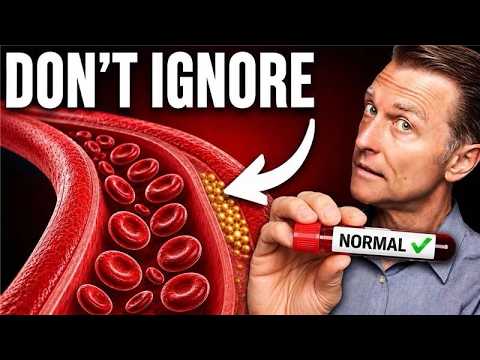
50% of Heart Attack Victims Had “Normal” Lab Results
Is LDL really the “bad cholesterol”? Uncover the truth behind common cholesterol myths, what high LDL and cholesterol levels actually mean, and whether elevated LDL is as dangerous as you’ve been led to believe.
0:00 Is LDL bad?
0:21 LDL cholesterol explained
2:00 Two types of LDL cholesterol
2:38 Advanced lipid profile test
3:56 Cholesterol research
6:40 Cholesterol and heart disease prevention
10:52 Clogged arteries and LDL
11:28 Large-buoyant LDL vs. small-dense LDL
11:48 Statins
13:07 High cholesterol levels in healthy people
🌟 10 biological signals control how you feel every day, but only 1 matters most for YOUR body. Take the free 2-minute quiz to find out: https://drbrg.co/43M2FUm
Explore the hidden factors behind heart disease, cholesterol levels, and cardiovascular health:
▶️ https://youtu.be/W9qSb6--XfE
▶️ https://youtu.be/dQqXD-8osb8
▶️ https://youtu.be/hq9Al6LR2O4
Read this article to learn more about your cholesterol levels: https://www.drberg.com/blog/how-to-read-and-understand-cholesterol-numbers
Just so you know, my full line of high-quality supplements is available on Amazon — search Dr. Berg Supplements.
LDL is a protein made by the liver and serves many important functions in the body. LDL provides the raw materials needed to produce hormones such as estrogen, testosterone, and cortisol. It is also involved in the production of vitamin D and bile.
More than half of all heart attacks occur in people with normal LDL levels, raising important questions about the role of LDL in cardiovascular disease.
There are two main types of LDL: small, dense LDL and large, buoyant LDL. Small, dense LDL is associated with inflammation, insulin resistance, and chronic stress. Large, buoyant LDL is generally considered non-pathogenic.
Despite the focus on lowering LDL cholesterol, there is limited evidence that simply reducing LDL levels acts as heart disease prevention. Higher LDL levels have even been associated with longevity in some research.
Many people are prescribed statins without determining which type of LDL they have. An advanced lipid profile can help identify whether your LDL is primarily small dense LDL or large buoyant LDL, providing a more complete picture of your cardiovascular health.
DATA:
https://www.nejm.org/doi/full/10.1056/NEJMoa1200303
https://pubmed.ncbi.nlm.nih.gov/28684083/
https://pmc.ncbi.nlm.nih.gov/articles/PMC7387892/
https://www.ahajournals.org/doi/10.1161/CIRCULATIONAHA.124.068885
https://pmc.ncbi.nlm.nih.gov/articles/PMC10982736/
https://pubmed.ncbi.nlm.nih.gov/15210526/
Dr. Eric Berg, DC Bio:
Dr. Berg, age 61, is a chiropractor who specializes in Healthy Ketosis & Intermittent Fasting. He is the author of the best-selling book "The Healthy Keto Plan" and is the Director of Dr. Berg Nutritionals. He no longer practices but focuses on health education through social media.
Follow Me on Social Media:
YouTube: https://drbrg.co/drberg
YouTube Shorts: https://www.youtube.com/@drbergshorts
Keto Recipe: https://www.youtube.com/@drbergketorecipes
Facebook: https://www.facebook.com/drericberg
Instagram: https://www.instagram.com/drericberg/
Spotify Podcast: 🎧 https://drbrg.co/DrBerg-Spotify
TikTok: https://www.tiktok.com/@drbergofficial
X: https://x.com/dr_ericberg
Disclaimer:
Dr. Eric Berg received his Doctor of Chiropractic degree from Palmer College of Chiropractic in 1988. His use of “doctor” or “Dr.” in relation to himself solely refers to that degree. Dr. Berg is a licensed chiropractor in Virginia, California, and Louisiana, but he no longer practices chiropractic in any state and does not see patients so he can focus on educating people as a full-time activity, yet he maintains an active license. This video is for general informational purposes only. It should not be used to self-diagnose and it is not a substitute for a medical exam, cure, treatment, diagnosis, prescription, or recommendation. It does not create a doctor-patient relationship between Dr. Berg and you. You should not make any change in your health regimen or diet before first consulting a physician and obtaining a medical exam, diagnosis, and recommendation. Always seek the advice of a physician or other qualified health provider with any questions you may have regarding a medical condition.
*Dr. Eric Berg, DC, is not AI-generated. AI-enhanced elements may be used in this video for production purposes only.
#health #keto #ketodiet #weightloss #ketolifestyle #intermittentfasting #lowcarb
Thanks for watching! I hope you'll try an advanced lipid profile test for a more accurate way to evaluate your cholesterol levels.