Everyone knows that funny noises coming from the engine compartment of a car mean bad news. Usually you're listening for knocking, rattling, and grinding, though — not meowing, squeaking, and... chirping? However, just like Americans fell in love with V8 engines, animals seem to like them too, though for entirely different reasons.
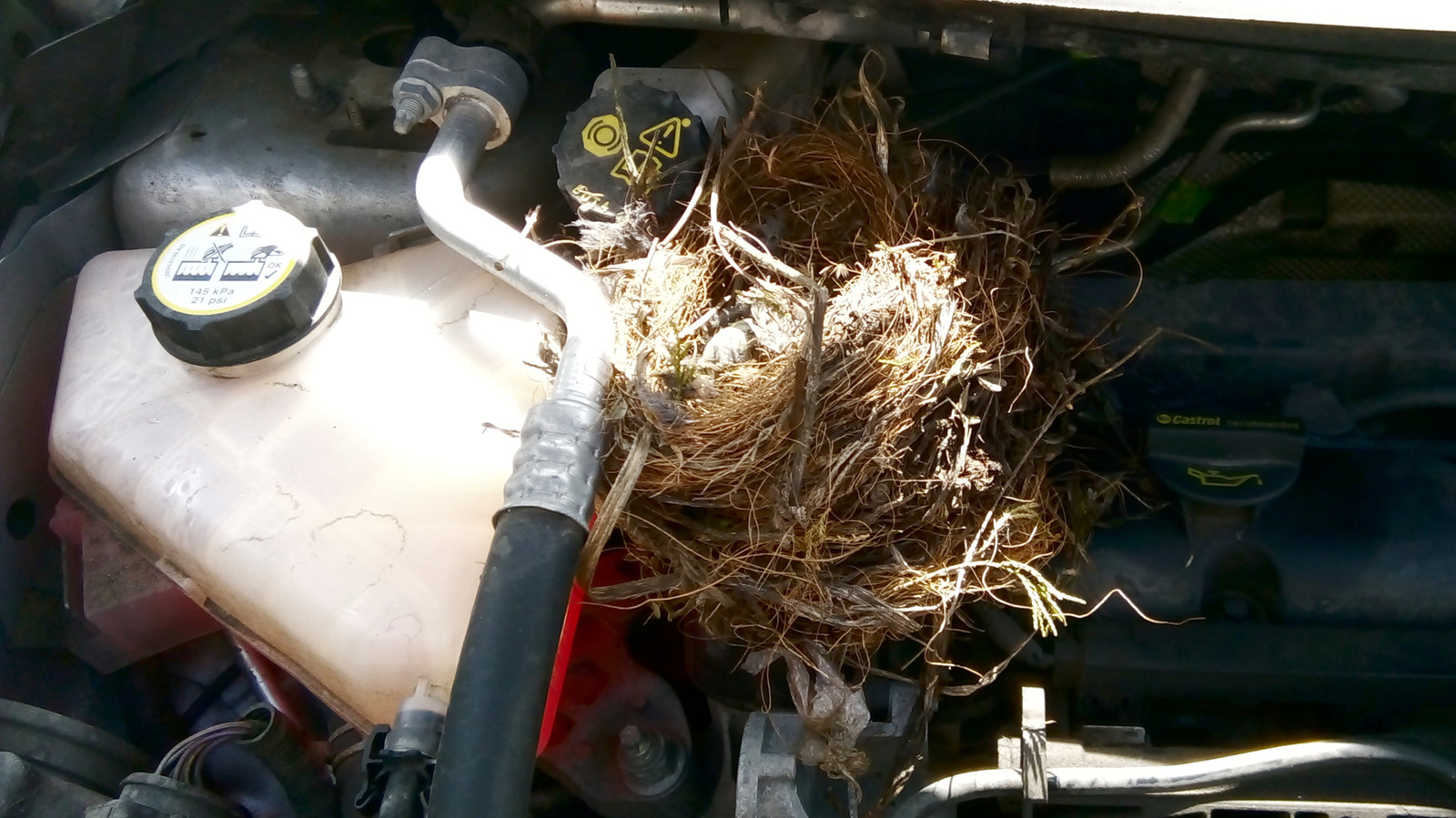
If you find a cat hanging out in your engine compartment, well, congrats! You've been chosen by the cat distribution system and are now the proud owner of an engine cat. Take that baby home, and give them a grease-themed name. If it's birds you find hunkering down and building a nest in your engine bay or maybe in the wheel well, you'll need to treat the situation a little more carefully. Most birds are protected by the Migratory Bird Treaty Act (MBTA) of 1918, and simply removing them might not be an option. One Kansas dealership found this out the hard way when they discovered a robin nest in a sold F-250.
As the U.S. Fish and Wildlife Service notes, the law states:
"No person may take (kill), possess, import, export, transport, sell, purchase, barter, or offer for sale, any migratory bird, or the parts, nests, or eggs of such bird except as may be permitted under the terms of a valid permit..."
Not every single bird is covered by the MBTA, but all migratory birds native to any territory belonging to the U.S. are, so the chances are that the flying friend you've uncovered under your hood is protected by law. If you find yourself in this position, you'll need to reach out to the Fish and Wildlife Service to proceed legally. The MBTA doesn't really care whether the nest is on your land or your property. The birds are protected regardless.
If you luck out and find a new nest that doesn't yet have any eggs in it, you're clear to move the nest and get driving. Don't park your car in the same spot again, though, as the birds may just come back for round two. But once a bird's nest has eggs or chicks in it, handling the nest of a species covered by the MBTA becomes quite difficult. You can appeal to the U.S. Fish and Wildlife Service for a removal permit, but these are typically only awarded if the birds pose a health threat or are in danger. Unfortunately, impatience likely doesn't qualify as "immediate danger."
Those who have another car at their disposal may just want to wait the problem out. Once a nest is "inactive" — meaning it's no longer occupied by eggs or chicks — the protections granted are drastically reduced. At this point, destroying a nest that's been built on or inside a vehicle is much more likely to be legal. If you can't wait that long — and who could blame you, really — your best bet is to contact your local wildlife agency or a licensed pest control service. Either institution may be able to help you come up with a safe, legal removal procedure.
Just be patient with the poor, struggling parents cuddled up in your wheel well. After all, it's not their fault that your Subaru is such a nice place to settle down and raise a family, nor is it their fault that their droppings happen to be acidic enough to damage your paint. Your car offers them protection from predators, a refuge from the elements, and a little bit of warmth in a scary, uncertain world.