‘Peaceful Russia’: Anti-War Exiles Found Their First Political Party
Russian opposition politicians and activists have launched a new political party, betting that a formal political structure can help unite Russia’s fragmented anti-war movement and eventually challenge President Vladimir Putin’s rule.
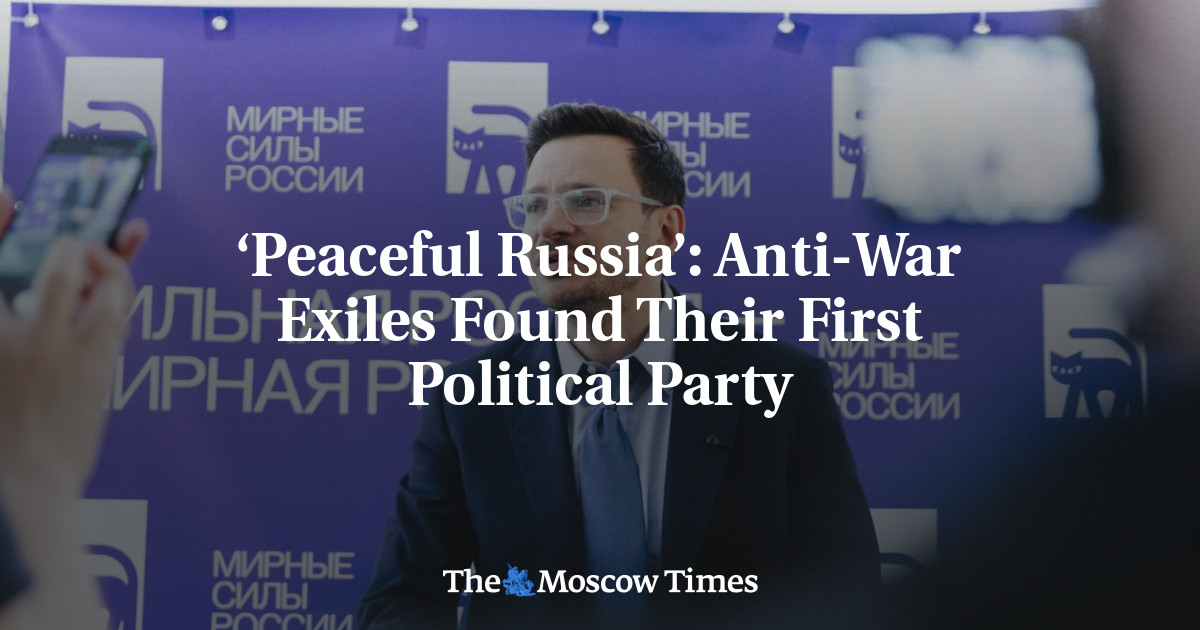
Led by Ilya Yashin, a former political prisoner and close ally of late Kremlin critic Alexei Navalny, Peaceful Russia seeks to act on behalf of Russians both inside and outside the country.
While numerous anti-war and anti-Kremlin organizations have been created since Russia’s full-scale invasion of Ukraine, Yashin said that Peaceful Russia would fill a gap by serving as a larger political platform which he says did not previously exist.
“A political party is not just a club of concerned citizens or a committee for anti-war advocacy. A party is, first and foremost, an instrument for the struggle for power,” Yashin told The Moscow Times.
“By choosing the party format, we are openly declaring that our key goal is to take power in the country. That is exactly why we are uniting and exactly why we are building this structure — so that we can claim power,” he said.
Critics argue that Peaceful Russia risks becoming another opposition initiative that offers a “democratic alternative” to Putin but has little tangible impact, particularly as Russia’s opposition remains deeply divided and is often consumed by internal disputes.
Yet politicians and activists who attended the founding event say the party has the potential to bring together a broad range of anti-war and anti-Putin Russians and give them the chance to directly participate in politics for the first time in years.
The congress
“Most opposition organizations in the Russian diaspora today operate either in a closed or semi-closed format” Yashin said.
“It seemed very important to me that such an organization be created — one with broad internal democracy, a high level of internal debate and based on the principles of pluralism and collegiality so people can join and have the opportunity to influence decisionmaking,” he said. “We have created a democratic structure for people.”
The Peaceful Russia founding event.
yashin_russia / Telegram
More than 100 delegates attended the June 12-13 founding congress in Berlin, which was scheduled to coincide with the Russia Day holiday.
Yashin declined to disclose the party’s funding sources, citing security concerns for its sponsors, but said the money comes from “several of our supporters” who “have never financed politics before.”
Delegates elected Olga Prokopyeva, a member of the France-based organization Russie-Libertés, and Yashin’s former colleagues on the Moscow municipal council Yelena Kotenochkina and Konstantin Kosov as deputy chairs.
The party’s 25-member political council includes human rights advocates, former Russian lawmakers, activists from Navalny's former regional headquarters, feminist activists and members of the democratic youth movement Vesna.
Kotenochkina said the party’s ideology was intentionally broad in order to appeal to both liberal-democratic and social-democratic supporters. Its structure also allows for the creation of both regional branches and internal party factions.
The initiative has “attracted new people who had not previously been involved in political activism, or who had not worked within existing opposition organizations,,” said Inna Bondarenko, a researcher and human rights activist who attended the founding congress as a delegate.
“It was precisely this diversity — the wide range of views, ideologies and political ideas on display — that made the gathering so important and fascinating to watch,” Bondarenko told The Moscow Times.
Ilya Yashin at the Peaceful Russia founding event.
yashin_russia / Telegram
She said many details of the party's platform remain unresolved.
“The charter, declaration and manifesto have yet to be finalized following the congress, so we haven’t seen their final versions,” she said, noting that she largely aligns with what have been so far adopted.
While the party hopes to appeal to a broad spectrum of anti-war Russians, Bondarenko said its precise ideological identity remains unclear.
“That brings us to a broader question: how do you unite people across all kinds of borders, including geographical and political ones?” Bondarenko said. “Is there a single political ideology that can do that, and does ideology itself even matter at this moment? Those questions remain open.”
Russians inside the country and abroad
Another challenge the party faces is how to balance outreach toward anti-war Russians abroad with efforts to engage those who remain inside the country.
“I don’t see any direction as more important than another,” Yashin told The Moscow Times.
Yashin said the party will establish security protocols for working with people inside Russia as “there are many nuances here, given the risks of criminal prosecution.”
Kotenochkina also said the party intended to work with both groups, despite the security risks faced by opposition supporters inside Russia.
“At this stage, the main goal is for Russians — both inside the country and around the world — to know that there is a party that they will be able to support when first free and competitive elections become possible,” she said.
“The party intends to defend the rights and interests of Russians both at the international level and in the countries where its branches will be established,” Kotenochkina said, adding that she nevertheless did not expect Western governments to treat the party as a fully fledged political force.
“Europe appears to be closing itself off further to Russians and so far there has been no breakthrough — neither through the European Parliament nor through the Russian platform at the Parliamentary Assembly of the Council of Europe,” she said.
‘Tense atmosphere’
The broader question of unity among anti-war opposition figures also remains unanswered.
Party co-founder and former St. Petersburg municipal deputy Maxim Reznik has accused Yashin, who announced the creation of the party in March, of trying to centralize control and turn Peaceful Russia into “a party built around a single leader.”
In comments to the Poland-based outlet Vot Tak, Reznik said Yashin had initially proposed electing a chairman temporarily before moving to a system of co-chairs.
“His argument was: let’s elect a chairman just this once, and then we’ll move to co-chairs. We know what ‘just this once’ means — we’ve had ‘just this once’ for 30 years,” Reznik said. “But I believed in his good intentions and that was a big mistake.”
He also accused Yashin of behaving “like a Moscow aristocrat,” saying he would shut people down during discussions with members of the organizing committee.
The exiled investigative news outlet IStories reported that disagreements over the party’s founding documents got so heated that delegate Vladimir Milov left the hall while muttering expletives.
“The atmosphere at the congress was tense,” Kotenochkina said.
The Peaceful Russia founding event.
yashin_russia / Telegram
Yet she said she saw nothing problematic in the clashes of ideas, values and even political approaches that emerged during the discussions.
“Fundamentally, two models came into conflict — a horizontal structure with distributed leadership and a vertical one. I hope that over time we will be able to combine both logics into something more viable — open to grassroots initiatives, yet still stable and capable of making decisions quickly,” Kotenochkina said.
“In Russia, we simply didn’t have the opportunity to build experience — neither in party-building nor in experimenting with different formats. Perhaps that time has now come,” she said.
Leonid Volkov, a leading figure at Navalny’s Anti-Corruption Foundation (FBK) who attended the gathering as a guest speaker, shared a similar view.
“Everything is completely normal. This is a living political process. There is a place where Russian citizens can vote and debate. That’s a great thing and it should be valued,” he said.
According to Yashin, it was “particularly telling” that representatives of two effectively rival organizations attended the congress — Volkov from the FBK and Marat Gelman from the Anti-War Committee co-founded by prominent Kremlin critic Mikhail Khodorkovsky.
“We consider all participants in the Russian opposition to be our allies in the fight against Putin…We are creating a party in order to fight Putin,” he Yashin told The Moscow Times.
“The main risk for us is that all our discussions and work will be reduced to purely procedural and regulatory definitions,” Yashin said.
“I hope that we will be able to steer the party away from that path,” he said. “I hope we will be able to structure our work in a way that maintains a balance between internal democracy and public politics.”
“Whether we succeed or not remains to be seen.”
A Message from The Moscow Times:
Dear readers,
We are facing unprecedented challenges. Russia's Prosecutor General's Office has designated The Moscow Times as an "undesirable" organization, criminalizing our work and putting our staff at risk of prosecution. This follows our earlier unjust labeling as a "foreign agent."
These actions are direct attempts to silence independent journalism in Russia. The authorities claim our work "discredits the decisions of the Russian leadership." We see things differently: we strive to provide accurate, unbiased reporting on Russia.
We, the journalists of The Moscow Times, refuse to be silenced. But to continue our work, we need your help.
Your support, no matter how small, makes a world of difference. If you can, please support us monthly starting from just $2. It's quick to set up, and every contribution makes a significant impact.
By supporting The Moscow Times, you're defending open, independent journalism in the face of repression. Thank you for standing with us.
Not ready to support today? Remind me later.
×
Remind me next month
Thank you! Your reminder is set.
We will send you one reminder email a month from now. For details on the personal data we collect and how it is used, please see our Privacy Policy.