Hyundai’s New i20 Morphs Into A Baby Crossover
Brazil gets the new i20 first, but Hyundai says the European version will differ in its design, powertrain, interior, and suspension tuning
https://www.carscoops.com/author/thanos-pappas/
by Thanos Pappas
A new generation of the i20 has hit the Brazilian market.
Subcompact model gains a larger body and SUV styling cues.
Its lineup skips hybrids entirely for gas and ethanol power.
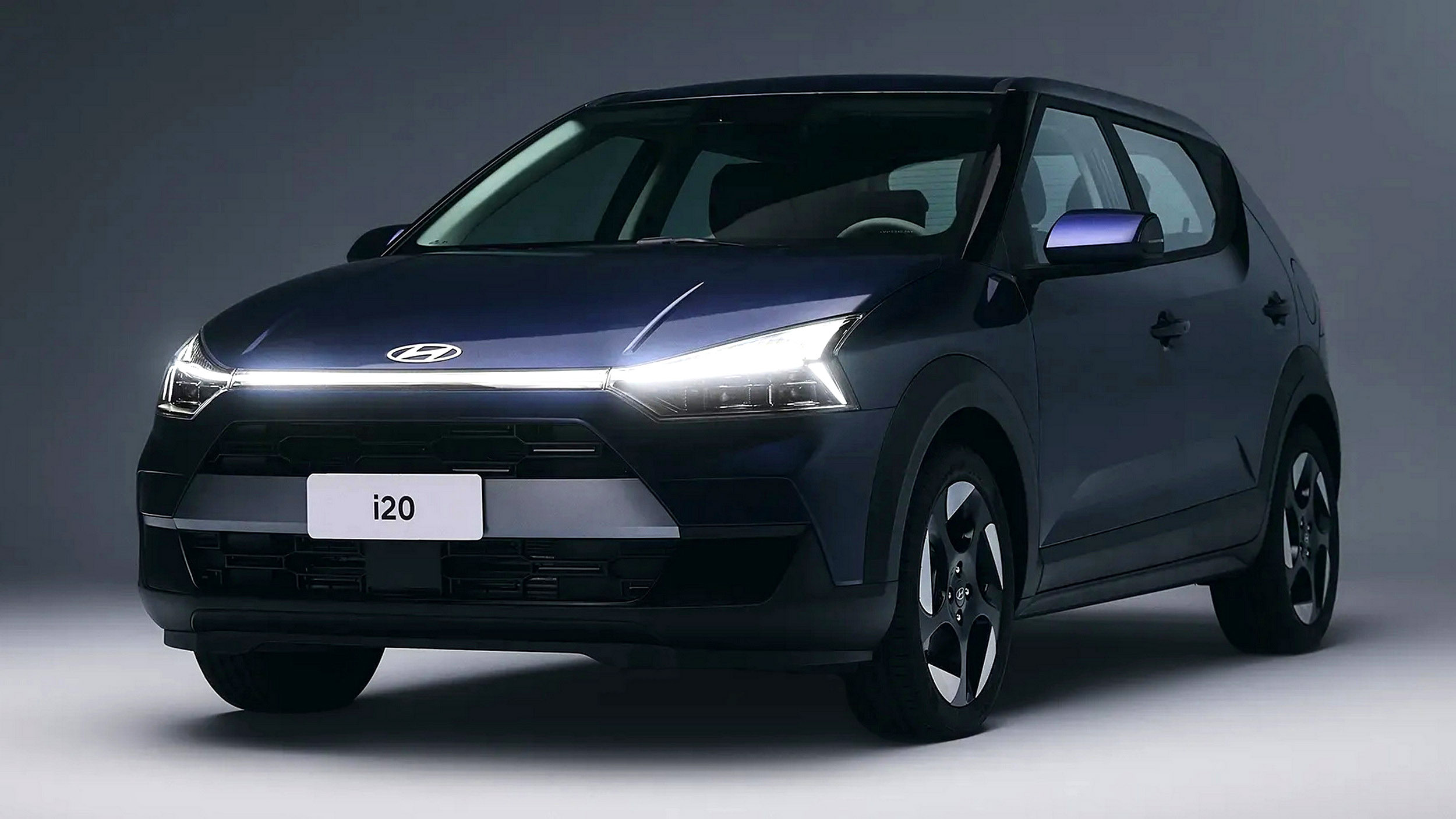
Hyundai pulled the wraps off the new i20 in Brazil, and it doubles as a preview of the global car coming down the line. The subcompact hatch picks up a crossover stance, a fresh design language, and the brand’s newest tech, all while keeping a purely combustion engine lineup for Brazilian buyers.
Following the new i20’s debut, Hyundai clarified that the European-spec version will ride on the same architecture but diverge in design, powertrain lineup, interior layout, and suspension setup. Even so, earlier spy shots suggest the two will share plenty.
More: Hyundai’s Ioniq 3 Looks Like Someone Crossed A Veloster With A Pontiac Aztek
The styling borrows from the Ioniq 3, dialed back a few degrees. Plastic cladding wraps the bumpers and wheel arches, and paired with blacked-out pillars and a flat roofline, it gives the i20 the stance of a shrunken SUV. Think Creta, scaled down.
Other highlights include the large grille, the full-width LED running lights with Lamborghini-style DRLs up front, the sculpted profile, the rising beltline, and the 17-inch diamond-cut alloy wheels on the flagship trim.
Hyundai
The Brazilian-spec i20 carries a 2,580 mm (101.6-inch) wheelbase, identical to the outgoing European third-gen car. The new generation stretches a bit further overall, though, measuring 4,130 mm (162.6 inches) long and standing 1,505 mm (59.3 inches) tall.
More: Hyundai’s Gas Hot Hatches Are Getting A Special Send-Off Before They Take The Manual With Them
Inside, a free-standing digital cockpit pairs two 12.3-inch displays. Hyundai kept a healthy count of physical buttons and knobs below the touchscreen and on the steering wheel, then added a separate climate panel on the center console between the vents. The pictured Ultimate trim wears bi-tone synthetic leather upholstery.
Engines And Transmissions
The Brazilian model skips electrification entirely, sticking with combustion engines that run on gasoline or ethanol. The base naturally aspirated 1.0-liter three-cylinder makes up to 79 hp (59 kW / 80 PS), and the turbocharged version steps up to 113 hp (85 kW / 115 PS). Both send power to the front wheels through a manual or automatic gearbox.
More: Hyundai’s Venue-Sized Bayon Could Get A 140-HP Hybrid America Won’t
Hyundai will build the i20 locally at its Piracicaba plant, next to the HB20, HB20S, and Creta. The overlap between the subcompacts raises an obvious question about longevity, and the i20 could eventually take over for the locally developed second-gen HB20, which arrived in 2019 and was facelifted in 2022.
Brazilian pricing runs from R$ 99,990 (US$ 19,800) for the base manual to R$ 139,990 (US$ 27,700) for the turbo automatic flagship. The i20 lines up against the VW Polo, Chevrolet Onix, Toyota Yaris, and Fiat Argo.
What About The European Model?
SH Proshots
Europe still gets the third-gen i20, a 2020 car updated in 2023 and built in Turkey. A successor could land late this year or in 2027.
More: Hyundai’s 2027 Kona Drops The Pixel Quirks For A Boxier Look
The global i20 should share its architecture and core design with the Brazilian version, but the powertrain story changes, most likely to mild-hybrid units. Expect small exterior and interior tweaks too, plus a suspension setup retuned for European roads and tastes.
The European car will also likely get a sporty N Line trim and a proper i20 N hot hatch running a stronger self-charging hybrid setup.