Elon Musk’s $1.1 Trillion Of Wealth Resting On A Foundation Of Fluff?
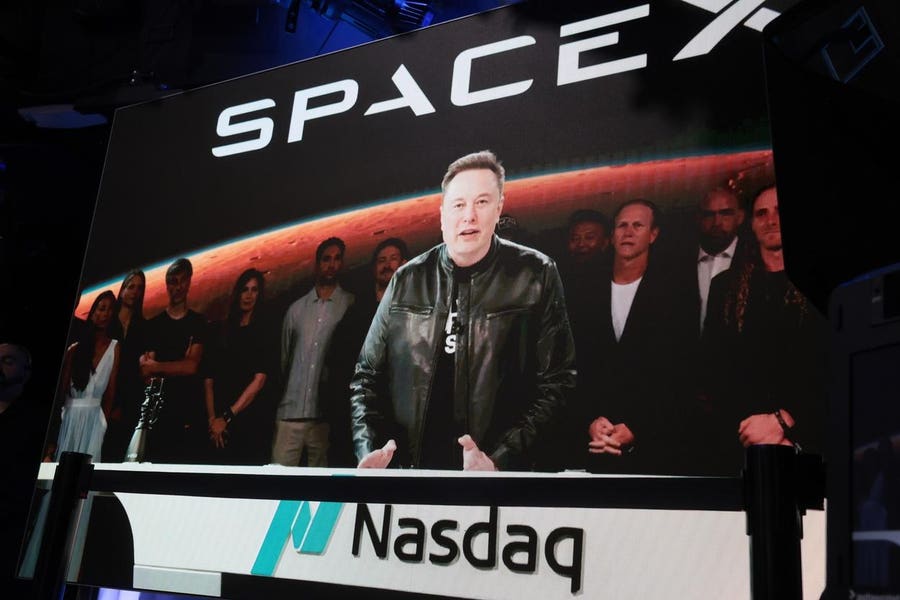
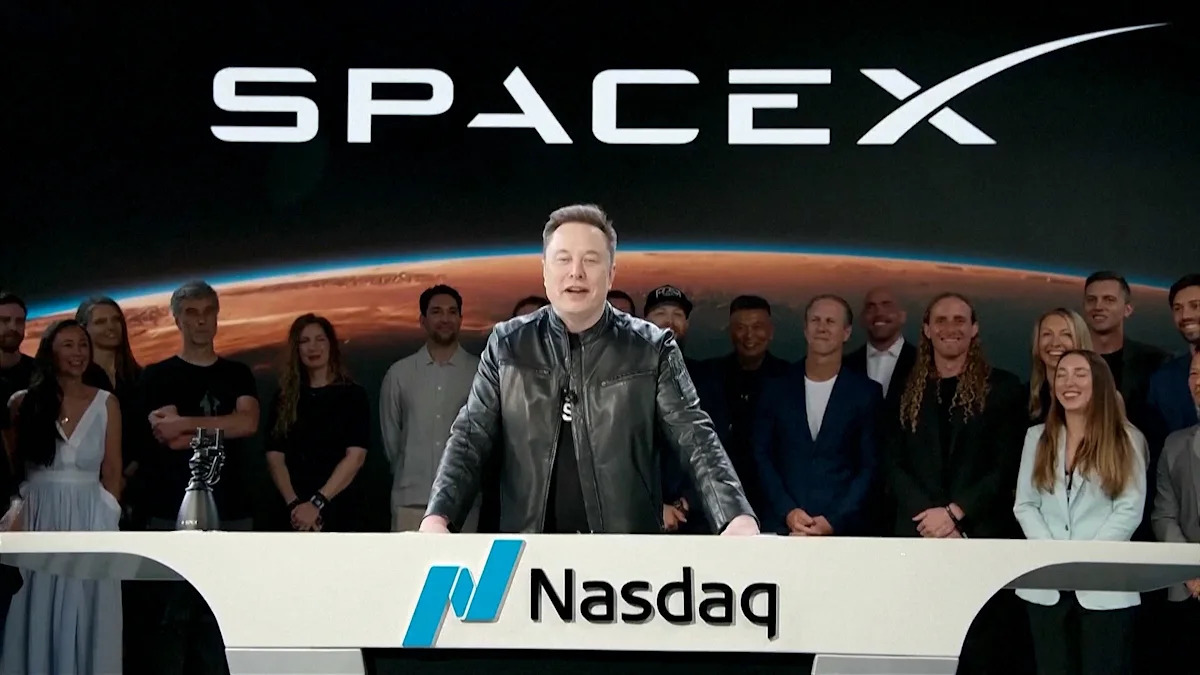
NEW YORK, NEW YORK - JUNE 12: Elon Musk, founder and CEO of SpaceX, speaks via video before the ringing of opening bell at the Nasdaq Marketsite at the launch of the company's initial public offering (IPO) on June 12, 2026 in New York City. SpaceX is set to begin trading under the ticker SPCX following what is expected to be the largest initial public offering in history. Elon Musk, who also serves as chief executive of Tesla, could become the world's first trillionaire. In a filing with the Securities and Exchange Commission, the company said it plans to raise $75 billion by selling 555.6 million shares at $135 each. (Photo by Spencer Platt/Getty Images)Getty ImagesWith SpaceX’s IPO last Friday, Elon Musk became the world’s first trillionaire. Over 95% of Musk’s wealth is concentrated in SpaceX and Tesla. At the Friday close, SpaceX’s market cap was about $2.1 trillion, and Tesla’s market cap was about $1.27 trillion. Musk’s stake in SpaceX is about 70% of his wealth, and his stake in Tesla is over 15%.Plausibly, the market caps of both SpaceX and Tesla comprise a lot of fluff, in the sense of being far above their respective fundamental values. In this regard, both SpaceX and Tesla qualify as being high sentiment beta stocks. Typically, high sentiment beta stocks are difficult to value on fundamentals and difficult to arbitrage. In addition, companies with high sentiment beta stocks are associated with exciting narratives that lead their stock prices to be high relative to their respective earnings. SpaceX’s earnings are negative. Tesla has positive earnings, but its P/E is over 370.All of this is to say that most of Elon Musk’s rests on a foundation of investor euphoria rather than strong fundamentals. This is not to suggest that Musk’s wealth is in danger of imploding, at least soon. Euphoria carries with it a lot of momentum, and is influenced by hype, especially the kind of hype surrounding the largest IPO in history.With this said, investors might benefit from focusing on some germane facts about Tesla that have gotten buried in the SpaceX hoopla. Consider the following:A company’s fundamental value is determined by its forecasted free cash flow steam and its current cash holdings. Except for the five-year stretch between 2018 and 2022, Tesla’s free cash flows have been negative. Analysts have consistently overestimated future free cash flows for Tesla. This is not promising for Tesla’s outlook and fundamental value.As I discussed in my recent post, there are three behavioral finance phenomena associated with IPOs. These are: hot issue markets, first day price pops, and long-term underperformance. While Tesla’s IPO in 2010 did not occur in a hot issue market, its stock did have a first day price pop of over 40%. In a previous post, I pointed out that Tesla’s stock would have exhibited long-term underperformance, but for the after-market. In fact, Tesla’s cumulative return, based only on returns generated during trading hours, is actually negative—indeed, substantially negative. The stock’s strong long-term performance comes entirely from the aftermarket.There is a day-of-the-week pattern in stock returns that is especially strong for meme stocks like Tesla. Overnight returns are strongly positive from the Monday close to the Tuesday open. As I discussed in a previous post, there are some who theorize that this pattern reflects price manipulation by some institutional investors. Notably, while Monday returns during trading hours tend to be strong, the reverse is true for Tuesday returns. The theory goes that some institutional investors support the holdings in their portfolios between the Tuesday open and the Wednesday close, as trading hour returns tend to be weak during these two days. Indeed, overnight returns from the Wednesday close to the Thursday open tend to be negative, perhaps because some institutional investors are unwinding their trades from the previous Monday close.Some investors might view Tesla’s high P/E ratio as testament to investors’ faith in Elon Musk. It is certainly plausible that many investors hold Tesla stock for this reason, in spite of the firm’s negative free cash flows. However, the stark contrast between trading hour returns and overnight returns suggests that there is more going on with Tesla’s stock than investor faith in Musk.Tesla and SpaceX are both meme stocks, where retail investors are especially active. Musk intentionally included retail investors in the IPO allocation process for SpaceX shares. Controlling for day-to-day market fluctuations, for the average meme stock, there is only one trading day where meme stocks have positive returns during the trading day. That day is Monday, after retail investors have had time over the weekend to do research and think carefully about their stock trades.At the time of Tesla’s IPO, in 2010, investors did express concern that Tesla was operating at a loss. Now, investors are expressing the same view about SpaceX. In neither case did negative earnings prevent a first day price pop. The stocks of firms that have IPOs typically rise in the first six months. Thus far, SpaceX has followed the behavioral IPO script – a hot issue market and a first day price pop -- and it remains to be seen if SpaceX continues to stay on script.One thing for investors to keep in mind is that high sentiment beta stocks are very sensitive to changes in market sentiment. At the moment, sentiment is positive. However, inflation is increasing, which puts upward pressure on interest rates. The AI-sector has been borrowing heavily to finance projects that look to be cash flow negative for quite some time. High leverage, weak cash flows, and rising interest rates are the hallmark of financial fragility and economic instability. A Minsky moment, if it happens in the near future, will be devastating to high sentiment beta stocks like SpaceX and Tesla. This is what it means for Elon Musk’s wealth to be sitting on a foundation of fluff.