What did the Black Death ever do for us?
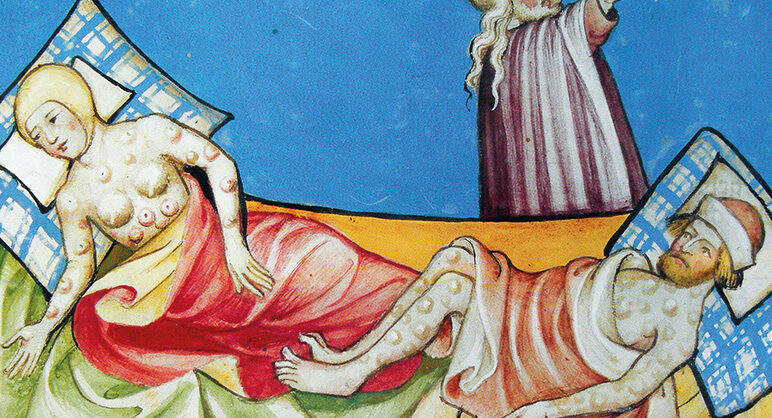
The Black Death, writes Thomas Asbridge, “was unquestionably one of the defining episodes in the history of our species, and a critical turning point in the development of human civilisation”. It is also one of the best known: generations of schoolchildren have loved learning about the black sacks of pus that gathered under armpits, in groins and lymph glands before the disease’s victims suffered an inevitable, agonising death.
Asbridge, a medieval historian at Queen Mary, University of London, is somewhat dismissive of the efforts of others to do justice to the great pandemic that swept across much of Asia, Europe and Africa during the 14th century: “Few historians covering this subject have sought to convey any clear sense of what it was like to live and die during the age of the Black Death.” Instead, he says, “Most scholars prefer to adopt a detached point of view when considering such topics as death rates and disease transmission.” As a result, they make “little or no attempt to reconstruct the lives of the individuals and groups who witnessed this pandemic”.
It is not clear who Asbridge has in mind with this claim. Groundbreaking and outstanding books have recently been written on this topic. For instance, Ole Benedictow’s magisterial The Complete History of the Black Death, John Aberth’s excellent The Black Death: A New History of the Great Mortality in Europe, 1347-1500 and James Belich’s brilliant The World the Plague Made: the Black Death and the Rise of Europe have all published in the last five years.
Asbridge was unlucky enough to be infected with Covid in mid March 2020 and then to develop long Covid. The symptoms of the latter were so severe that he was left debilitated, unable to walk or speak for more than a few minutes. He had to stop teaching and was close to giving up his career as an academic historian. Covid pops up, intermittently but consistently, throughout the book. Like the Black Death, says Asbridge, Covid “appears to have started in Asia… though the circumstances are still being disputed and may never be resolved”. There were, he admits, “massive differences”: after all, the Black Death claimed around 100 million lives (or more than a quarter of the population of Europe, the Middle East and North Africa). Still, the author asks: “What, if anything, does the Black Death have to teach us in the 21st century?”
Subscribe to the New Statesman for £1 a week
The author writes fluently, taking us first on a tour of the places and regions where historians of the time left written records. Ironically, these records, made while much of the world was being wiped out, conveyed a clear sense of what it was like to live and die in the age of mass mortality. “So incurable was the evil,” wrote the Byzantine emperor John VI Kantakouzenos, “that neither any regularity of life, nor any bodily strength could resist it. Strong and weak bodies were all similarly carried away, and those best cared for died in the same manner as the poor.” Demetrios Kydones, a Byzantine statesman, explained that in the imperial capital of Constantinople, “We are busy bringing friends to the grave.” The feeling was not just one of sorrow: “I, who have to live in this terror… feel deep fear in my soul.”
Asbridge then spins us round the Nile Delta in North Africa, up to the Italian cities and on into France and then the British Isles, quoting primary sources that explain how victims “spat blood from their mouths”; they would often die “almost immediately, with swellings under their arms and in their groins”. There is little to choose from between the many different extracts that he draws on, as a grisly death is a grisly death. It does not take long to get the idea that being infected brought no joy and much suffering.
There are some heartbreaking moments, though, such as when Edward III’s daughter Joan dies of the plague on her way to Castile. Death has “snatched… our dearest daughter, whom we loved best of all”, wrote the English king when informed. “No fellow human being could be surprised if we were inwardly desolated by the sting of this bitter grief, for we are humans too.”
Of course, life expectancy in the 14th century meant that expectations of long and happy lives were limited. A bad toothache could mean curtains. Near constant warfare also meant those called to defend king and country often never made it home: this was the age of the Hundred Years’ War, after all. Some scholars, including Asbridge, link images of the danse macabre – the theme of much medieval art, usually translated as the “dance of death” – with the Black Death, though the first known example dates to the 1420s, some 80 years after the pandemic swept across the Mediterranean. The point, nevertheless, is that death was everywhere in this period.
Some dealt with the fear of a terrifying disease by performing “devout processions with the chanting of litanies on specified days of the week” to try to win divine protection. Others took matters into their own hands and blamed Jews for being involved in the spread of a new pestilence, claiming that people were falling ill after drinking from wells that had been poisoned. “Many were burnt for this and are being burnt daily,” wrote Louis Sanctus in Avignon, “for it was ordered that they should be punished thus.”
“Over the course of six horrifying years,” says Asbridge, the Black Death spread “across the face of the known world, engulfing a vast swathe of territory” that stretched from Scandinavia to Mesopotamia “and beyond in the East”. This is a disaster book, in other words, recording sorrow, heartbreak and lives lost to a disease that moved quickly and killed with lethal efficiency.
How did the Black Death begin? Asbridge provides an overview of the latest work on the biological origins of the plague, where recent pioneering research has inspired new questions about where the disease spread from in the 1340s. (The historian Philip Slavin has produced evidence that it first broke out in northern Kyrgyzstan.) But Asbridge is hesitant to offer an explanation as to what caused the Black Death, or the spillover event when the disease transferred from an animal or the environment into a human population. The likely mutation in a pathogen that altered its transmission route and increased its lethality, or the establishment of new plague reservoirs of the disease, such as in south-central Germany, which appears to have been crucial in keeping plague in circulation in the second half of the 14th century, are touched on only modestly.
At the start of the book, the author states that his primary contention is that the repercussions of the pandemic “were felt most severely in parts of the Muslim world rather than in Catholic Europe”. That is quite a challenge, not least since the Muslim world was a large and fractured one, so understanding which parts did better than others and why is important. This has vexed many historians of disease in Europe too, where in recent years a vocal group of scholars has challenged assumptions about lethality as well as about the spread of the disease.
A sanguine view might be that while the Black Death brought depopulation and decline, it also served as a catalyst for a surge in confidence, in artistic production and in empire building, especially in the Mediterranean, Near East and Central Asia. It is likely that mortality rates were indeed high, even if not as high as suggested by some sources. But the fact of the matter is that while Asbridge is right to underline the suffering unleashed by the pandemic, it also preceded a golden age for some. One example is the expansion of the Ottoman empire, especially in the late 1300s, when it expanded deep into Europe; another that of the creation of a vast realm by Tamerlane that was unconstrained by any obvious limitation – including any obvious shortage of manpower. Although Asbridge mentions both in passing, a fuller explanation of how and why either or both were able to benefit from the trauma of chaos and death would have been welcome and important.
Asbridge draws on a large and welcome number sources, and enjoys throwing out a bold claim from time to time – for example that the Black Death played a role in the rise of Protestantism, in the explorations of the coast of Africa by Bartolomeu Dias, even in the “Great Divergence” during which Europe caught up with and overtook Asia – even though all of these took place decades, centuries, or even many centuries after the 1340s. Shockwaves can and do have long-term effects, as the historian James Belich shows, and it is not impossible to stand up big arguments. But they would have benefited, in Asbridge’s case, from more evidence.
In Europe too, while the Black Death was destructive, it also brought plenty of silver linings. If you were lucky enough to survive the horrors of waves of disease, there was good news in store. Wages rose thanks to new opportunities to convert labour to higher rewards. Better still, with fewer people around, many if not most things became cheaper, such as horses, wagons, protein and property. People started having more sex (or at least more marriages were occurring) and dressing and living more flamboyantly. Pandemics produce disaster for some, but they also bring benefits to others.
Those nuances may have been worth drawing out, as well as others. For example, one of the effects of rising wages among those with the lowest incomes was a resurgence of the slave trade, especially in the Mediterranean, where the disease had hit hard. Another consequence was the ecological turnover that resulted from changes in demand for crops as well as timber – which, in the case of the Baltic, was crucial to the expansion of maritime capabilities that had consequences in the centuries that followed.
Perhaps understandably given his own near-death experiences, Asbridge steered away from upsides or consequences, instead favouring devastation and catastrophe. And perhaps that is why his conclusion about what we can learn is a kind one, rather than one that draws on the practical measures drawn up to ward off new outbreaks: to self-isolate and to try to contain the spread of disease. We should take comfort, he says, from the fact that the Black Death “can offer us hope” since it reveals “the best and worst of human nature”. Civilisation did not break down, he notes, as plague survivors rebuilt “their shattered lives”. All of this suggests, then, “that the human species has an extraordinarily strong will to survive and possesses the capacity to bend, rather than break, amidst the storm of sudden change, rising to meet the needs of new challenges”. In a rapidly changing world, “We may all need to take comfort from that thought.”
That is true enough. But the most important thing in any pandemic is to stay alive. And for that, we should all be grateful: after all, none of us would be here today had our ancestors been picked off by the Black Death, or indeed by any of the waves of plague that followed. As beneficiaries to one of the great disasters in history, we should remember to raise a toast to those who did not make it – and one in thanks to those who did.
Peter Frankopan is a professor of global history at the University of Oxford
The Black Death: A Global HistoryThomas AsbridgeAllen Lane, 560pp, £40
Purchasing a book may earn the NS a commission from Bookshop.org, who support independent bookshops
[Further reading: Flesh, death and bohemia]
Content from our partners
Related