5 Things You Need to Know About NASA’s Artemis 3 Crew
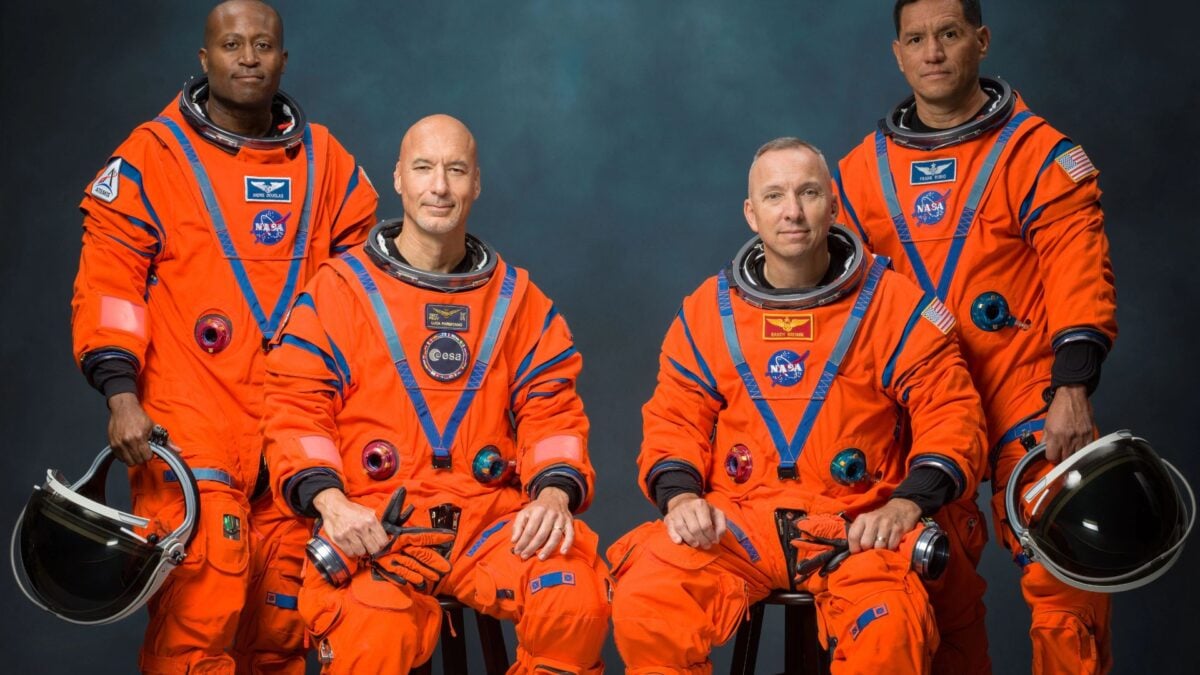
Over the course of NASA’s Artemis 2 mission, the world fell in love with astronauts Reid Wiseman, Victor Glover, Christina Koch, and Jeremy Hansen. There’s something so special about the camaraderie of a crew—that inescapable, beautiful, dutiful link between astronauts going where no humans have gone before, to paraphrase Koch. When Artemis 3 lifts off in 2027, we’ll get to witness that magic all over again. After weeks of anticipation, NASA finally unveiled the Artemis 3 crew on Tuesday. This mission will send the agency’s Andre Douglas, Frank Rubio, Randy Bresnik, and the European Space Agency’s Luca Parmitano to low Earth orbit to test out NASA’s commercial Moon landers in space. Seeing these astronauts assembled as a crew for the first time truly made Artemis 3 feel real, and humanity’s return to the lunar surface has never seemed closer. If you can’t wait to get acquainted with these four intrepid explorers, look no further. Here’s what you should know about the astronauts who will make the next leap toward establishing a sustained American presence on the Moon.
1. Rubio spent over a year in space During Artemis 3, the crew will spend about two weeks in low Earth orbit. For Artemis 3 Mission Specialist Frank Rubio, that will feel like a piece of cake. Rubio holds the American record for the single longest spaceflight at a whopping 371 days.
When he launched to the International Space Station (ISS) aboard a Russian Soyuz spacecraft on September 21, 2022, Rubio’s mission was only supposed to last a standard six months. But in December 2022, the spacecraft began leaking coolant, forcing NASA to extend his mission by another six months. Rubio returned to Earth on September 27, 2023, alongside Roscosmos cosmonauts Sergey Prokopyev and Dmitri Petelin. His extended stay in low Earth orbit allowed NASA researchers to gather critical data on the health impacts of long-duration spaceflight. Living in microgravity for more than a year takes a toll on the body, despite the daily endurance and strength-training exercises ISS astronauts do during their missions. Understanding how to minimize muscle atrophy, bone density loss, cardiovascular changes, and other impacts will be extremely important as humanity ventures farther from Earth.
2. Artemis 3 will be Douglas’s first spaceflight Andre Douglas became a NASA astronaut in 2022 but has not yet flown to space. Though he trained alongside the Artemis 2 astronauts as a backup crew member, his services were not needed on that mission. His first spaceflight will be aboard Artemis 3 as a mission specialist, and honestly, that’s an awesome way for an astronaut to earn their space wings. Rest assured, Douglas hasn’t been twiddling his thumbs since joining NASA. As an engineer at the agency’s Applied Physics Laboratory (APL), he supported the development of the Double Asteroid Redirection Test (DART) mission, which launched in 2021. He also worked with the systems engineering team on MEGANE, a sophisticated gamma-ray and neutron spectrometer developed by the Japanese Aerospace Exploration Agency’s Mars Moons eXploration (MMX) spacecraft. 3. Parmitano survived a water incursion during a spacewalk Spacewalks are one of the most dangerous parts of an astronaut’s job, and Artemis 3 pilot Luca Parmitano is no stranger to the risks. While conducting a spacewalk on the ISS in 2013, he suddenly felt something unusual inside his helmet.
“My head is really wet and I have a feeling it’s increasing,” the Italian astronaut radioed down to NASA Mission Control about an hour into the walk. Parmitano was experiencing a water incursion, a dangerous, potentially life-threatening mishap wherein water that the spacesuit uses for thermal regulation leaks into an astronaut’s helmet. The leak quickly got worse, and after 23 harrowing minutes, Mission Control terminated the spacewalk and ordered him and his partner, NASA astronaut Chris Cassidy, to retreat back inside the space station.
Parmitano survived the incident unharmed, but later recounted the terrifying experience in a blog post. Here’s an excerpt—be warned, it’s bound to give you chills. As I move back along my route towards the airlock, I become more and more certain that the water is increasing. I feel it covering the sponge on my earphones and I wonder whether I’ll lose audio contact. The water has also almost completely covered the front of my visor, sticking to it and obscuring my vision. I realise that to get over one of the antennae on my route I will have to move my body into a vertical position, also in order for my safety cable to rewind normally. At that moment, as I turn ‘upside-down’, two things happen: the Sun sets, and my ability to see—already compromised by the water—completely vanishes, making my eyes useless; but worse than that, the water covers my nose—a really awful sensation that I make worse by my vain attempts to move the water by shaking my head. By now, the upper part of the helmet is full of water and I can’t even be sure that the next time I breathe I will fill my lungs with air and not liquid. To make matters worse, I realise that I can’t even understand which direction I should head in to get back to the airlock. I can’t see more than a few centimetres in front of me, not even enough to make out the handles we use to move around the Station. 4. Bresnik served as ISS commander Randy Bresnik will serve as commander during Artemis 3. His prior experience aboard the ISS makes him well equipped to assume this leadership role, having commanded the space station during the Expedition 53 mission in 2017. ISS commanders are responsible for ensuring the safety and wellbeing of the crew, the protection of the space station, and the successful completion of the mission. While managing those big responsibilities, Bresnik also conducted three spacewalks within the span of one month, each one lasting more than 6 hours. During these excursions, he and another member of the crew performed maintenance on one of the Latching End Effectors (LEE) on the station’s Canadarm2 robotic arm and made improvements to a camera system.
5. First Artemis crew with NASA and ESA astronauts This one may seem obvious, but it’s actually a big deal. The European Space Agency is NASA’s most critical international Artemis partner. Parmitano will be the first Artemis astronaut to represent ESA—a nod to Europe’s essential contributions to the program. Most notably, ESA provides NASA with the European Service Modules that supply power, propulsion, and life support to the Orion spacecraft. These modules are a cornerstone of the Artemis program, allowing Orion to safely transport crews to and from space. They functioned beautifully during both Artemis 1 and Artemis 2, with no major anomalies. The agency was also supposed to provide key infrastructure for NASA’s Lunar Gateway, which would have been the first space station in orbit around the Moon. NASA has paused that program to focus on building a Moon base, so ESA is reevaluating its role and working to determine whether some of that infrastructure can be repurposed for other elements of the Artemis program.