How The Supreme Court Is Tightening Early Prison Release
Filed
12:00 p.m. EDT
06.06.2026
In recent decisions, the justices restricted the bipartisan First Step Act that President Donald Trump signed in his first term.
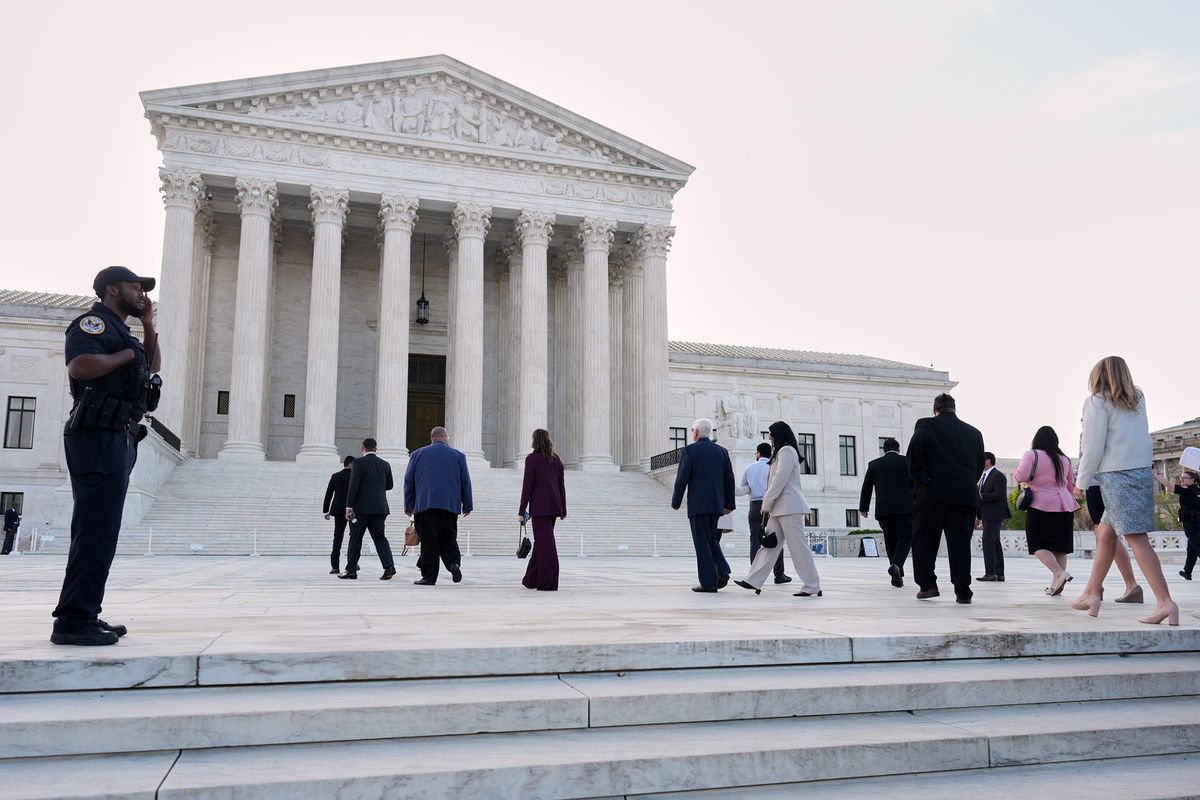
The U.S. Supreme Court Building in Washington, D.C., in April 2026.
J. Scott Applewhite/Associated Press
This is The Marshall Project’s Closing Argument newsletter, a weekly deep dive into a key criminal justice issue. Want this delivered to your inbox? Sign up for future newsletters.
What counts as an extraordinary and compelling reason to let someone out of prison early?
A terminal illness? Advanced age? A family emergency? For all three, the answer in the federal system is “perhaps,” but also: “probably not.” But what about a sentence that Congress now says is too harsh, or if a judge later doubts whether a person was rightly convicted in the first place? Since late 2018, the answer here had also been “maybe,” at least in some federal courts.
That changed last week, when the Supreme Court majority answered no to both scenarios, tightening the mechanisms of compassionate release in the federal system. In two separate decisions, the justices ruled that compassionate release cannot be used to revisit doubts about a conviction, or to reduce a sentence that would be considered excessive by today’s penalties.
Compassionate release has been a part of federal law since 1984, when Congress granted courts the authority to reduce a prison sentence for “extraordinary and compelling” reasons. At the time, however, only the Bureau of Prisons itself could bring a motion for release, and prison officials virtually never did. A 2013 Department of Justice Report found an average of just 24 releases a year under this system, or roughly 0.01% of federal prisoners.
In part to fix that, Congress in 2018 passed the bipartisan First Step Act. Among other changes to the federal system, it allowed incarcerated people to take their compassionate release claims directly to a judge. This hardly opened the floodgates, but it did lead to a roughly 20-fold increase in successful release motions, up to 481 out of just over 2,500 applications in fiscal year 2024, according to the U.S. Sentencing Commission.
According to commission data, judges cited “unusually long sentence and change in law” as part of their rationale for granting release in about 20% 0f those cases. The Supreme Court's decision last week in Rutherford v. United States likely limits the use of compassionate release in this way moving forward.
The decision centered on the case of Daniel Rutherford, who committed two armed robberies in 2003. A jury convicted him of several offenses, including two counts of using and carrying a firearm during a violent crime. At the time, federal law required that some penalties for charges like this be “stacked,” meaning they had to run consecutively. This resulted in a 42 1/2 year sentence, largely driven by a mandatory 32-year penalty for the gun charges. The First Step Act eliminated that form of mandatory stacking for future cases. If Rutherford were convicted of the same crime today, he would be facing a minimum of just 14 years. He sought compassionate release on this and several other bases.
Justice Amy Coney Barrett wrote for the court’s majority that Congress’ decision to not make new sentencing laws apply to old cases was a common one, and therefore nothing “extraordinary.” Thus, it doesn’t fit within the boundaries of compassionate release.
The majority came to this conclusion despite the fact that Congress explicitly named who was in charge of determining how to define “extraordinary and compelling,” and it wasn’t the justices. The original 1984 law created the U.S. Sentencing Commission and tasked it with issuing policy statements on what should constitute a legitimate compassionate release claim. The commission issued a policy guideline in 2023 finding that an unusually long sentence could, under specific circumstances, serve as an extraordinary and compelling reason for compassionate release, though the decision was controversial within the commission itself.
For the three liberal justices, and some legal commentators, that should have ended the matter. In the dissent last week, Justice Sonia Sotomayor wrote that Congress had directed the Sentencing Commission — “not this Court” — to define extraordinary and compelling reasons. The policy didn’t automatically free anyone, she emphasized — 80% of compassionate release applications are still denied — it simply allowed judges to consider sentencing disparity as part of a broader, case-by-case inquiry into whether continued imprisonment remained justified.
The second case the justices considered, Fernandez v. United States, asked a different version of the same question: If an outdated sentence is not extraordinary and compelling, what about possible innocence?
The case centers around Joe Fernandez, who was convicted in 2014 in a murder-for-hire plot and sentenced to two life sentences. He has said he’s innocent throughout. No court has declared him innocent to date, but in 2022, the district judge who presided over his original trial granted him compassionate release and sentenced him to time served, based in large part on concerns about the truthfulness of the star witness in the case. Fernandez had also recieved a much longer sentence than his alleged co-conspirators who took plea agreements.
The Supreme Court majority ruled in his case that questions about the validity of a conviction were also not a valid basis for compassionate release. The very term compassionate release, Barrett wrote, was evidence of the law’s “focus on granting mercy rather than righting legal wrongs.”
In a lone dissenting opinion, Justice Ketanji Brown Jackson countered bluntly: “An innocent man stuck in prison for life: Can there be a more ‘extraordinary and compelling’ reason to shorten a prison sentence than that?”
Part of the majority’s rationale was that if a prisoner believes his conviction is legally invalid, the proper route is a habeas corpus petition, or federal post-conviction review, not compassionate release. Habeas corpus is the ancient legal mechanism by which a person in custody can ask a court to examine whether that custody is lawful, and this procedure has gained renewed focus in the U.S. legal system in recent months in the immigration detention context.
All of that makes the Supreme Court’s next First Step Act case especially interesting. On Monday, the justices agreed to hear the case Maxwell v. Thomas next term, which asks whether a federal prisoner can use habeas corpus to challenge the Bureau of Prisons’ handling of good time credits expanded under the First Step Act. Those credits could move a person out of prison sooner and into home confinement or a halfway house.
As far as last week’s rulings go, the court was not overbroad in its compassionate relief sentences, legal analyst Doug Berman writes. While the decisions affect the kinds of claims people incarcerated in federal prisons will make, “they need not and should not fail to press claims that all sorts of other reasons can amount to extraordinary and compelling reasons for a sentence reduction in a range of other contexts.”