The History Behind The Most Bizarre Single-Wheeled Vehicle Ever Conceived
As the 1930s rolled in, the world saw improved roads, better engines, and a three-box car silhouette that remains largely unchanged even today. However, the world of four-wheeled, front-engined, rear-wheel-drive vehicles was too sensible and safe for people like Dr. John Archibald Purves. A brilliant engineer, Purves wanted to reinvent the way cars travelled. History is hazy on what exactly inspired his creation — perhaps it was a dream, or a sketch by Leonardo da Vinci – but the result was a self-contained and shockingly bizarre vehicle called the Dynasphere.
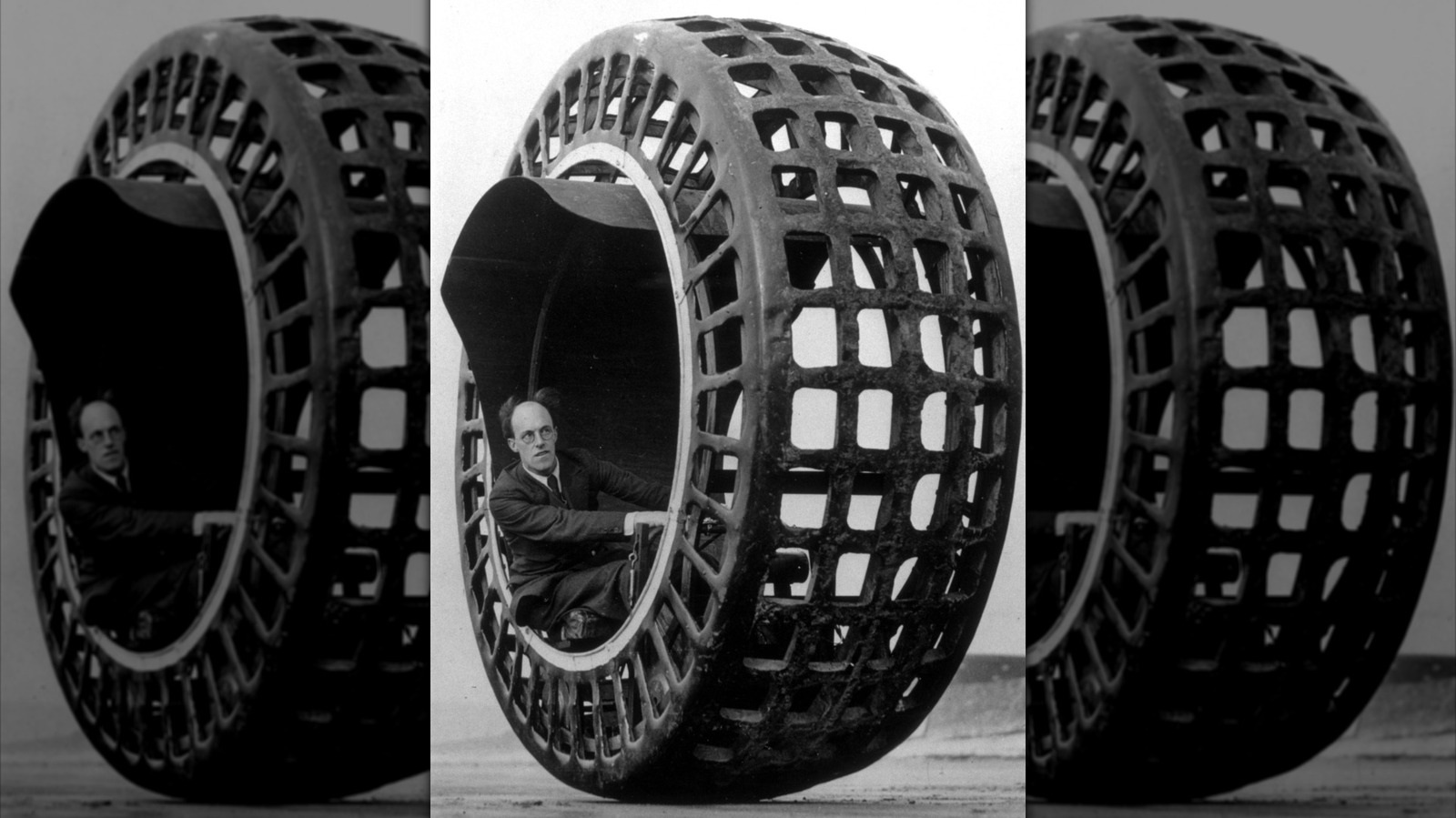
The Dynasphere was a giant rolling cage that looked less like a vehicle and more like a wheel broken loose from a giant wheelbarrow. It was also a monowheel — a vehicle where the passengers and the engine sit inside the circumference of a single massive tire — an idea that's been around since the mid-19th century. Most were small, hand-cranked contraptions, or motorized hoops. Purves, however, thought bigger — and beyond the personal motorized unicycle. He wanted a family car rolling on a single, large wheel and carrying multiple passengers to places at high speeds.
The anatomy of the Dynasphere
To fully appreciate the madness that was the Dynasphere, it's important to know how it was actually put together. First seen in 1932, the full-scale Dynasphere was a massive, 10-foot-tall latticework structure made of iron and weighing roughly 1,000 pounds. Essentially, it was a one-ton rolling donut. At the heart of this iron contraption was a remarkably clever piece of packaging. Inside the giant outer wheel ran circular tracks, and riding on them was an internal carriage that housed the driver, a passenger, and the powerplant.
Purves built two functioning prototypes. The first was powered by a tiny 2.5-horsepower Douglas air-cooled twin-cylinder motorcycle engine, mated to a three-speed gearbox. Later, he constructed a smaller, electrically powered version driven by a battery-operated motor.
The brilliance — and inherent flaw — of the design lay in how it generated momentum. The internal engine didn't turn the outer wheel directly via an axle. Instead, it turned a set of smaller wheels that climbed up the internal track of the giant outer hoop. By moving the weight of the engine and the passengers forward, the vehicle effectively upset its own center of gravity, forcing the outer wheel to roll forward to catch up with the shifting weight inside it. The open latticework was designed to give the driver a view of the road ahead — assuming you could see through the blur of spinning iron bars.
The downsides of the Dynasphere
The Dynasphere, like all monowheels before and after it, suffered from a laundry list of engineering shortfalls that made it terrifying to operate in the real world. The biggest one was probably "gerbling" — the internal carriage turning with the wheel. A monowheel moves when the internal carriage climbs the inside of the wheel, and gravity pulls the wheel forward. It is a theory that works fine under gentle, steady acceleration. However, when you slam on the brakes or hit a sudden obstacle, the momentum doesn't just cease, and the internal carriage doesn't just stay level. Instead, the force carries the occupants up and over, swinging them like a pendulum — or like a gerbil inside a running wheel.
Then there is the nightmare of steering. The Dynasphere had a steering wheel like a normal car, but unlike a normal car, turning the Dynasphere's steering wheel caused the internal carriage to tilt to the steering wheel's direction, tipping the entire vehicle to one side or the other. So, to make a turn, you had to lean a one-ton passenger vehicle at the precise angle required for the speed you were traveling. Leaning while slowing down could tip the vehicle over to its side.
Weatherproofing — or lack thereof — was another problem. The Dynasphere was open to the elements. Even if Purves had fitted it with a windshield or windows, the design meant that the entire latticed tire spun directly over and around the passengers. So if it rained or you passed over a wet or muddy patch, the giant spinning tire would act like a massive conveyor belt, scooping up the water and muck and lifting it above the cabin.
The brief era of public demonstration
Even though the Dynasphere was a potential rolling deathtrap, Purves was a master promoter. He put it on public display as the future of personal transportation. In 1932, the Dynasphere made its grand debut on the wide, flat sands of Weston-super-Mare, a seaside town in Somerset, England. The beach sounded like the perfect testing ground, with plenty of space and the soft sand to cushion inevitable tip-overs.
A British Pathé newsreel on YouTube from that test shows the ten-foot iron wheel rolling across the beach with Purves at the controls. The vehicle actually managed to achieve a top speed of around 30 miles per hour, which we imagine must have felt a lot faster sitting inside that giant donut. Later, Purves brought the Dynasphere to the famous Brooklands racing circuit in Surrey. To the uninitiated, Brooklands is considered the birthplace of British motorsport — a high-speed banked concrete oval circuit. It must have been quite the sight seeing the Dynasphere share the track with low-slung racing cars. Purves even worked on a second, larger prototype — a monowheel bus – designed to carry more passengers.
The demonstration footage shows the Dynasphere rolling past crowds of curious onlookers, who watched the machine with a mix of awe and confusion. The Dynasphere looked stable in a straight line, it moved under its own power, and created the right kind of publicity. For a brief moment, it looked like Purves was onto something. If he'd been successful, the Dynasphere could have had a cult following, maybe even being elevated into one of the most brilliantly quirky car communities around.
The utopian dream of the one-wheel car
One of the reasons why people took the Dynasphere seriously in the 1930s was because this was an era obsessed with futurism. Magazines like Popular Mechanics, Modern Mechanix, and Meccano Magazine were filled with wildly optimistic concept drawings of the future, such as giant flying cars and subterranean bullet trains. Purves leaned heavily into this utopian vision; he argued that the Dynasphere was a more efficient vehicle for the future.
Even today, traditional cars waste massive amounts of energy turning gears, axles, and four separate wheels. By contrast, the Dynasphere had just one wheel, which, by using gravity as the primary means of propulsion and with less friction, should make it more efficient.
Purves didn't just want to replace the traditional passenger car — he envisioned giant Dynaspheres taking over global transport. It was an elegant dream of a simpler, cleaner, and more efficient world. Meccano Magazine even commented that these giant wheels would eventually grow in numbers. To many, the monowheel looked like the logical next step in automotive evolution. If anything, it would have a spot among the world's strangest vehicles.
Why was the Dynasphere left behind?
As we all know, the giant wheel revolution never came. Only two prototypes of the Dynasphere were ever built before the idea ran out of steam. The project was abandoned, joining the ranks of flying cars and jetpacks. The ultimate downfall of the Dynasphere wasn't just that it was difficult to steer or that it covered its occupants in mud. One major reason was that the traditional automobile got too good, too fast.
While Purves was trying to solve the fundamental problems of the monowheel, car companies were perfecting the mass production of cheap, reliable, and comfortable four-wheeled cars. A regular car was less efficient on paper, but it had a roof and heating, and didn't flip you upside down if you braked too hard. The monowheel concept is still somewhat relevant today, in the hands of hobbyists, and has evolved into something totally different, such as omnidirectional monoball scooters.
Today, the Dynasphere is remembered as a glorious piece of automotive left-of-center art. A definitive "what if" of the pre-war era, it represents a time when the rules of car design weren't written in stone and when a brilliant engineer with a wild idea could build something unprecedented and test it on a public beach. The Dynasphere was flawed, dangerous, and entirely impractical, but it was also bold, beautiful, and unapologetically strange. It may have been a dynamic disaster, but it remains one of the most spectacular, bizarre, and wonderful vehicles ever conceived.