Latin America reaches 10,000 electric buses in operation
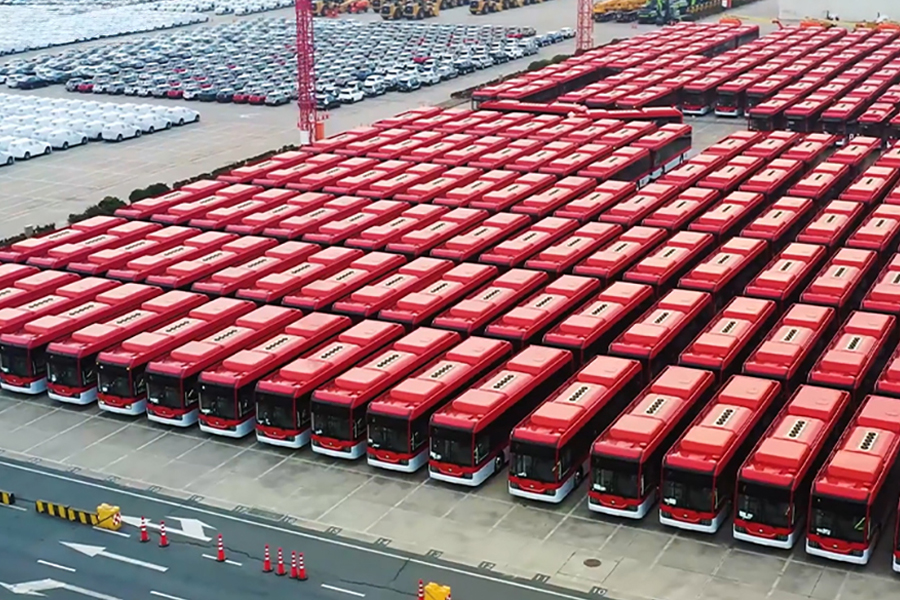
The International Council on Clean Transportation (ICCT) has analysed new data on the electric bus market in Latin America and the Caribbean in its ‘Market Spotlight’ publication series. At the beginning of the year, the region counted 9,115 electric buses — 40 per cent more than a year earlier and ten times as many as in 2017. Battery-electric buses are driving this growth. According to the authors, they ‘have increasingly overtaken trolleybuses as the dominant electric bus type in the region.’As of February, the fleet had already grown to 9,909 electric buses—the most up-to-date dataset on the market in South America. If the momentum of the past three months has continued, even slightly, the 10,000th electric bus may have already been deployed.This can be inferred from data from the E-Bus Radar, which also forms the basis for the ICCT report. The report, officially titled ‘Electric Bus Market in Latin America, 2025,’ defines electric buses as BEVs or trolleybuses (with or without onboard battery packs). A total of 33 countries were analysed, including the twelve nations of South America, the seven nations of Central America, and the 14 Caribbean states.As mentioned, the ICCT based its data on statistics from the E-Bus Radar platform, which is managed by the Zero Emission Bus Rapid-deployment Accelerator (ZEBRA) initiative. The ZEBRA initiators—including the ICCT itself—aim to accelerate the rollout of electric buses in the region while documenting progress. The alliance was founded in 2019, initially focusing on major cities such as Medellín, Mexico City, São Paulo, and Santiago de Chile, where a combined total of around 50,000 buses operate.Electric buses primarily operate in Chile, Colombia, and BrazilOverall, the ICCT report identifies electric buses in twelve of the 33 countries surveyed, spanning 77 cities and metropolitan regions across Latin America. However, the authors stress that the market ‘remains highly concentrated.’ They add that ‘Chile, Colombia, and Brazil make up most of the fleet (80%), with deployment clustered in a few major cities.’ Together, the three countries account for around 80 per cent of the continent’s electric buses.Electric buses measuring between twelve and 15 metres dominate the market and account for the vast majority of vehicles in operation. Chinese manufacturers also lead the regional market, with BYD, Foton and Yutong ranking as the top suppliers of electric buses.The adoption of electric buses in Latin America and the Caribbean remains concentrated in a small number of countries. By the end of 2024, Chile accounted for 47 per cent of the region’s electric bus fleet, followed by Colombia with 17 per cent and Brazil with 16 per cent. Mexico represented 12 per cent of the continent’s electric buses, while all other countries combined accounted for around eight per cent.Over 4,000 electric buses in Santiago aloneA closer look at specific locations reveals a continued concentration in a few major cities. Santiago, the Chilean capital, stands out: with 4,222 electric buses (as of February), around four in ten electric buses in Latin America operate in this metropolis. The city’s fleet is not only the largest in the region by far but is also growing at a disproportionately rapid rate (55 per cent from 2024 to 2025).São Paulo also recorded significant growth, increasing its fleet from 460 to 1,095 vehicles, according to the ICCT report. As of February, the number had even risen to 1,271 units. Meanwhile, Bogotá’s fleet grew only slightly, from 1,486 to 1,554 vehicles. Mexico City (804) and Quito (145) also have notable fleets, though trolleybus services continue to play a prominent role in their systems.
Grafik: ICCT
Chinese manufacturers dominate the marketA small number of manufacturers continue to dominate the market, with Chinese bus builders playing the leading role. According to the study authors, BYD leads the market with 2,961 vehicles sold between 2017 and 2025, accounting for 32 per cent of the regional fleet. Foton follows with 1,492 vehicles, ahead of Yutong with 1,417 and Zhongtong with 946.Brazilian manufacturer Eletra ranks fifth with 894 vehicles, most of them operating in its domestic market. Eletra is also the first non-Chinese manufacturer among the top five suppliers. Together, the five manufacturers account for 85 per cent of the region’s fleet.Other manufacturers currently play only a minor role in the continent’s electric bus market, including King Long with 318 vehicles, Scania with 225, Mercedes-Benz with 159, Higer with 147 and Sunwin with 96.According to the report, 12- to 15-metre buses are the most popular vehicle type and account for 68 per cent of the regional electric bus fleet. Smaller electric buses measuring between eight and 11 metres are particularly important in Colombia, where they make up 49 per cent of the fleet. They also account for 12 per cent in Chile, but remain rare in other countries.The authors of the ICCT report add that articulated buses measuring more than 18 metres are still limited in number. In terms of drivetrain technology, trolleybuses — which are typically longer vehicles — are also losing importance. However, they continue to play a key role in Mexico, where they account for 55 per cent of the fleet, and in Brazil with 23 per cent.The ICCT experts supplemented their fleet analysis with an estimate of the greenhouse gas (GHG) emissions saved by e-buses in the respective countries. The authors are fundamentally convinced that ‘BEBs achieve significant reductions in life-cycle greenhouse gas emissions compared to internal combustion engine vehicles.’ The estimated savings range from 65 per cent in Mexico to 85 per cent in Brazil, with differences attributed to the CO₂ intensity of national electricity grids. The ICCT refers to its own methodology for these calculations.According to the methodology, buses with internal combustion engines produce the highest greenhouse gas emissions in all analysed countries, mainly through exhaust emissions. In the case of electric buses, emissions stem primarily from electricity generation as well as vehicle and battery production. The ICCT stresses that ‘the carbon intensity of the electricity grid is the primary factor influencing differences across countries in Latin America.’Focusing on 12- to 15-metre buses, the authors estimate that battery-electric buses cut emissions by 85 per cent in Brazil, 77 per cent in Colombia, 70 per cent in Chile and 66 per cent in Mexico compared to diesel buses. For trolleybuses, the estimated reductions range from 79 per cent in Brazil to 51 per cent in Chile.theicct.org, ebusradar.org