Mystery of the Mary Celeste 'ghost ship' is SOLVED: Study reveals how an explosion of ethanol vapor may have caused the crew to jump ship in panic
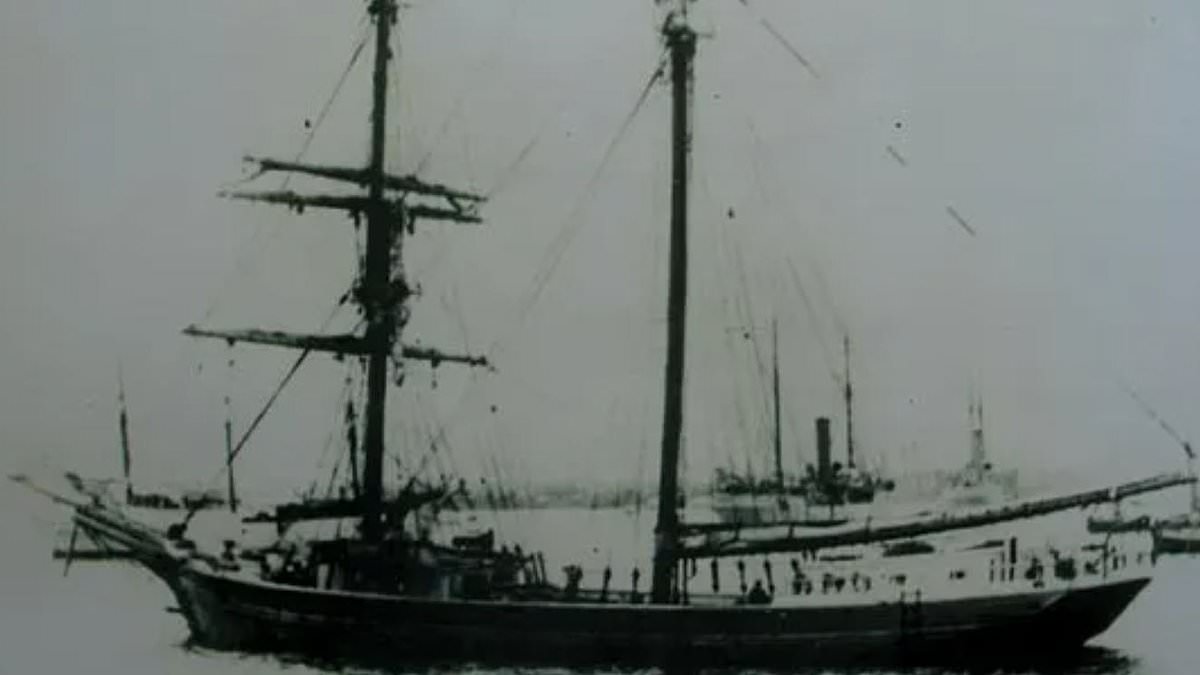
On December 5, 1872, a British ship sailing through the North Atlantic stumbled upon a merchant vessel, the Mary Celeste, drifting through the ocean without a soul aboard.The cargo and the crew's belongings were untouched without a hint of a struggle, as if all 10 people on board had simply vanished into thin air.Now, over 150 years later, scientists have finally solved the mystery of the most famous 'ghost ship' in nautical history.And they say the real reason for the crew's sinister disappearance was an explosion of flammable ethanol vapour.Dr Jack Rowbotham, a chemist from the University of Manchester, told the Daily Mail: 'One thing that has always been suspicious to us as chemists is that their only cargo was almost pure ethanol.'In fact, the Mary Celeste was filled with over 1,700 barrels of pure alcohol, but when investigators came on board, nine of these barrels were mysteriously empty.Scientists think that up to 1,100 litres of ethanol leaked into the hold and vaporised, creating the perfect conditions for a terrifying fireball.'It basically spooked the crew into abandoning ship very quickly without leaving any trace,' says Dr Rowbotham. On December 5, 1872, a British ship sailing through the North Atlantic stumbled upon a merchant vessel, the Mary Celeste, drifting through the ocean without a soul aboard Scientists say that the crew of the 'ghost ship' Mary Celeste may have been scared into jumping ship by an ethanol fire which broke out in the hold Even at the time the Mary Celeste was found, the merchant ship's boozy cargo was the topic of intense speculation.Given the missing crew and empty barrels, many assumed that some alcohol–fuelled disaster drove the crew to drunkenly flee the ship.In an ironic twist, the crew were actually teetotal, having been hired by Captain Benjamin Briggs specifically for that reason.But Dr Rowbotham says that alcohol was still the likely source of their downfall, just not in the way many suspected.'There is a key temperature which is very important for ethanol, and that is 13°C (55°F),' says Dr Rowbotham.'That point, called its flash point, is the minimum temperature at which the vapour from ethanol will ignite.'Critically, the Mary Celeste took on its cargo of ethanol from New York in the middle of winter, where temperatures were well below the flash point.But as the ship travelled eastwards into the Azores, the temperatures started climbing to somewhere above 20°C (68°F). Scale model tests show that a build–up of ethanol fumes in the hold could trigger an explosion that would scare the crew but not singe the wood, making it seem like the crew vanished without a trace To make matters worse, the ship's logs show that the Mary Celeste had hit bad weather en route, leading them to batten down the hatches.That created a sealed chamber below the deck, which slowly filled with increasingly dangerous ethanol fumes.When the weather finally got better, the crew threw open the hatches, allowing oxygen to rush in and create an extremely flammable mixture.While researchers will never know exactly what started the fire, it would have only taken a tiny spark to trigger an enormous explosion.'They are basically sitting on a bomb, and they're hanging around smoking pipes,' says Dr Rowbotham.To see what that would have looked like, Dr Rowbotham and fellow University of Manchester chemist Dr Frank Mair created a scale experiment as part of a new Channel 5 documentary.Dr Rowbotham and Dr Mair built a one–to–18 scale model of the ship, and filled the hold with a proportional amount of ethanol vapour.When the ship was cooled to New York temperatures, even a spark from an electrical cable didn't produce a fire. Dr Jack Rowbotham (left) and Dr Frank Mair (right), of the University of Manchester, conducted the tests as part of a Channel 5 documentary. They say the blast was big enough to blow the hatches off the ship However, once the scientists simulated temperatures closer to the Azores, that same spark triggered a violent explosion.Dr Rowbotham says: 'An example of an ethanol fire that people might be familiar with is a Christmas pudding. Imagine that on something the size of a ship.'The fire produced a roaring flash of blue flame that instantly engulfed the hold and ship, as well as a 'phenomenal' bang from the resulting shockwave.Dr Rowbotham says that the fire in the scale model was so powerful it blew the hatches clean off the ship and threw them across the room.That blast would have terrified the crew and may have scared them into abandoning ship as soon as they could.However, despite being suggested as soon as the ship's cargo was revealed, the ethanol fire theory has long been rejected because of the ship's pristine condition.None of the other barrels of ethanol caught fire, and the wood in the cargo bay was not so much as singed.But these scale model experiments reveal that this is exactly what would happen in the case of a real alcohol explosion. After the initial explosion, the captain of the Mary Celeste, Jack Rowbotham (pictured), may have ordered the crew to abandon ship before the 1,700 barrels of pure alcohol on board caught fire Despite the fire reaching around 2,000°C (3,632°F), none of the wood in the scale model had any trace of burns.Dr Rowbotham says: 'If we hadn't filmed it, you wouldn't have been able to see that there had been an explosion on the ship.'Ethanol and oxygen are such an efficient fuel mix that the flame flashes and vanishes in a matter of seconds, without leaving any soot or other signs of a fire.While wood can burn well, it actually takes a long period of sustained heat to catch on fire.This explains how there could have been an explosion big enough to startle the crew, which still left the Mary Celeste looking as pristine as the day it left port.Dr Rowbotham adds: 'There are so many crazy conspiracy theories about what happened, but we wanted to show what you could learn from doing an experiment, and how valuable that is.' The Mary Celeste: History's most famous ghost ship On December 5, 1872, a British brigantine named Dei Gratia was sailing near the Portuguese islands of the Azores when the crew spotted a ship adrift on choppy seas.To Captain David Morehouse's shock, that ship was the Mary Celeste, an American merchant vessel named the Mary Celeste, which had left New York just eight days before him.The Mary Celeste was supposed to be travelling from New York to Genoa, Italy, with a cargo full of almost pure ethanol. This was to be used as part of a trade agreement, in which the US provided raw alcohol for Italy to make cheap fortified wines.However, when Captain Morehouse came aboard to offer assistance, he discovered that the Mary Celeste was abandoned.The cargo was intact, and there was still a six-month supply of food and water, but no one was left on board.The mystery was further deepened by the fact that there was no sign of an apparent struggle or any reason that the crew would have needed to flee so fast.After spotting the Mary Celeste, the crew of the Dei Gratia sailed around 800 miles to Gibraltar, to attend a salvage hearing that would determine whether they were entitled to payment from the ship's insurers.The attorney general in charge of the inquiry, Frederick Solly-Flood, suspected foul play and launched a full investigation.However, despite the court investigating the issue, no explanation was ever found for why the Mary Celeste would have been abandoned.