The Rise And Fall Of The German Battleship Bismarck, Part II
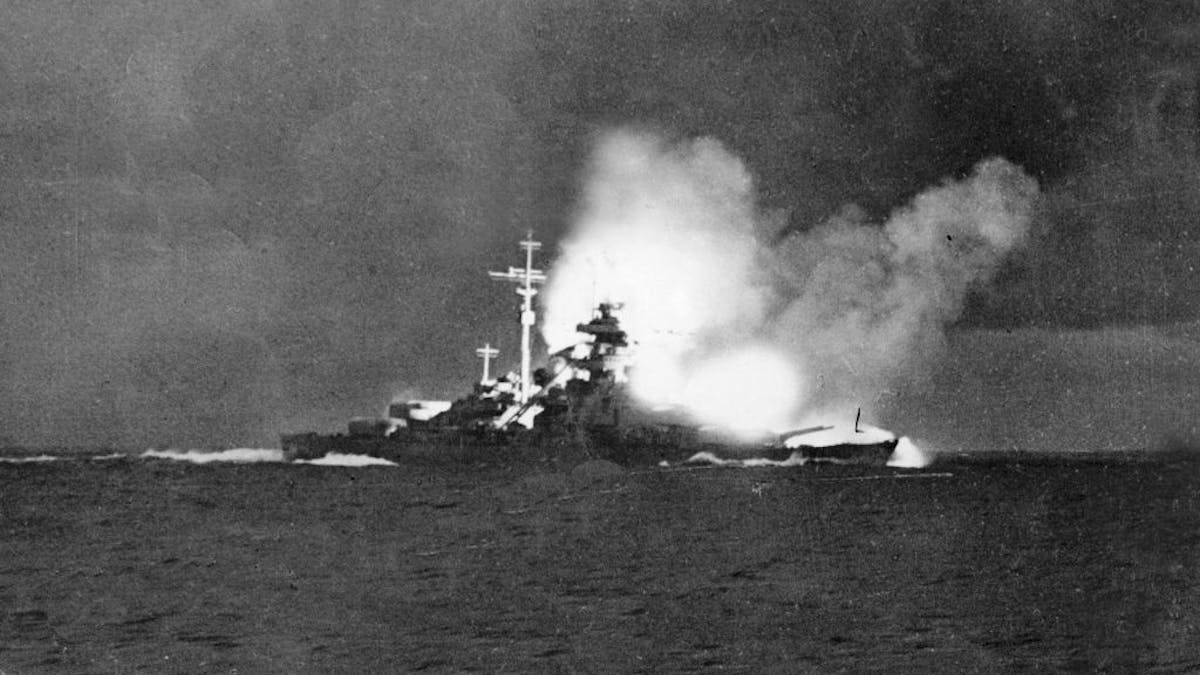
Editor’s note: This is the second in a four-part weekend series on the hunt for the Bismarck, coming up on its 85th anniversary this month. The short-lived “battlecruiser” concept involved mounting the biggest guns on the fastest hull — the idea being they could outrun heavy battleships while wielding enough firepower to destroy faster armored cruisers. Stretching 860 feet from bow to stern, Hood, the most famous of them all, displaced 46,000 tons and carried eight 15-inch guns. But the type’s speed came at a cost. To compensate for the immense weight of their guns, battlecruisers sacrificed armor protection, particularly deck armor. Though they may have looked like battleships, when put into the line at Jutland, three inadequately armored examples were blown apart, and 3,300 sailors perished; the design was effectively abandoned. Hood, already under construction, was still completed in 1920, but she became the last of her kind.Like the German battleship approaching over the gray horizon, Hood was arguably the most aesthetically pleasing ship in her navy. Throughout the interwar years, she toured the world as a floating symbol of British power, earning the sobriquet “The Mighty Hood.” Yet beneath the glamour she was, in the words of historian Iain Ballentyne, a heavyweight boxer with a glass jaw. Although plans existed to refit her with thicker armor, events overtook them. And so, in the predawn darkness of May 24, 1941, Hood found herself steaming headlong toward the most powerful operational battleship in the world.Accompanying Hood was the 44,000-ton Prince of Wales. She carried 10 14-inch guns in a four-and-two-gun turret forward and another four-gun turret aft. A true battleship, she was well-protected. But she had troubles of her own. Commissioned only three weeks earlier, Prince of Wales was plagued by mechanical defects, including chronically malfunctioning turrets (civilian engineers even sailed with her), while her crew remained largely untested.Overall command of the British squadron rested with Vice Admiral Lancelot Holland aboard Hood. Holland intended to run straight in, presenting a narrow target before turning to “cross the T” — placing his ships broadside so all their heavy guns could fire while forcing Bismarck, presumed to be leading the German column, to answer only with her forward turrets. But during the night, the cruisers lost contact with the enemy. By the time the Germans were reacquired, Holland found himself badly positioned, approaching from the southeast at an oblique angle in a long, slow run-in.He knew the approach was perilous. Hood’s thin deck armor — only three inches — left her vulnerable to plunging fire. At long range, Bismarck’s shells would descend in steep arcs down onto the battlecruiser’s weak decks. The range had to be closed quickly so incoming shells would flatten their trajectory and strike Hood’s thicker twelve-inch belt armor instead. Compounding matters, Holland’s ships were positioned in a way that denied them use of their aft guns — the very predicament he had hoped to impose upon the Germans.From Suffolk, farther north, one sailor observed: “Against the light horizon were silhouetted the German ships, while away to port and barely distinguishable against the low cloud forming their background were Hood and Prince of Wales. As they tore along with their guns cocked up in the air, they were a gallant sight, and we watched with the feelings of a producer who has set his stage and now only awaits the rising of the curtain.” Then came the electrifying signal: FROM HOOD. ENEMY IN SIGHT. AM ENGAGING.At 5:52 a.m., with the range down to 14 miles, Holland calmly gave the command, “Open fire.” Hood’s forward guns erupted in flame, followed moments later by Prince of Wales. The massive shells took nearly 50 seconds to arrive, throwing up towering geysers around their target — Prinz Eugen.Holland had made a grievous, if understandable, error. In the skirmish with Norfolk the previous evening, the concussion of her own guns knocked out Bismarck’s radar. So during the night, the smaller cruiser moved into the lead. From a distance, Prinz Eugen had similar lines to Bismarck, which Holland assumed to be the lead ship. But she only displaced 18,000 tons and carried eight-inch guns. Skippered by Lindemann’s 1913 Naval Academy classmate, Captain Helmuth Brinkmann, she was a dangerous opponent…but not a battleship. Several British salvos landed near the German cruiser while Bismarck’s unmolested gunners impatiently awaited permission to fire. Realizing the error, Holland coolly ordered his crews to “switch target to the right.” However, in the confusion no correction was made and Hood continued firing on the smaller lead ship. Prince of Wales, recognizing the mistake earlier, had already shifted fire onto Bismarck. But they had lost the advantage of firing first to get the range quicker.Few experiences rival the terror of being on the receiving end of incoming heavy shells. Seaman 2nd Class Josef Statz remembered, “When the shells flew overhead, they literally ripped a scream from your body. It was indescribable.”For several minutes, British projectiles fell around the German battleship. Yet Bismarck still had not fired. Admiral Lütjens hesitated, mindful of his orders to avoid engagements with enemy warships. But as seconds turned to minutes, Captain Lindemann finally had enough. He snapped, “I will not have my ship shot out from under my ass!” before grabbing a phone and barking to the gunnery officer: “Permission to fire.”Suddenly, Bismarck’s eight 15-inch guns unleashed a full broadside, lighting up the dawn. The concussion staggered the ship itself. Machinist Mate 1st Class Heinrich Kuhnt remembered: “It felt like it was bending, pushed sideways in the water. It was amazing.” A sailor aboard Prince of Wales recalled seeing “a line of orange flashes right across her side, which meant she was using her fore and aft guns at us! Waiting… waiting…waiting. Range closing. And then presently hearing a WHOOOOOSH!!!” Ted Briggs, an 18-year-old signalman standing on Hood’s compass platform near Holland, and the ship’s captain, Ralph Kerr, described the surreal horror of watching the shells approach: “The first thing I saw were four red stars with a gold center coming from her. And I suddenly realized they were fifteen-inch projectiles coming towards us. Then we heard this scream like an express train going overhead.”Prinz Eugen was by now firing her eight-inch guns, shifting targets as the situation required, augmenting Bismarck’s firepower. A second German salvo bracketed Hood as the battlecruiser charged ahead, desperate to get inside the “zone of immunity” re: plunging fire. The Germans then unleashed a third broadside. A shell from Prinz Eugen struck Hood aft, detonating anti-aircraft ammunition below and setting fires, killing and maiming several crewmen. Through the voice pipes Briggs could hear the screams of wounded men. While the German cruiser peppered her opponents, Bismarck found the range. She fired a fourth salvo. One shell smashed through Hood’s observation deck above the compass platform. A shaken crewman sent to inspect the damage returned to report that above them was a veritable charnel house; one officer was unrecognizable, missing both face and hands.Only five minutes into the battle, Hood was in trouble. By now Holland had closed the range to seven miles, which he hoped placed him inside the zone of immunity…but he was wrong. He then ordered a turn to port so both Royal Navy warships could finally bring their aft turrets to bear. It was during this fatal maneuver that Bismarck fired her fifth salvo. After a 30-second trip, a 15-inch armor-piercing shell screamed down and plunged through Hood’s vulnerable deck armor, smashing deep into the ship’s vitals and then detonating her magazines.All at once, an immense superheated sheet of flame ripped upward through the center of the battlecruiser until it resembled a gigantic acetylene torch rising hundreds of feet into the air. Then Hood blew apart in a colossal fireball that left both British and German sailors aghast. Within seconds, her stern disappeared beneath the sea while flames and smoke engulfed the ship. Hood’s bow reared up vertically before beginning its terrible descent into the Atlantic. As she went under, a forward turret fired in a final act of defiance from a doomed gun crew.In just a few seconds, the most celebrated warship in the world was gone. All that remained of “The Mighty Hood” was a flaming patch of oil and debris on the surface of the ocean. Out of a crew of 1,418, only three survived: Ted Briggs, Bob Tilburn, and Bill Dundas. It is believed that an exploding boiler beneath them hurled the trio upward on a rush of air and water, saving them from the suction dragging the rest of the ship downward.Every man who witnessed the explosion was stunned. Zimmerman recalled hearing the news as it spread through Bismarck: “The Hood sunk? It was such a shock. At first there were smiling faces everywhere, but that didn’t last long. As there was a strange feeling in our stomachs that tomorrow that could be us.”Sensing blood, Bismarck and Prinz Eugen now trained all their guns on Prince of Wales — whose own turrets were malfunctioning. The Battle of the Denmark Strait, barely five minutes in, had become a catastrophe for the Royal Navy.***Brad Schaeffer is a commodities fund manager, author, and columnist whose articles have appeared on the pages of The Wall Street Journal, NY Post, NY Daily News, The Daily Wire, National Review, The Hill, The Federalist, Zerohedge, and other outlets. He is the author of three books. You can also follow him on Substack and X. His latest book, “A War For Half The World: Why the Real Battle for the Future was Fought in the Pacific,” will be released in February 2027.