May 17, IDAHOBIT: Global day celebrates sexual and gender diversity at the heart of democracy
This press release is issued by the IDAHOBIT Advisory Group, which brings together 18 organisations and networks working to advance LGBTQIA+ rights at global and regional levels.
ILGA World coordinates the group, which includes also: APCOM, Asean SOGIE Caucus, Asia-Pacific Transgender Network, CariFLAGS, EATHAN, LGBTI ERA, Global Alliance for Trans Equality (GATE), GIN-SSOGIE, IGLYO, ILGA Asia, ILGALAC, IPPF, Out Leadership, SOGI Campaigns, TGEU, and Workplace Pride.
Geneva (Switzerland), 15 May 2026 – From grassroots groups to global institutions, people across the world will unite on May 17 to celebrate sexual and gender diversity as part of the International Day against Homophobia, Transphobia, and Biphobia (IDAHOBIT). The IDAHOBIT advisory group estimates that events will take place in more than 60 countries and territories worldwide.
Celebrated every year since 2005, the day marks the anniversary of the World Health Organisation’s (WHO) decision in 1990 to declassify homosexuality as a mental disorder.
Over the years, IDAHOBIT has brought together individuals, organisations, and governments from around the world to raise awareness of how stigma, violence, and discrimination still affect people of diverse sexual orientations, gender identities and expressions, and sex characteristics, and to advocate for the laws and policies allowing LGBTQIA+ people to truly exercise their rights.
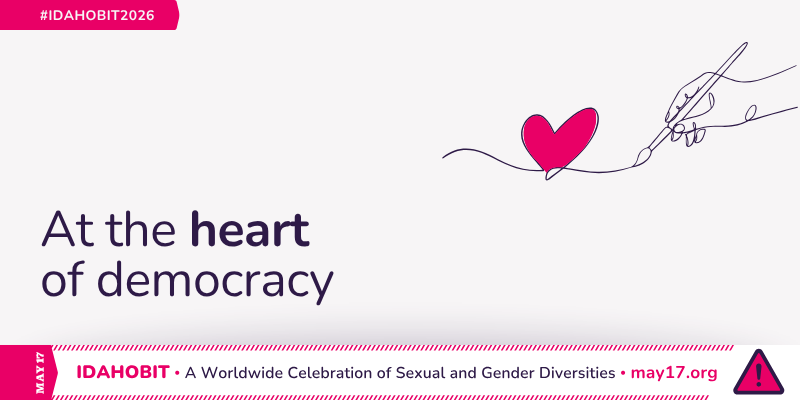
The theme for 2026: “At the heart of democracy” In 2026, the world will celebrate IDAHOBIT under the theme “At the heart of democracy.” At a time when reactionary governments are making attacks on sexual and gender diversity and on bodily autonomy, a staple of their tactics to test the resilience of democratic systems, the actions of LGBTQIA+ people and their allies remind everyone that societies can flourish only when there is genuine equity and justice for all.
For a list of registered events in countries around the world, resources, and tips on how to celebrate the day, please visit may17.org.
The past year in LGBTQIA+ people’s rights: criminalisation rises The current wave of democratic backsliding is unfolding as governments retreat from the promise of equity and justice for all. Throughout 2025, governments worldwide slashed foreign aid, which enabled civil society organisations to operate, precisely when far-right movements and authoritarian governments were trying to dismantle social progress.
As data from the ILGA World Database indicates, the number of countries criminalising consensual same-sex sexual acts rose for the first time in years: 65 UN member States still have such laws on the books.
At least 62 countries have restrictions on freedom of expression related to sexual and gender diversity issues. While laws protecting individuals from hate crimes based on sexual orientation exist in 63 UN member States, only 40 do so based on gender identity, 10 on gender expression, and 8 on sex characteristics.
Despite the setbacks, however, progress is still happening. The Human Rights Council renewed the mandate of the only UN expert explicitly tasked with protecting LGBT and gender-diverse people from violence and discrimination. Legal victories emerged globally: Saint Lucia decriminalised consensual same-sex acts, and the Dominican Republic did likewise for its armed forces.
Courts upheld our rights: the Court of Justice of the European Union (CJEU) issued key judgements on trans people’s rights and recognition of same-sex marriage across EU member states. In Hong Kong, a judge recognised a son of a lesbian couple, after only one parent had been listed as the child’s mother for years. Kenya’s Eldoret High Court directed the government to introduce trans-protection legislation—a continental first. In the United States, the Supreme Court rejected efforts to overturn its 2015 marriage-equality ruling. Tens of thousands defied the Budapest Pride ban, marking a landmark moment for European democracy. The Council of Europe set its first intersex human rights standards, and the UN High Commissioner for Human Rights released its inaugural report on intersex discrimination and violence.
To date, 17 UN member States have implemented bans on so-called ‘conversion therapies’ at the national level, while 9 have introduced nationwide restrictions on unnecessary interventions for intersex youth. Additionally, 18 UN member States allow for legal gender recognition without restrictive preconditions at the national level, and 37 have legalised marriage equality.