Putin’s terror blitz meets Ukraine’s biggest wartime corruption scandal
It’s becoming increasingly difficult to ignore the scale of what Ukraine is now facing as Russia launched one of the largest aerial assaults of the entire full-scale invasion overnight, firing a staggering 731 aerial targets against Ukraine in a coordinated attack involving Shahed drones, cruise missiles and ballistic missiles as Kyiv and multiple other regions again came under sustained bombardment.
Ukrainian officials described the strike as one of the heaviest and most prolonged attacks since February 2022, as Moscow increasingly leans on mass aerial terror while its broader battlefield momentum continues to stall.
According to Ukraine’s Air Force, 693 targets were either intercepted or electronically suppressed during the assault, including 652 drones, 29 Kh-101 cruise missiles and 12 Iskander-M or S-400 ballistic missiles.
The primary direction of the attack was Kyiv, although strikes and damage were reported across multiple regions throughout the country, though notably Dnipro remained relatively quiet, which in itself was telling about the shifting focus and geography of Russia’s latest terror campaign.
Despite the enormous interception rate, the sheer scale of the attack still resulted in casualties, infrastructure damage and civilian destruction.
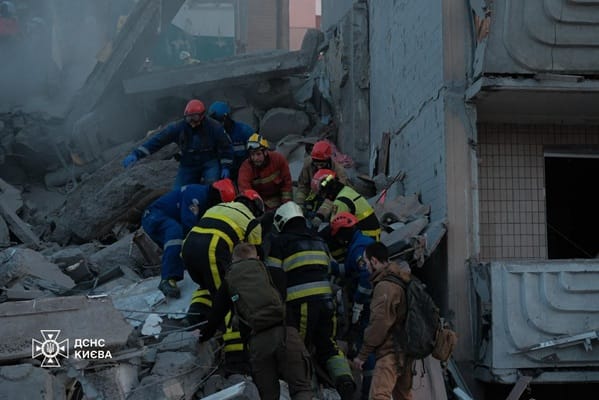
Residential buildings, rail infrastructure, energy facilities and civilian areas were struck in several regions, while emergency services worked throughout the morning to rescue civilians trapped beneath rubble. Ukrainian officials reported fatalities and dozens of injuries nationwide following the combined daytime and overnight assault.
Official PictureTop of Form
President Volodymyr Zelenskyy stated that rescue and recovery operations were continuing across Ukraine following what he described as another deliberate Russian attack against civilians. Kyiv’s military intelligence also warned that Russia appears to be shifting towards a prolonged and systematic aerial pressure campaign designed to exhaust Ukrainian air defences while simultaneously targeting critical civilian infrastructure.
Terrorism by any other name.
The attack itself reinforced a growing reality now increasingly acknowledged even by more cautious Western observers: Russia’s battlefield strategy is evolving as the war grinds deeper into attrition. Moscow continues making marginal territorial gains in some sectors, but the broader spring offensive has increasingly shown signs of stagnation, while Ukrainian deep-strike operations against Russian oil infrastructure, logistics and military assets continue expanding with Ukraine increasing both the distance and regularity of its assaults deep inside Russia itself.
My personal view is that while Ukraine has levelled the playing field somewhat in this war, the conflict is now escalating rapidly. Russian attacks are increasingly focusing further west, dangerously close to NATO borders, with stray drones regularly entering countries like Moldova, Poland & other NATO countries, while Ukraine recently caused major disruption to Putin’s Victory Day parade, also shutting down 13 Russian airports and striking additional refinery infrastructure inside Russia.
A rescue operation is currently underway in Kyiv at the site of a Russian drone strike on a nine-story residential building – an entire section of the building has been completely destroyed. Dozens of people have been rescued. Tragically, one person has been killed. My… pic.twitter.com/HKyqZ4sFv3
— Volodymyr Zelenskyy / Володимир Зеленський (@ZelenskyyUa) May 14, 2026
Despite persistent rumours surrounding elements of Putin’s inner circle allegedly seeking an eventual off-ramp from the war, missiles and drones were raining down across Ukraine overnight while Kyiv simultaneously confronted one of the most politically explosive moments of the war internally.
On the very same day as Russia’s largest aerial attack, Ukraine’s High Anti-Corruption Court ordered former presidential chief of staff Andriy Yermak into custody for 60 days, setting bail at 140 million UAH, approximately $3.2 million.
The ruling marks arguably the single most significant anti-corruption case Ukraine has faced during the full-scale invasion.
For years, Yermak was viewed as one of the most powerful men in Ukraine and widely regarded as Zelenskyy’s closest political ally and wartime fixer. His influence stretched across diplomacy, presidential strategy, international negotiations and military coordination throughout much of the war.
Now, however, the former presidential heavyweight finds himself accused in a major money laundering investigation tied to alleged corruption surrounding elite property developments near Kyiv. Ukrainian anti-corruption agencies allege millions of dollars were funnelled through a broader criminal scheme connected to state energy corruption investigations. Yermak has denied wrongdoing and announced plans to appeal the court decision.
The symbolism could scarcely be greater.
At the precise moment Russia intensifies its military and information war against Ukraine, Ukraine itself is publicly placing one of the most influential wartime political figures in the country through open legal scrutiny.
That reality fundamentally undermines repeated narratives portraying Ukraine as some kind of authoritarian dictatorship.
Dictatorships do not usually place the second most powerful political figure in the country under public anti-corruption investigation during the middle of an existential war.
The timing also comes amid an escalating information battle internationally following controversial public attacks on Zelenskyy by former presidential spokesperson Yulia Mendel during appearances linked to Tucker Carlson’s increasingly pro-Russian media ecosystem.
Much like broader defeatist narratives now circulating online, the messaging increasingly revolves not around outright Russian victory, but around exhaustion, convincing Western audiences Ukraine cannot win, while simultaneously attempting to convince Ukrainians resistance itself is pointless.
But the events of the last 24 hours instead highlighted something far more complicated to me. Ukraine remains under enormous strain militarily, economically and politically. Russia continues attempting to overwhelm the country through mass aerial bombardment, energy pressure, economic attrition and information warfare all at once. Yet simultaneously, Ukraine’s anti-corruption system continues operating openly, even against figures once considered politically untouchable.
That matters enormously for Ukraine’s Western partners, because this war was never purely military and once Putin eventually stalled, it was always going to become more political, economic and psychological as well.
Russia also increasingly appears to understand that an outright battlefield breakthrough remains difficult, particularly as Ukraine’s domestic drone production, deep-strike capability and defensive adaptation continue expanding. Instead, Moscow increasingly relies on terror strikes against civilian infrastructure, societal exhaustion, political destabilisation and information warfare designed to fracture both Ukrainian morale and Western support simultaneously.
Yet despite the scale of the overnight assault, despite the exhaustion, and despite the political turmoil now unfolding in Kyiv itself, Ukraine continues demonstrating something Moscow fundamentally struggles to replicate, and arguably fears most:
Public scrutiny, internal accountability and functioning state institutions during wartime.
The absence of those very things is arguably one of the reasons Russia now finds itself bogged down in a grinding war of attrition, having sustained enormous losses reportedly exceeding 1.3 million casualties while increasingly relying on external support from states such as North Korea and Iran.
That may ultimately prove just as strategically important as anything happening on the battlefield itself.