HORGAN: Dublin's M50 - the Road to Nowhere?
But that’s hardly the full story of Dublin and Ireland in recent times. One of the great untold stories of Ireland since independence has been the growing dominance of Dublin in the life of Ireland. This is clearly illustrated by the country’s demographics over the same period.
Just before the foundation of the Irish state, the 1911 census recorded that Dublin city and county had a population of 477,196 or approximately 15% of the population of today’s equivalent Republic of Ireland. The comparative figure for Dublin city and county in the most recent 2022 census was 1,458,154 or approximately 28% of the Irish population. In simple terms, the population of Dublin in relation to the rest of Ireland has doubled since the foundation of an independent Irish state.
However, these demographic changes mask other important changes. The early 20th century Dublin immortalised by James Joyce was a compact, urban space effectively contained between the city’s canals. It was also a Dublin with a much smaller economic footprint on Ireland compared to its modern-day equivalent.
In contrast, today’s Dublin completely dominates Ireland and is now best described as a mega, low-density, urban sprawl which now extends way beyond those same canals into the surrounding counties of Leinster. Central to this vision of Dublin has been the motor car which has literally driven the development of the city over the last half century.
It is in this context that an orbital ring road of Dublin came to be seen as a solution to Dublin’s traffic problems. However, rather than fixing the problem the M50 appears to have only given oxygen to a flawed vision of a Dublin based primarily around the car.
Today, the over-concentration of economic activity inside the M50 continues. This has fostered an entirely unsustainable vision of Dublin whereby people who cannot afford to live there are still required to work there. The system’s answer to this dilemma relies largely on the private car and the same M50.
A recent RTÉ Primetime programme on the M50 sketched out the reality of this. The programme featured a woman living in Mullagh, Co. Cavan who made the daily 70km commute to her place of work in Phibsborough each day. On a good day the journey took between an hour and 20 minutes and two hours meaning a daily commute of about 3 hours. In terms of M50 commuter lore, that is now more like the norm than the exception for commuters.
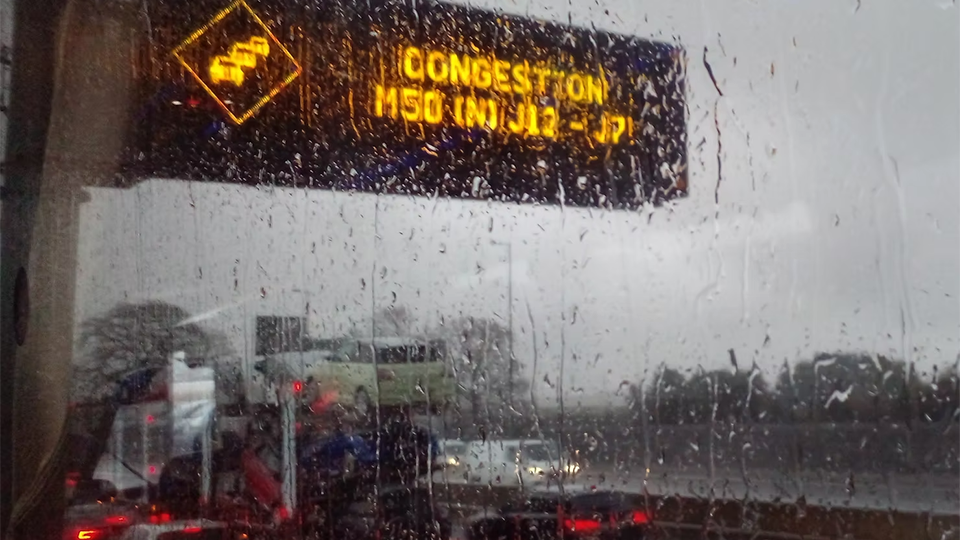
Much like any piece of infrastructure, the problem with the M50 these days is that increasing traffic levels have meant that the roadway is simply clogged up. Those traffic levels are increasingly driven by the simple fact that much of Ireland’s economic activity is now concentrated inside the M50.
The Irish state itself has been a key player in driving this concentration. Not alone has the state and its related agencies expanded massively over the last half century but most of its related work opportunities are now situated inside the M50.
Even today, the state is still actively increasing traffic levels on the M50. The recent signalling by the government of the lifting of the passenger cap at Dublin Airport has already seen passenger numbers increasing from 32m to 36m in 2025 alone and may well hit 50m by 2030.
Situated just off the M50, it is entirely implausible to think that most of these extra passengers will not end up traversing an M50 that is already viewed as being at full capacity.
Neither does the proposed MetroLink, linking Ranelagh to Swords and also serving Dublin Airport, provide a solution to M50 gridlock. Dublin Airport already handles about 85% of all air traffic in the Republic of Ireland meaning that many of these passengers are travelling from Munster, Connacht and Ulster. Even with a new Metro Link most of these will continue to use the M50 to get to and from Dublin Airport.
Darragh O Brien, the Minister for Transport, has been an enthusiastic supporter for the lifting of the passenger cap at Dublin Airport. That’s hardly surprising given that Dublin Airport is in O Brien’s own Fingal constituency and boosting employment opportunities for your constituents will always be popular.
However, as Minister for Transport, O Brien has had far less to say about the impact on the M50 of adding millions of extra passengers to Dublin Airport every year. Indeed, the one topic you’re unlikely to ever hear raised in relation to the scrapping of the passenger cap is its likely effect on M50 traffic levels.
Solutions to the problems of the M50 tend to revolve around tarmacadam and poured concrete. The favoured solution now emerging appears to involve the building of a new, outer orbital route around Dublin – a sort of bigger M50 extending from Naas to Drogheda. But this surely is a case of reheating a failed vision of an overly centralised economic centre served by an army of car-dependent commuting worker bees.
There is nothing intrinsically wrong with an orbital motorway around Dublin – in fact, that is now an essential piece of infrastructure for any modern city. However, in the case of the M50 it’s more a case that the vision for Dublin and Ireland that goes with it has now been shown to be deeply flawed.
Until that changes, the M50 will continue to be just that – a road that leads to nowhere.