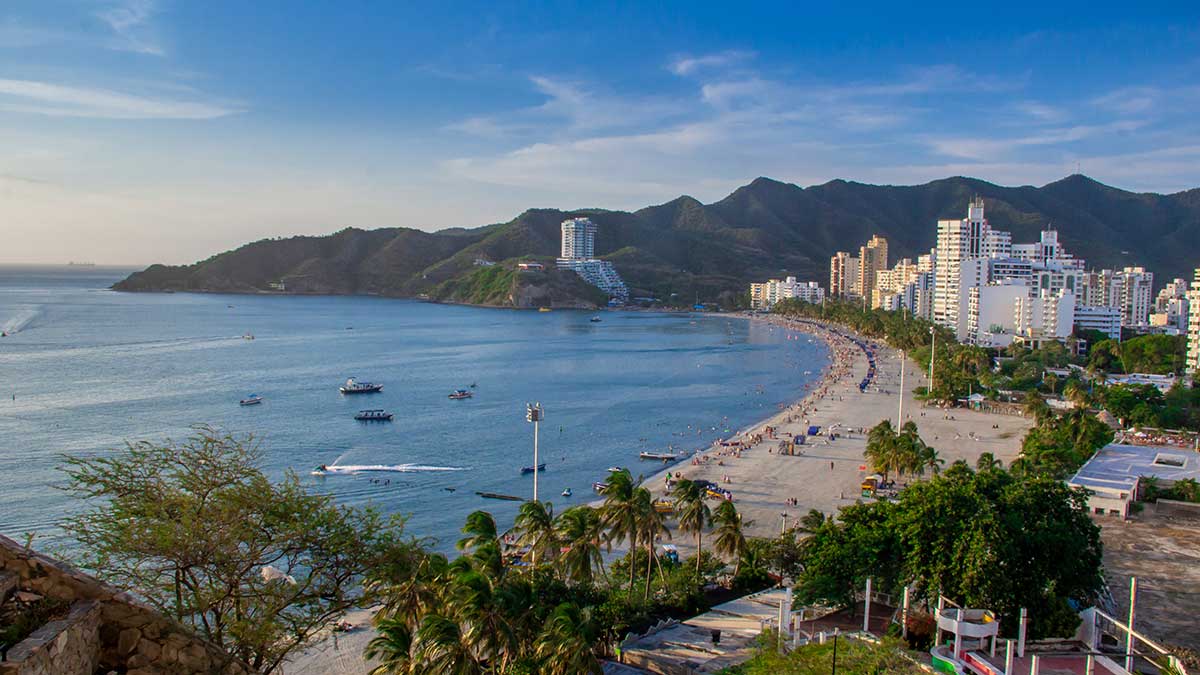
Santa Marta May Be the Moment the World Started Walking Away From Fossil Fuels
Fifty-seven countries representing roughly a third of the global economy walked into a coal port and agreed it was time to leave coal, oil, and gas behind. This is not the beginning of a joke. They did it without the United States, China, India, Russia, or Saudi Arabia in the room; and that was the point.
The First Conference on Transitioning Away from Fossil Fuels, co-hosted by Colombia and the Netherlands in Santa Marta, Colombia, from April 24 to 29, was conceived as an end-run petrostates that have stalled U.N. climate talks for three decades. It opened against the backdrop of the Iran war, the largest oil supply disruption in history, and a growing sense in capitals from Manila to Madrid that fossil fuel dependence is no longer just a climate problem, it is a national security concern.
Whether Santa Marta marks a genuine inflection point or another diplomatic detour will depend on what the participating governments do in the next 18 months. But the debate has shifted, and that matters to the climate and U.S. energy policy.
A Coalition of the Willing, Sitting in a Circle
The Santa Marta format was deliberately unlike a United Nations Conference of Parties, or COP. Instead of plenary speeches and bracketed text, ministers and envoys sat in small circles, discussing issues with civil society and Indigenous representatives in the room. Officials, according to Carbon Brief’s on-site reporting, described the conversations as “refreshing,” “highly successful,” and “groundbreaking.”
The guest list was as much a statement as the agenda. Colombia and the Netherlands invited countries that had backed a roadmap for a fossil fuel phase-out at COP30 in Belém last year. China, India, Russia, the United States, and the Gulf states were not on the list. Co-host Irene Vélez Torres, Colombia’s environment minister, told reporters the goal was to avoid “a rehashing” of Belém and to gather a “coalition of the willing.” Among those willing were several major fossil fuel producers, including Australia, Norway, Canada, Colombia itself, and Nigeria, which acknowledged the contradictions in their own economies but committed to the conversation.
Panama’s special climate representative, Juan Carlos Monterrey Gómez, speaking at the opening plenary, captured the mood: “For 34 years, we have negotiated the symptoms of the climate crisis and bulletproofed its cause. Thirty-four years of pledges. And where are we now? Economies built on fossil fuels are unraveling in real time. Fossil fuels are not just dirty. They are unreliable, they are dangerous, and they must end.”
The Iran War Changed the Game
The conference happened in the long shadow of the Iran war. The closure of the Strait of Hormuz, through which roughly 20 percent of global oil and significant LNG volumes pass, triggered what the International Energy Agency (IEA) has called the largest supply disruption in the history of the global oil market. Brent crude hit $144 per barrel earlier this spring. U.S. gasoline averaged $4.10 a gallon. The Philippines declared an energy emergency. Pakistan moved to a four-day public sector workweek to conserve fuel.
Those disruptions reframed the energy transition argument. UK climate envoy Rachel Kyte told Santa Marta delegates it “would be irresponsible to ignore the second fossil-fuel crisis in five years,” referring to the war in Ukraine and now Iran.
“Price volatility and dependence on imports are structurally and unacceptably impacting our economies,” Dutch climate minister Stientje van Veldhoven told the attendees. “We need to move away from fossil fuels not only because it is good for the climate, but because it strengthens our energy security.”
U.N. climate chief Simon Stiell made the same point earlier this spring at a meeting with the IEA in Paris, telling reporters that the war is “supercharging” the energy transition. The IEA reports that the Iran war has “thoroughly upended” the global outlook for oil consumption, with global demand now projected to contract by 80,000 barrels per day in 2026, the first annual decline since the 2020 pandemic. The IEA had projected growth of 730,000 barrels per day before the war began.
The shift is showing up in trade flows. Chinese exports of solar panels, batteries, and electric vehicles rose 70 percent year over year in March, according to energy think tank Ember, with EV exports up 140 percent.
“The era of fossil fuel security is over,” U.K. Energy Secretary Ed Miliband said in a statement that week. “the era of clean energy security must come of age.”
What Santa Marta Produced
Santa Marta wasn’t a treaty negotiation, and the co-hosts were clear that it would not produce binding commitments. What it did produce was a structure for making progress. The closing plenary on April 29 announced four concrete deliverables:
A second conference in 2027, co-hosted by Tuvalu and Ireland—an explicit pairing of a small island state and a high-income country to signal the coalition’s membership.
A workstream to develop national fossil fuel transition roadmaps, supported by a new global science panel. France and Colombia each released their own roadmaps during the conference.
A financial reform project focused on identifying fossil fuel subsidies and addressing the debt traps that constrain developing countries. Supported by the International Institute for Sustainable Development.
An effort to decarbonize trade, supported by the OECD, with the goal of building toward a “fossil fuel–free trade system.”
The new Science Panel for Global Energy Transition was launched at the academic pre-conference. It will be based at the University of São Paulo and will involve 50 to 100 scientists. Unlike the U.N.’s seven-year assessment cycle, the panel intends to produce annual updates and country-specific analysis on request. Johan Rockström of the Potsdam Institute and Carlos Nobre of the University of São Paulo, who launched it, framed the panel as deliberately independent of government line-by-line approval, which is a major change from the U.N. model.
A science pre-conference also produced a synthesis report from roughly 400 scientists with 12 “action insights,” including explicit recommendations to halt all new fossil fuel expansion and to prohibit fossil fuel advertising on the grounds that fossil fuels are health-harming products. A separate roadmap, led by Professor Piers Forster of the University of Leeds, outlined how Colombia could cut energy emissions to 90 percent below 2015 levels by 2050, with net economy-wide savings of about $23 billion annually by mid-century.
The Brazilian COP30 presidency has committed to building these inputs into an “informal” fossil fuel roadmap to be presented at COP31 in Turkey this November. That handoff is the test. Santa Marta produced a process; COP31 will reveal whether the process has political weight.
The Limits Of Cooperation
It would be easy to oversell this. Santa Marta gathered representatives of roughly a third of the global economy. The other two-thirds, including the world’s top two emitters and its largest oil producer, the United States, were absent. Tuvalu’s climate minister Maina Talia, who will co-host the 2027 conference, told Climate Home News that the criteria for invitations would have to change “If we are missing out the main players in the discussion, then we are moving in a loop, he said. “We need to find somehow how we can engage with [them], because there is no point in talking to ourselves.”
The Fossil Fuel Treaty initiative, a binding legal instrument that 18 nations have backed, did not appear in the final report. None of the workstreams has enforcement mechanisms. And the same Iran war that is accelerating renewable adoption is also being used by some governments, including the Trump administration, as justification to roll back climate policy and expand domestic fossil fuel production. Energy security can be argued in either direction. Which argument wins is a political fight, not a technical one.
Canada’s opening statement at the conference was widely noted for managing to avoid the words “fossil fuels” entirely—a reminder that even among the willing, willingness varies.
And outside the venue, Colombian mining unions protested the conference, holding signs that read “More oil, less Petro.” Colombia heads into a presidential election in late May, and President Gustavo Petro’s successor is not guaranteed. The durability of the Santa Marta process depends on a level of continuity that no single host country can guarantee.
Why It Still Matters
Santa Marta is not the moment fossil fuels ended. It is the moment a critical mass of governments stopped pretending the COP process alone could end them. That is a meaningful diplomatic shift. For three decades, the industry’s biggest structural advantage at U.N. talks has been the consensus rule: any single petrostate could block any binding language on production. Santa Marta is the first serious attempt to route around that veto.
The Strait of Hormuz crisis made it impossible for finance ministers, defense ministers, and central bankers to keep treating fossil fuel dependence as a separate file from national security. The IEA’s Fatih Birol called the situation the “greatest global energy security challenge in history.” Solar and battery costs that have fallen 80 percent and 90 percent, respectively, over the last decade made the alternative real. Santa Marta gave that combination a forum.
Whether the world is actually pivoting away from fossil fuels faster is something we will measure in pipeline cancellations, capital flows, and emissions curves over the next several years—not in conference communiqués. But the rhetorical floor moved in Santa Marta. “Fossil fuel” went from a phrase carefully edited out of negotiated text to the title of a conference that 57 governments showed up to. Coalitions of the doers tend to start small and either grow or fade. This one is worth watching.
What You Can Do
Individual action alone will not phase out fossil fuels. But the policy decisions that will, especially over the next 18 months heading into COP31, are shaped by sustained public pressure and personal choices that signal demand:
Track the workstreams. Santa Marta’s three workstreams (national roadmaps, finance, trade) and the Brazilian COP30 presidency’s informal fossil fuel roadmap will be the substantive deliverables to watch ahead of COP31. Climate Home News, Carbon Brief, and the Fossil Fuel Treaty initiative all publish detailed updates.
Ask your representatives where they stand. In the U.S., neither party invited Santa Marta participants. State and city governments, however, can join subnational coalitions like the Beyond Oil and Gas Alliance. Local action remains the most practical lever.
Reduce your own exposure to oil price volatility. Heat pumps, EVs, and rooftop or community solar are the household-scale equivalent of energy security policy. Federal tax credits remain available for many of these in 2026, though the IRA framework is under active threat—worth acting before that changes.
Support utilities and pension funds that are divesting from fossil fuels. Where you have a vote, whether as a customer, a shareholder, or a pension participant, ask whether the organization is screening for fossil fuel transition risk.
Donate or volunteer with groups doing transition work. The Fossil Fuel Non-Proliferation Treaty Initiative, Climate Action Network, and Indigenous-led organizations like the Organisation of Indigenous Peoples of the Colombian Amazon were central to making Santa Marta happen.
Post navigation