Labour’s post-mortem debate begins
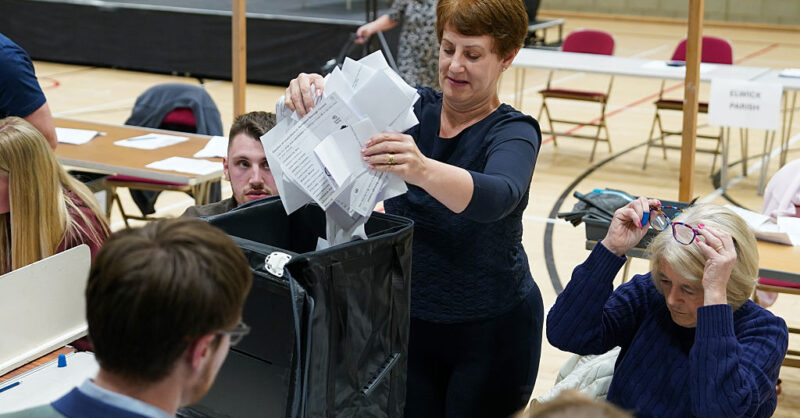
The counting has begun in the English local and Scottish and Welsh parliamentary elections, and with a long weekend ahead, I approach today’s analysis with a degree of trepidation.
What we know so far – with only a few dozen English councils having declared, and most of them electing only a third of their seats – is that Reform UK is performing strongly across the North and Midlands of England.
The most striking results I’ve seen so far are in Hartlepool in the North East, Newcastle-under-Lyme in the West Midlands, and North East Lincolnshire in the East Midlands. In each case, the pattern was the same: Reform swept the board, taking virtually every seat up for election from Labour and the Conservatives in almost equal measure (in Lincolnshire, a single Lib Dem prospered while Reform won 14 of the 15 seats available). Nigel Farage said this morning that the two main parties had been “wiped out” and positioned Reform as a force that transcends the traditional left–right divide in politics.
Labour’s official line is that local elections are a poor predictor of general election results and that governments have often recovered from poor mid-term performances. The party is even circulating comparisons with the 1999 local elections, when Tony Blair’s New Labour lost more than 1,100 council seats just two years after his landslide victory (though this overlooks the fact that Blair still won those elections on both vote share and seats).
Subscribe to the New Statesman today and save 75%
But beyond the necessary evasions and sugar-coating of damage control, more hard-headed calculations are taking place within different wings of the Labour Party, and the post-mortem arguments are already beginning to emerge.
From the party’s right, there are already confident claims that the results vindicate the politics of Shabana Mahmood and other figures who have advocated a hardline approach to immigration in order to attract potential Reform voters. They believe Labour must do more to neutralise Reform in the party’s former heartlands. I do wonder how well that argument will survive contact with the inner London declarations later today, where Labour is expected to be walloped by the Greens. The party’s left, meanwhile, will argue that this is precisely the consequence of pursuing that brand of politics.
The soft-left argument against a rightward shift is also taking shape this morning: that Reform performed so well yesterday partly because the Green surge siphoned votes away from Labour, allowing Farage’s candidates to win on strong, though not spectacular, vote shares. Their answer to this disaster is therefore to consolidate progressive voters behind a more openly left-wing Labour leadership. A figure from Labour’s soft left predicted this to me only recently: that the sheer number of seats gained by Reform could trigger renewed calls for Labour to shift further to the right, and that their wing of the party needed to be prepared to resist a Thermidorian reaction.
The main story of the next few days will be Labour’s post-mortem, much of which will consist of people using the results to validate what they already believed and to argue for policies and strategies they were already advocating for the party’s future.
But we must also keep an eye on the bigger picture. The Conservative Party’s attempt to hype a “Kemi bounce” has not translated into a national recovery. Like Labour, the Tories are suffering at the hands of Reform. They will no doubt point to some positive results – they have already held on to their old fortress of Westminster City Council by a whisker – but questions about the leader’s strategy will grow louder as the party struggles to revive itself despite the government’s unpopularity.
And keep an eye out for discontent within the Liberal Democrats over Ed Davey’s supposedly “asleep at the wheel” leadership. His party was once the principal beneficiary of disaffection with the two major parties. After yesterday’s elections, that no longer appears to be true.
This piece first appeared in the Morning Call newsletter; receive it every morning by subscribing on Substack here
[Further reading: Live results map: Wales, Scotland and local elections]
Content from our partners
Related