Trump’s Killing Spree Isn’t Stopping the Flow of Drugs Into the U.S.
The Pentagon claims that attacks on civilian boats in the Caribbean and Eastern Pacific have severely curtailed the import of illegal drugs to the United States. And President Donald Trump says this has saved more than 1 million American lives. Experts call these assertions laughable and reporting by The Intercept shows that claims by the White House and War Department are baseless, phony, or both.
“The administration has failed to explain the long-term objectives of this mission or provide any evidence of reduced drug flows into the United States,” Sen. Jack Reed of Rhode Island, the top Democrat on the Senate Armed Services Committee said about the campaign on Thursday. “I would ask for a credible answer to this most fundamental question: What is the operation actually meant to accomplish?”
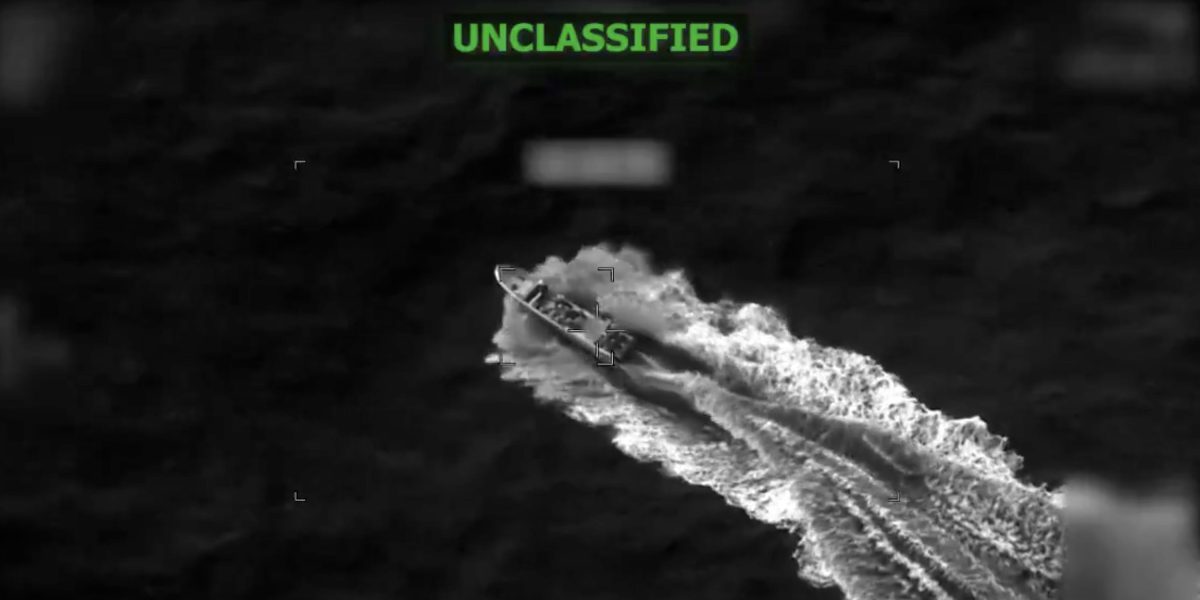
Under Operation Southern Spear, the U.S. military has conducted attacks on 54 so-called drug boats in the Caribbean and Eastern Pacific Ocean, killing more than 185 civilians, since September. The latest strike, on April 26 in the Pacific, killed three people. The Trump administration claims its victims are members of at least one of 24 or more cartels and criminal gangs with whom it claims to be at war but refuses to name.
Experts in the laws of war, as well as members of Congress from both parties, say the strikes are illegal, extrajudicial killings because the military is not permitted to deliberately target civilians — even suspected criminals — who do not pose an imminent threat of violence. These summary killings are a deviation from the standard practice in the long-running U.S. war on drugs, in which law enforcement agencies generally detained suspected drug smugglers and brought them to trial on criminal charges.
“These are extrajudicial executions, or even just murders — something similar to a cop shooting a fleeing suspect in the back when there is no self-defense justification,” said Adam Isacson, the director for defense oversight at Washington Office on Latin America, a human rights group. He called the growing death toll “a gross human rights violation.”
While Trump consistently lies about various aspects of the boat strikes, including the illicit narcotics allegedly on the boats and the number of lives supposedly saved by the attacks, the Pentagon has followed suit, using rhetorical sleight of hand and seemingly disingenuous statistics to bolster the claims of their commander-in-chief.
“I can’t imagine how you could come to some of these conclusions regarding illegal smuggling and drug overdose deaths based on the facts as we know them,” said retired Rear Adm. William Baumgartner, the former commander of the Seventh Coast Guard District, who oversaw drug-interdiction operations in the Southeast U.S. and the Caribbean Basin.
The Pentagon and White House for months failed to respond to detailed questions from The Intercept on the boat strike campaign.
Trump has repeatedly claimed that the vessels attacked by the U.S. are trafficking fentanyl, a synthetic opioid. “The boats get hit and you see that fentanyl all over the ocean, it’s like floating in bags, it’s all over the place,” he said in October of boats leaving from Venezuela.
Rep. Sara Jacobs, D-Calif., a member of the House Armed Services Committee, and five other government officials briefed on boat strikes told The Intercept that top officials admitted in close-door briefings that the vessels are not transporting fentanyl. “They had some convoluted reason why it was still impacting fentanyl that was hard to follow and I did not buy,” said Jacobs, who serves the San Diego area. “Representing a border community, I know that 99 percent of the fentanyl that comes into the United States comes through legal ports of entry by U.S. citizens and legal permanent residents.”
Fentanyl is generally produced in the United States or Mexico, Baumgartner said. “I have not seen any evidence that fentanyl has ever been smuggled from South America to the United States,” he told The Intercept. “Cartels would not smuggle fentanyl down to South America just to smuggle it back by boat.”
“I have not seen any evidence that fentanyl has ever been smuggled from South America to the United States.”
While bales of cocaine float in water, Baumgartner said, fentanyl is shipped in dramatically smaller quantities and would not be seen floating in the aftermath of an airstrike.
Fentanyl or not, Trump has also touted astounding decreases in drug smuggling due to the boat strikes. “Drugs entering our country by sea are down 97 percent,” Trump said at a January 29 White House briefing. Experts said that Trump’s claim is ridiculous, invented, or involves disingenuous numbers meant to deceive the American people. “It wouldn’t be the first time this administration just made up something out of whole cloth,” said Sanho Tree, the director of the Drug Policy Project at the Washington-based Institute for Policy Studies.
Baumgartner noted that even the Pentagon figures put the lie to Trump’s claim. “He’s trying to imply that 97 percent of the cocaine that left South America by boat headed to the United States has been stopped,” he said. “That’s not true and is contradicted by the administration’s own statements.” Acting Assistant Secretary of War for Homeland Defense and Americas Security Affairs Joseph Humire, for example, offered completely different numbers to Congress, telling the House Armed Services Committee in March that there “has been a 20 percent reduction of movements of drug vessels in the Caribbean and an additional 25 percent reduction in the Eastern Pacific.”
The word “deterrence” has become a popular Pentagon euphemism for the use of lethal strikes, in contrast to previous U.S. government efforts to marshal economic, diplomatic, and military means to convince adversaries to change their ways. “Deterrence has a signaling effect on narco-terrorists, and raises the risks with their movements,” Humire claimed. But last month, for example, there were eight strikes in the span of 16 days, including five in five days. “That shows that traffickers, even along that high seas route, are not being deterred,” said Isacson.
The amount of cocaine seized by U.S. authorities suggests the strikes have had little impact on the trade. “Really absurdly, there’s been no impact on flows of drugs toward the United States,” said Isacson. While data is limited, figures from Customs and Border Protection show that seizures at U.S. borders and along coasts have increased amid the Trump administration’s airstrikes in the Caribbean and Pacific. “CBP’s cocaine seizures have actually gone slightly up since the boat strikes began. Cocaine seized at all U.S. borders in the seven months before the strikes began was 38,000 pounds. In the seven months since, it’s 44,000 pounds — 6,000 pounds more,” Isacson explained.
The Coast Guard recently announced “record-setting interdictions” of cocaine in the Eastern Pacific under Operation Pacific Viper, indicating that large quantities of the narcotic are still transiting through that maritime corridor. Since last August, that service has seized more than 215,000 pounds of cocaine as part of this operation, Coast Guard spokesperson Brandon Hillard told The Intercept. “Narco-terrorists continue to go to great lengths to traffic illicit narcotics within and out of the Western hemisphere,” he said, highlighting “the seizure of hundreds of tons of cocaine.”
The general stability of the drug’s wholesale price also suggests it remains widely available. “The Coast Guard recently seized 1.2 tons of cocaine and reported a wholesale value of $19.3 million. This works out to be about a $16,500 per kilogram wholesale price. It doesn’t reflect the major jump in price that you would expect if you really had 97 percent reduction in flow,” Baumgartner explained of a seizure announced this month. “This report may be using old pricing information, but I would expect a significant spike in prices with even a 20 percent reduction in the cocaine flow.”
According to the drug-testing company Millennium Health, use of stimulants, including cocaine, is climbing sharply and was detected in urine samples at nearly twice the rate of fentanyl in 2025.
“A 97 percent reduction in cocaine flow would mean that cocaine was now extraordinarily rare in the United States,” said Baumgartner. “The price of cocaine would have skyrocketed. Addicts would be fighting each other over what little cocaine or crack they could find.”
Read Our Complete Coverage
Trump has also advanced absurd statistics about lives saved by attacks on boats. “When you see the boats being hit, those boats kill on average 25,000 people a boat,” Trump claimed. This echoed his previous assertion that “every boat that we knock out, we save 25,000 American lives.” Experts say that there is no way of knowing how many lives are saved due to drug interception efforts, but that Trump’s claims are nonetheless untethered from reality.
The Centers for Disease Control and Prevention reported more than 70,000 drug overdose deaths for the 12-month period ending in November 2025. By Trump’s math, the drugs on the 54 boats would have been responsible for 1,400,000 deaths — 20 times the number of overdose deaths in one year. “The claim that sinking each cocaine smuggling boat saves 25,000 lives makes no sense,” said Baumgartner. “That would probably be more than the number of cocaine deaths in the last five decades combined.”
While not as egregious as Trump’s claims, Humire also offered up overdose numbers that appeared calculated to deceive. “As early as September 2025, the Administration had also achieved a nearly 20% drop in deadly drug overdoses in the United States compared to the previous year,” said Humire, crediting Operation Southern Spear with a share of the success. Left unsaid is that the first boat strike occurred that September, meaning the strikes would have had little or no impact on the numbers. The Pentagon did not provide any details on the source of Humire’s figures.
“ There is no military solution.”
Experts say Humire’s statistics appear to be rhetorical sleight of hand, since Operation Southern Spear is not actually preventing the flow of fentanyl — the leading cause of overdose deaths in the United States. Baumgartner called it “misleading” to link Operation Southern Spear to decreases in overall drug overdoses and drug flow because it “only impacts cocaine smuggling, not fentanyl or other drugs.”
Humire claimed Southern Spear and National Defense Areas on the U.S. Southern border “diminished the flow of fentanyl,” telling Congress it is “down 56% since the same period last year.” In actuality, CBP’s seizures of fentanyl at the U.S.–Mexico border have been declining since 2023. Halfway into fiscal year 2026, fentanyl seizures are almost exactly half of the total for 2025.
War Secretary Pete Hegseth also claims that the boat strikes have significantly impacted the drug trade. “Some top cartel drug-traffickers in the @SOUTHCOM AOR have decided to cease all narcotics operations INDEFINITELY due to recent (highly effective) kinetic strikes in the Caribbean,” he wrote in a February post on X. The Pentagon won’t name these “top” traffickers, failing to respond to repeated requests for information from The Intercept.
Lawmakers and other experts say that the Trump administration completely misconstrues the nature of the drug trade. “They have a fundamental misunderstanding that drug trafficking is a business. And that means there is no military solution,” Jacobs told The Intercept.
Tree, of the Institute for Policy Studies, echoed this. “They’ve applied a war paradigm to an economic problem, as if there is a command structure of the global drug economy where the person at the top finally says, ‘We’ve had enough. Everyone, stop what you’re doing now. We surrender’ — as if a cartel boss could command users, growers, smugglers, money launderers, and dealers, to all give up. It doesn’t work that way,” he explained. “Even if you did find a case or two of someone deciding to get out of the business, there are an infinite number of replacements willing to step up because that’s where the money is. Smuggling is the business. There’s always going to be a Han Solo.”
“They’ve applied a war paradigm to an economic problem.”
The Trump administration’s killing of civilians on alleged drug boats contrasts with the administration’s ongoing embrace of drug traffickers, drug dealers, and certain cartels, as well as its cuts to drug enforcement efforts. Justice Department records show, for example, that the Drug Enforcement Administration’s staff has dropped by about 6 percent since 2024. And more than 5,000 FBI and DEA agents have been reassigned from combating drug cartels to immigration enforcement, according to Rep. Jamie Raskin, D-Md., the ranking member of the House Judiciary Committee. Trump’s then-Attorney General Pam Bondi also scuttled the Justice Department’s Organized Crime Drug Enforcement Task Forces which allowed the department to coordinate investigations of cartels and transnational criminal networks. And last year, federal prosecutions for drug trafficking dropped to their lowest level in more than two decades.
To justify January’s U.S. invasion of Venezuela and the kidnapping of its president, Nicolás Maduro, Trump administration prosecutors charged him with numerous crimes, including “Narco-Terrorism Conspiracy” and “Cocaine Importation Conspiracy.” The Trump administration is now running the country via a puppet regime that includes Interior Minister Diosdado Cabello, who was indicted in the U.S. for drug trafficking, having “partnered with some of the most violent and prolific drug traffickers and narco-terrorists in the world, and relied on corrupt officials throughout the region, to distribute tons of cocaine to the United States,” according to the Justice Department.
Trump has also granted clemency to around 100 people accused of drug-related crimes, including kingpins. He gave, for example, a “full and unconditional” pardon to former Honduran President Juan Orlando Hernández, who had been sentenced to 45 years in prison after being convicted in 2024 for using his office to smuggle 400 tons of cocaine into the U.S. Republican Sen. Bill Cassidy of Louisiana asked: “Why would we pardon this guy then go after Maduro for running drugs into the United States?”
On Thursday, Sen. Tim Kaine, D-Va., questioned Gen. Dan Caine, the chair of the Joint Chiefs of Staff, on the boat attacks. “What legal justification could there possibly be that would allow the U.S. military to strike boats in international waters and kill the occupants of those boats without a showing of evidence that there’s narcotics on those boats?” he asked, before being met by a stream of doubletalk about the legality of the attacks. Unable to elicit a straight answer, Kaine responded: “I think there’s a profound mismatch between what is occurring and the underlying assumptions in the legal opinion.”
Military briefers have admitted to members of Congress that they cannot satisfy the evidentiary burden necessary to hold or prosecute survivors of the boat strikes, leading the U.S. to repatriate, hand off, or leave injured victims to drown. Similarly, those killed — if they are involved in the drug trade — are hardly drug kingpins. An investigation by The Associated Press into the lives of nine of those killed in U.S. strikes found that while they had been smuggling drugs, they were not “narco-terrorists” or gang leaders but laborers, a fisherman, a motorcycle taxi driver, two were low-level criminals, and one was a local crime boss. All were from a desperately poor area, and most were crewing such boats for the first or second time. “These individuals don’t matter in the grand scheme of things,” said one government official of those killed.
“We don’t use missiles to address a public health problem.”
Asked about the disconnect between the Trump administration pardoning drug kingpins and killing low-level persons who may be associated with the trade, Tree said it was par for the course. “The punitive aspect of the drug war has never been about logical consistency,” he said, noting that tobacco will kill close to 500,000 Americans this year, six times the number of overdoses. “Does that mean Trump is going to drone strike the homes of tobacco executives in the U.S.? Can other countries target them since Trump lacks the political will? That would be absurd because we don’t use missiles to address a public health problem.”
“These are visceral knee-jerk responses designed to make politicians appear tough,” Tree said, “but being tough is not the same as being effective.”




Comments (0)