To eat or be eaten? The dilemma facing ringed seals in Hudson Bay
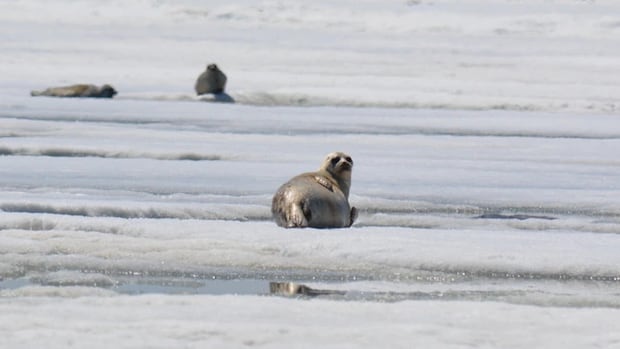
Listen to this articleEstimated 4 minutesThe audio version of this article is generated by AI-based technology. Mispronunciations can occur. We are working with our partners to continually review and improve the results.Ringed seals in Hudson Bay are willing to risk life and limb — even becoming food themselves — if a certain area offers them a particularly diversified menu. That’s according to a study recently published in the journal Ecology Letters, looking at the predator-prey relationship between the seals and polar bears. The researchers say that relationship should be taken into account when establishing marine protected areas. While the seals generally avoid areas with lurking polar bears, the study says they could be willing to risk higher predation levels for especially abundant food sources. “We were interested to see how seals manage finding food and not becoming food,” says Katie Florko, a research scientist at the University of British Columbia and the study’s lead author. “What we found was really interesting, that seals were entering high-risk areas when there was really plentiful fish or really diverse fish. And so we found this trade-off where they would take on a bit more risk if there was really good reward.”An aerial view of ringed seals on sea ice in Hudson Bay. (Submitted by Katie Florko)Researchers tagged 26 seals with satellite telemetry transmitters to follow their movement — including dives — near the Belcher Islands in Nunavut, in southeast Hudson Bay. The scientists also attached GPS collars to 39 polar bears in the area and tracked them over three years. The collars provided researchers with more than 18,000 locations, allowing them to model the bear’s range and determine zones with a higher predation risk for seals. “We found that ringed seals dove for a shorter duration when in high-risk areas ... perhaps to allow for time to return to an alternative breathing hole or haul-out lair if they detected a polar bear,” the study reads. GPS collars allowed researchers to track the movement of 39 polar bears over 3 years. (Submitted by Katie Florko)Considering the 'fear' element The researchers say proper modelling is important to determine protected areas, and it should include consideration of both top-down and bottom-up processes — in this case, that means both the amount of food accessible to the seals and also the pressure from polar bears as predators. Not taking into account that “fear” element could lead to protecting areas that seals are already avoiding, says Marie Auger-Méthé, the study’s statistician. While the relationship between prey and predators has been studied for many species in other regions, Florko says that's not the case in the Arctic. But she says climate change could have substantial effects on those relationships as the Arctic is warming four times faster than the rest of the world. One example, she says, is a greater concentration of polar bears on smaller areas of pack ice; another is the changing distribution of various fish species in the region. Study a ‘good step’Brendan Kelly, chief scientist at the International Arctic Research Center at the University of Alaska Fairbanks, says the study is “a really good step towards having a more realistic representation of what might constrain the distribution of seals” but that he also has certain “quibbles.” One example is around the hypothesis that the seals come to the surface more slowly if they suspect a predator is nearby. Kelly has also done some work tracking ringed seals in other areas of the Arctic. Based on his field observations, he says seals are generally always cautious when surfacing.Researchers tracked the movement of 26 seals near the Belcher Islands, an archipelago in the southeast part of Hudson Bay. (Submitted by Marie Auger-Méthé)“Most often, they still can't tell if a bear or a biologist is waiting for them there because there's a layer of snow and ice floating on the surface of the breathing hole, and they can't see through that,” he said. “Polar bears try not to announce themselves. They don't put up signs saying, ‘Hey, we're hunting in this area,' right? … Mostly animals have to just assume the worst because their predator is always trying to fool them and surprise them.” He also cautions against interpreting the results too broadly without taking into account certain other factors that would influence seal movement, such as other predators, oxygen intake when diving, and other changes during the breeding season. Still, he said the research is valuable, even if it's not "going to turn into a management [strategy] tomorrow."