Michael Tilson Thomas, L.A.-born maestro who led San Francisco Symphony, dies at 81
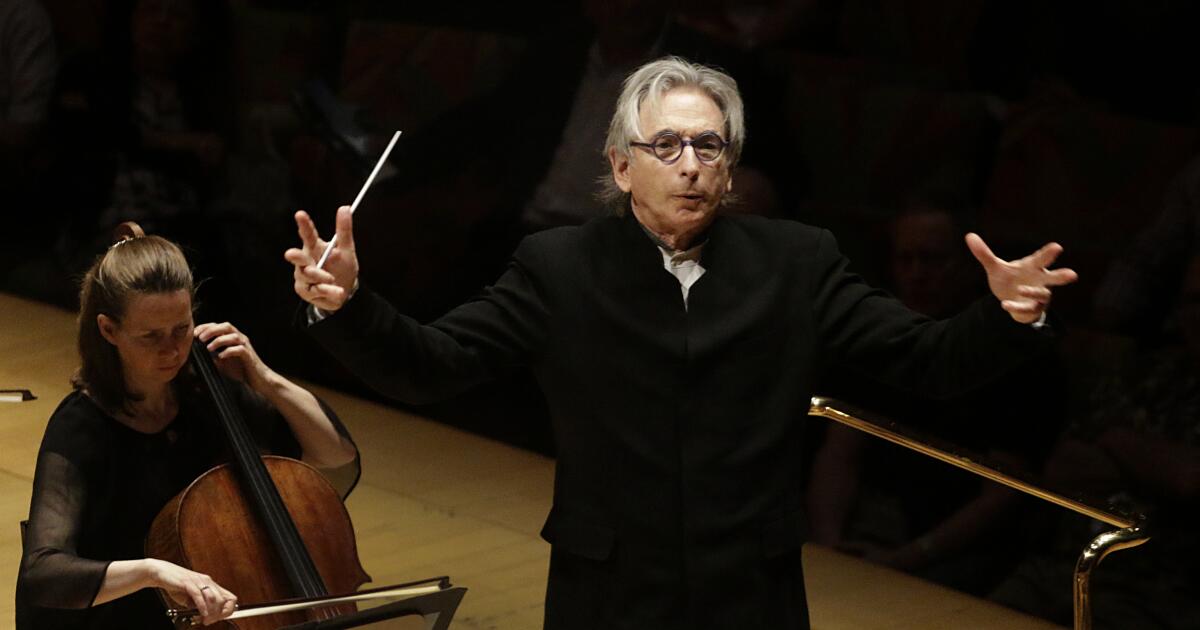
Grammy-winning conductor Michael Tilson Thomas, the bird-like maestro affectionately dubbed MTT and a “bad boy of classical music” while leading almost all of the major orchestras of the United States and Europe since his teen years, has died in his San Francisco home. Born in Los Angeles, the celebrity conductor and former child prodigy died Wednesday of glioblastoma, a representative for Tilson Thomas confirmed to The Times. He was 81.He had a brain tumor removed in 2021 and underwent months of therapy. He was met with rapturous standing ovations at the New York Philharmonic and San Francisco Symphony upon his return to the stage months later.Tilson Thomas’ illness seemed to inspire him to work more and travel regularly. In 2022, he conducted in Prague, Munich, London, New York, Miami, Cleveland, San Francisco and L.A. When Times classical music critic Mark Swed sat down for an interview with him in 2023, the critic noted that Tilson Thomas seemed as indefatigable as ever.Tilson Thomas told Swed that his doctors were “jubilant” after his most recent MRI. He had told them, “‘Yeah, I get it. In other words, I’m still dying. But not as quickly as you would originally suppose.’”“Well, in that case, I intend to make the most of it,” Tilson Thomas said.That led him, wrote Swed, “to begin trying to dig out his piles of unfinished pieces he has composed over the decades and see what he can do with them.”The 1960s wunderkind long served as the San Francisco Symphony’s music director and later the conductor laureate of the London Symphony Orchestra, leading the latter ensemble on regular tours in Europe, the U.S. and Japan, as well as the Salzburg Festival. He was also a guest conductor of the Los Angeles Philharmonic in the 1980s. In recent years, he had returned to the stage at Walt Disney Concert Hall to present pandemic-weary audiences with electrifying concerts of Sergei Prokofiev’s wartime Fifth Symphony, his own personal “Meditations on Rilke” and Alban Berg’s “Three Pieces for Orchestra,” among others.Swed captured the excitement his concerts brought to Angelenos in a January 2022 review, writing, “Word must have gotten out. Michael Tilson Thomas’ concerts with the Los Angeles Philharmonic are not to be missed. They are an inspiring study in resilience. But they are mainly essential for hearing great music.”The 2019 Kennedy Center honoree, a protege of the late Leonard Bernstein, was a gifted pianist known for his exuberant compositions and ability to break down musical genres, and in particular, his dynamic interpretations of Gustav Mahler. He also specialized in music from Russia and work by George Gershwin and his friend and colleague Aaron Copland. He could conduct Beethoven one moment and dance like James Brown in the next, according to a Times review. Tilson Thomas made a habit of imploring his orchestras and audience members to trust him and “come inside the music,” and his talents and charismatic personality attracted attention and praise worldwide.Sometimes moody and no stranger to tantrums, Tilson Thomas once stormed off the Hollywood Bowl stage to protest noise from a police helicopter — and won applause for the dramatic gesture. He reportedly tossed lozenges into the audience when a fit of coughing disrupted a performance with the Chicago Symphony Orchestra. He also once asked a mother to move midway through a New World Symphony orchestra concert in Florida, fearing the effect her restless child might have on the Adagio movement.The third-generation artist studied piano, conducting and composition at USC, and worked with Copland and Igor Stravinsky, quickly establishing himself as a boy wonder. He joked that he might have been the last czarist-trained musician to be doing Russian music (his teachers at USC included Jascha Heifetz and Gregor Piatigorsky). Tilson Thomas conducts a matinee concert with the Los Angeles Philharmonic at Walt Disney Concert Hall on Jan. 8, 2023. (Dania Maxwell / Los Angeles Times) A 12-time Grammy Award winner, Tilson Thomas remained an active composer throughout his career, creating major works such as “From the Diary of Anne Frank,” a UNICEF commission that premiered in 1991 and was narrated by Audrey Hepburn; and “Shówa/Shoáh,” inspired by the Heiwa No Kane bell, written in 1995 for the Pacific Music Festival Orchestra to commemorate the 50th anniversary of the Hiroshima bombing. Two years after his stint with the L.A. Phil, he co-founded and served as the artistic director of the New World Symphony, a postgraduate orchestral academy in Miami that prepares diverse young musicians for leadership roles in classical music.He became the San Francisco Symphony’s 11th music director in 1995, and his unprecedented 25-year tenure resulted in significant growth and international recognition for the ensemble. It also built a dynamic American base for the conductor, who was ultimately praised by his orchestra for his flexibility and experimentation, as well as innovative ways of making classical music more engaging for 21st century audiences.“When he arrived as music director at the San Francisco Symphony, shortly before turning 50, he was hailed as a new guy for a new era for an orchestra that seemed to have lost touch with the times and the Baghdad-by-the-Bay spirit of the city,” Swed wrote in 2019.The longevity of the appointment was one of his greatest satisfactions, he told the Guardian in 2012, before he was succeeded by Esa-Pekka Salonen.“It allows you the time to confirm beliefs that you have, to build audiences and encourage their adventurousness of spirit,” Tilson Thomas said. “And when it goes well, everyone co-mingles in such a way that you wonder who is actually making this wonderful music. It is as if it is just happening.”.”Tilson Thomas championed classical masters but also many contemporary American composers and transformed the orchestra’s annual Beethoven festival into an American Mavericks Festival featuring works of his mentors Bernstein and Copland. The first festival he helmed began with a headline-grabbing jam session by surviving members of the Grateful Dead.Soon after, Tilson Thomas led his new orchestra to a Grammy Award for their debut recording together of Prokofiev’s “Romeo and Juliet.”“Right place, right time,” the orchestra’s principal pianist, Robin Sutherland, said. “California boy gets a California band at a time when boy needs band and band needs boy.”He stepped down after the 2019-20 season and was named the organization’s music director laureate, but the COVID-19 pandemic snuffed out the ambitious celebrations that were to mark his triumphs. Still, despite the subdued send-off, his tenure was regarded “as one of the most successful and sustained partnerships between an orchestra and a music director that the American symphonic landscape has yet seen,” the San Francisco Chronicle said.“I’m happiest when I feel the music gets to a place where no one is really quite sure who is making the music. It just seems to be happening wonderfully, miraculously, rather than as a result of someone who’s saying, ‘Follow me,’” he told the newspaper. Michael Tilson Thomas, conductor and musical director of the San Francisco Symphony, after a practice in Davies Symphony Hall in February 2000. (Robert Durell / Los Angeles Times) Tilson Thomas said that the key to understanding him was understanding his extraordinary ancestry. His family hailed from Ukraine, where generations of Thomashefsky men were celebrated cantors — masters of the sacred songs expressing love to God. His grandparents, Boris and Bessie Thomashefsky, were founding members of the Yiddish Theater in America. His grandfather died before he was born, but his grandmother lived nearby and visited often.His father, Theodor Thomashefsky, began in New York theater at the Mercury Theatrecompany but found the family legacy too much, shortened his name to Ted Thomas and fled west. He wound up working on Roy Rogers cowboy serials and became fascinated by the Mojave Desert, where the serials were filmed. His mother, Roberta Thomas, was the head of research for Columbia Pictures and hoped her son would be anything but a performer.“I think a lot about what was obsessing them,” he told The Times in 2000, “what they were pursuing, what were their demons.” Tilson Thomas was born Dec. 21, 1944, and grew up in the San Fernando Valley. He was plunked before a piano at age 3 and could play by ear by 5. In grade school, he was aloof and preferred the company of musical scores. At 10, he studied under Dorothy Bishop at USC Prep and learned how an instrument could become an extension of a person. He donned his first tuxedo, which he inherited from his grandmother’s costume trunk, at 12, then had a musical epiphany at 13 when he listened to Mahler. By 19, he was named music director of L.A.’s Young Musicians Foundation Debut Orchestra and conducted the group — and soon, the full Los Angeles Philharmonic for youth concerts. At USC, he was the pianist and conductor in Piatigorsky and Heifetz’s master classes. He also worked with Stravinsky, Boulez, Stockhausen and Copland on premieres of their compositions at L.A.’s Monday Evening Concerts, according to his website. Tilson Thomas conducts the L.A. Phil in Mahler’s Second Symphony on July 9, 2013, at the Hollywood Bowl. (Lawrence K. Ho / Los Angeles Times) In 1968, he met Bernstein, the “West Side Story” composer hailed as the 20th century’s most successful American-born orchestra leader. “He reminds me of me at that age except that he knows more,” Bernstein said of Tilson Thomas. The two began working together in New York in the 1970s and Tilson Thomas inherited Bernstein’s broadcasts of the Young People’s Concerts. However, many thought Tilson Thomas too brash and arrogant to lead an orchestra, and, around the same time, Tilson Thomas fell in with New York’s disco-hopping crowd. In his mid-20s, he became assistant conductor — and later principal guest conductor — of the Boston Symphony Orchestra, and the “next Bernstein” talk began immediately. He was an instant sensation after making his New York debut at the Lincoln Center, filling in for conductor William Steinberg, who fell ill midway through the concert.“It was the same Hollywood scenario that had thrust Bernstein to prominence with the New York Philharmonic a quarter-century before. Both were of Russian-Jewish stock, pianists, uninhibited performers and gay, even if neither of them advertised that in those times,” The Times noted. Bernstein urged the Boston Symphony to name the 24-year-old Tilson Thomas its principal conductor but the musicians resisted, believing he was too immature. They threatened to revolt if he was appointed. So he took on his first musical directorship with the Buffalo Philharmonic in 1971 before making his way back to L.A. and later San Francisco.In 1985, the Los Angeles Philharmonic let his contract as principal guest conductor and artistic director of the summer training institute expire for less-than-diplomatic relations with management. Tilson Thomas insisted that his essential ambitions remained the same, whether he was behind the podium, in studio, on TV or online.“The most important thing about music is what happens when it stops, what remains with the listener, what they take away,” he told the Guardian in 2012. “A melody, rhythm, some understanding of another person or another culture. The way those experiences add up, in the soul of a person over the years, is the biggest prize classical music possesses.”It was Tilson Thomas’ ability to connect with audiences — of all kinds — drawing them in and encouraging them to really listen to the music, that made his musical acumen so much more rich and delightful to behold. “As a performer, it’s not only the shape of the music and the idea of the music or the message of the music — of course, that’s the main thing — which I’m interested in, but I’m also interested in music from the standpoint of what it means to the people, bless their hearts, who are actually playing it. And how to make it a more joyous and engaging experience for them, because that, of course, is going to change the whole meaning of it for the audience immediately,” Tilson Thomas said in his last interview with Swed.For the record:An earlier version of this story incorrectly reported that Tilson Thomas was survived by his husband, Joshua Robison. Robison died two months ago. Joshua Robison, Tilson Thomas’ longtime husband who also served as his manager and strategic partner, died Feb. 22. Over the course of a relationship that lasted nearly 50 years, Robison carefully shepherded his famous husband’s career, paying close attention to his particular strengths and helping him forge a path of expansive civic engagement and institutional collaboration.