


More than a century after combustion-engine motorcycles came to dominate the narrative of performance, the wave of electrification has finally begun to knock seriously on this door. The Senmenti ONE, launched by Horwin, is a product that attempts to answer head-on the question of "whether an electric motorcycle can be fast yet stable, brutal yet reliable." 0–100 km/h in 3.3 seconds, a top speed of 200 km/h, peak power of 74 kW, maximum torque of 894 N·m, a 16.9 kWh battery, and 300 km of combined city range—judged on these numbers alone, it already stands in the first tier of electric motorcycles. But specs are only the result; what is truly worth discussing is the platform, thermal management, energy algorithms, and overall vehicle setup behind these figures. Below, I will break down this spec sheet from six dimensions: performance, the three-electric system, thermal management, smart interaction, chassis and safety, and use scenarios.
Performance: 0–100 km/h in 3.3 Seconds, Top Speed 200 km/h
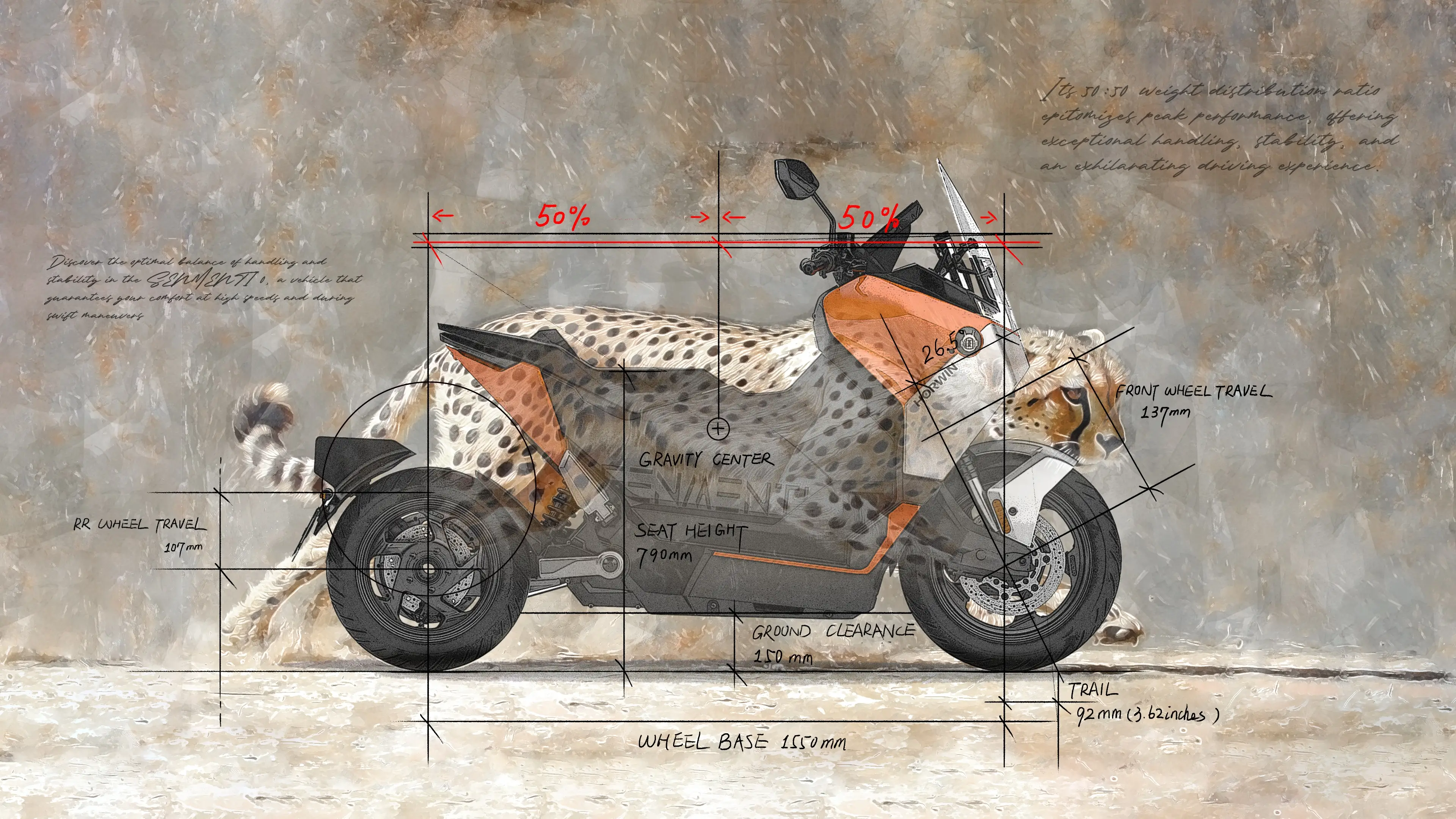
The most eye-catching aspect of the Senmenti ONE is undoubtedly its power metrics. A 0–100 km/h acceleration time of 3.3 seconds already places it in the "supercar class" of the two-wheeled world—many liter-class combustion-engine street bikes are also just over 3 seconds, and electric motorcycles, thanks to the instantaneous torque output characteristics of electric motors, often have an edge in the launch phase. The claimed top speed of 200 km/h (124 mph) shows that its power platform is not merely a "sprinter" for urban commuting but is configured with sustained high-speed capability.
Even more noteworthy is the torque figure: a maximum torque of 894 N·m. Whether this value is wheel torque or motor output torque is not specified in the spec sheet, but either way, the signal it conveys is clear—the acceleration feel of this bike will be at the "push-you-back-in-your-seat" level. Combined with the settings of 74 kW (about 100.6 hp) peak power and 35 kW (47.6 hp) continuous rated power, it is clear that Horwin has drawn a clear distinction between "peak burst" and "continuous output": peak handles acceleration and overtaking, while continuous power handles thermal stability and durability during high-speed cruising. This dual specification of "peak/continuous" is precisely what electric vehicles need to explain more clearly than combustion vehicles, because the shortcoming of electric motors has never been burst output, but rather sustained output.
Three-Electric Platform: The World's First 400V Triple Electric Integrated Power Platform
The Senmenti ONE is equipped with what Horwin claims is the "world's first 400V triple electric integrated power platform." The 400V voltage platform is already mainstream in the electric car field, but it remains a high specification on a two-wheeled motorcycle—higher voltage means lower current at the same power, lower wiring losses, and easier implementation of fast charging. The battery capacity is 16.9 kWh, and the official range figures are 300 km combined city, 210 km suburban, and 115 km highway.
Here one must objectively note: 300 km is experimental data under urban conditions, and 115 km on the highway is the real Achilles' heel of this class of high-performance electric motorcycle. A 16.9 kWh battery pack driving a 285 kg bike with 74 kW peak power will see aerodynamic drag and continuous power demand rapidly drain the battery during high-speed cruising. So the positioning of this bike is clear—it is a "performance toy for the city and nearby suburbs plus a commuter tool," not a long-distance touring bike. Fortunately, the charging segment makes up for some of this: DC fast charging (CCS2 interface) can go from 20% to 80% in about 30 minutes. This replenishment efficiency is already close to the refueling rhythm of a combustion vehicle, and it is also the confidence behind Horwin's repeated emphasis in its promotional materials that "energy replenishment efficiency is close to that of fuel vehicles." The spec sheet also mentions compatibility with national-standard DC, EU CCS2, and North American CCS1/NACS (to be launched later) interfaces, indicating that this is a product planned for the global market.
The drive format uses GATES belt transmission, which is very common on electric motorcycles—quiet, maintenance-free, and smooth, matching the characteristics of electric motors well. The motor is a center permanent-magnet liquid-cooled synchronous motor (Center PMLSM); the liquid-cooled design itself serves continuous power output and echoes the 35 kW continuous rated power mentioned earlier.
Thermal Management: "5+3+3" Multi-Channel and 12 Smart Cooling Modes
The real threshold for electric performance vehicles is not "how fast it can go" but "how long it can go without degradation." The solution offered by the Senmenti ONE in this regard is Horwin's pioneering "5+3+3" multi-channel thermal management system, which adopts air-liquid hybrid multi-modal integrated cooling. Horwin states that it is equipped with a kilowatt-level heat dissipation device, driven by intelligent interactive control algorithms for air cooling and water cooling, with coolant covering every battery cell.
This system, combined with 12 smart cooling modes, has a straightforward goal: to keep the battery and motor within the optimal temperature range during aggressive riding, thereby preserving continuous power output. For a bike with a claimed 200 km/h top speed and 35 kW continuous power, thermal management is not the icing on the cake but the prerequisite for whether the performance promise can be delivered. Many electric motorcycles have astonishing acceleration on paper, but after several consecutive full-throttle runs they enter power limitation—essentially because thermal management cannot keep up. Horwin has singled out thermal management for extensive discussion, showing that they are clear that this bike's selling point must be built on "persistent performance."
Energy Algorithms and Riding Modes: The ENCA Platform + Four Modes
In terms of energy management, the Senmenti ONE is equipped with the ENCA (Energy Network Collaborative Algorithm) platform, designed to monitor energy flow among the GCU (vehicle control unit), BMS (battery management system), and EDS (electric drive system) systems, and to allocate output according to riding needs through adaptive power algorithms, achieving seamless switching between modes.
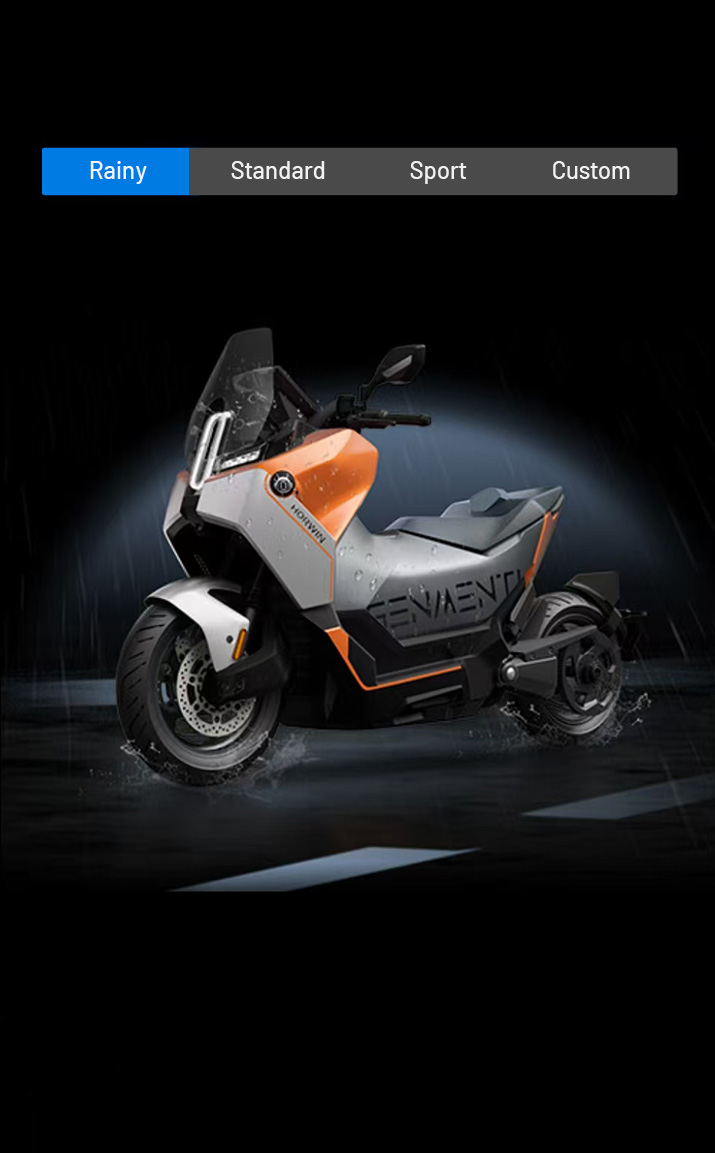
For the user, this translates into four riding modes: Standard, Sport, Rainy, and Custom. The Custom mode allows riders to freely adjust throttle response, acceleration and deceleration characteristics, top speed limit, and ABS intervention level—this deserves recognition, as it hands part of the "electronic control tuning authority" to the user, increasing both playability and accommodating riders of different experience levels. The Rainy mode converges torque output on slippery surfaces, a pragmatic safety configuration.
In terms of ergonomics, extended handlebar grips accommodate riders of different body types worldwide, and the extra-long seat plus coccyx support are officially stated to accommodate a wide range of riding positions. Such details show that Horwin has not made the Senmenti ONE a pure "straight-line acceleration machine" but has attempted to balance cruising comfort—after all, the dimensions of a 795 mm seat height, 1550 mm wheelbase, and 2195 mm vehicle length are themselves the proportions of a cruiser.
Chassis, Braking, and Smart Interaction
On the braking side, dual disc brakes combined with electric assisted braking (EAB) provide a deceleration feel similar to engine braking, and the latest Bosch 10.3ME ABS ensures stability during emergency braking, along with eTCS traction control. For torque output at the 894 N·m level, the importance of traction control and ABS intervention logic is no less than that of the brake hardware itself; this combination is a mainstream high-end configuration among current electric motorcycles.
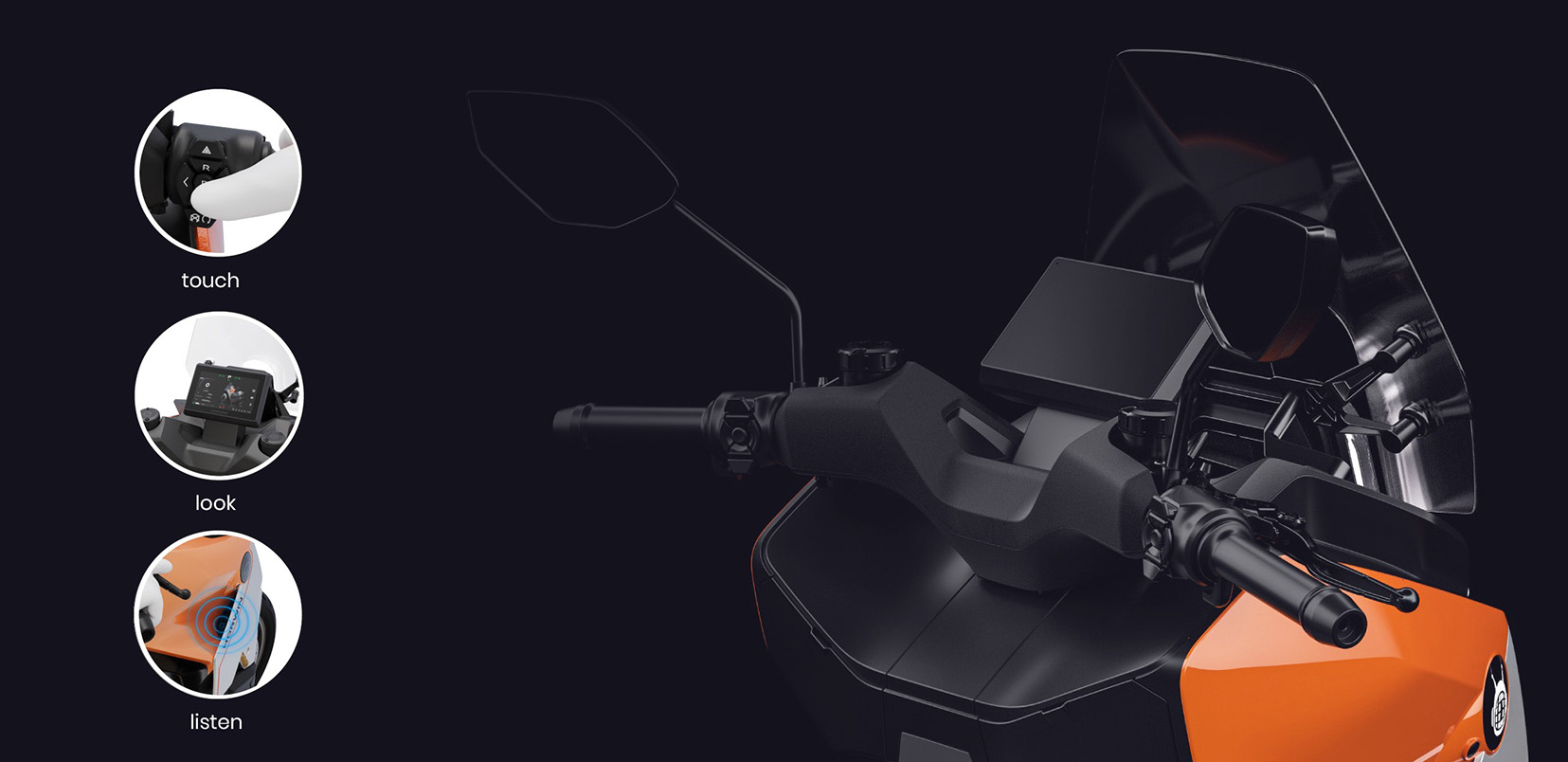
Smart interaction is another main thread. The HORWIN OS+ multimodal interaction system is based on research into motorcycle users' usage scenarios, providing multimodal interaction capabilities including physical buttons, tactile control, acoustics, and voice, emphasizing interconnectivity among people, vehicles, and terminals. A 7-inch TFT color display serves as the instrument panel, and with keyless digital key (APP/NFC/Bluetooth unlocking), handlebar heating, saddle heating, front windshield, cruise control, and other features, both comfort and tech feel are maxed out. Charging interfaces provide 7.5W USB+Type-A and 18W USB+Type-C, with everyday practicality in place.
The HORWIN APP completes the remote capabilities: remote monitoring and control (viewing vehicle information and battery status), finding your motorcycle, anti-theft alarm (including virtual fences), pre-heating, key sharing, OTA dashcam video transfer, and driving records and history. These functions are no longer novel in the electric two-wheeler space, but the completeness of integration is at the upper level.
Beyond the Specs: A Few Points to View Calmly
First, the range basis. 300 km is experimental data under combined city conditions, and the official footnote explicitly states that actual range is affected by factors such as ambient temperature, vehicle status, and driving habits. The highway figure of 115 km reminds us that this bike's long-distance capability is limited, and fast-charging network coverage is the key to whether it can "leave the city."
Second, the 285 kg curb weight. This weight is at the upper-middle level among electric motorcycles; low-speed maneuvering and U-turns on the spot require some physical effort, but combined with the 1550 mm wheelbase and 150 mm minimum ground clearance, high-speed stability should be guaranteed.
Third, the "testing phase" nature of the spec sheet. The official statement explicitly notes: vehicle images are from the testing phase, software interfaces and function displays are for reference only, some functions need to be obtained via OTA, and specific configurations are subject to the actual delivered vehicle. This means that the final form of some of the above functions (especially OTA-related ones and the APP ecosystem) still needs to be based on mass-production delivery.
Fourth, regarding expressions such as "world's first" and "industry first," these are manufacturer promotional language; readers can understand them as "differentiated attempts in technical routes" rather than independently verifiable industry conclusions.
Conclusion
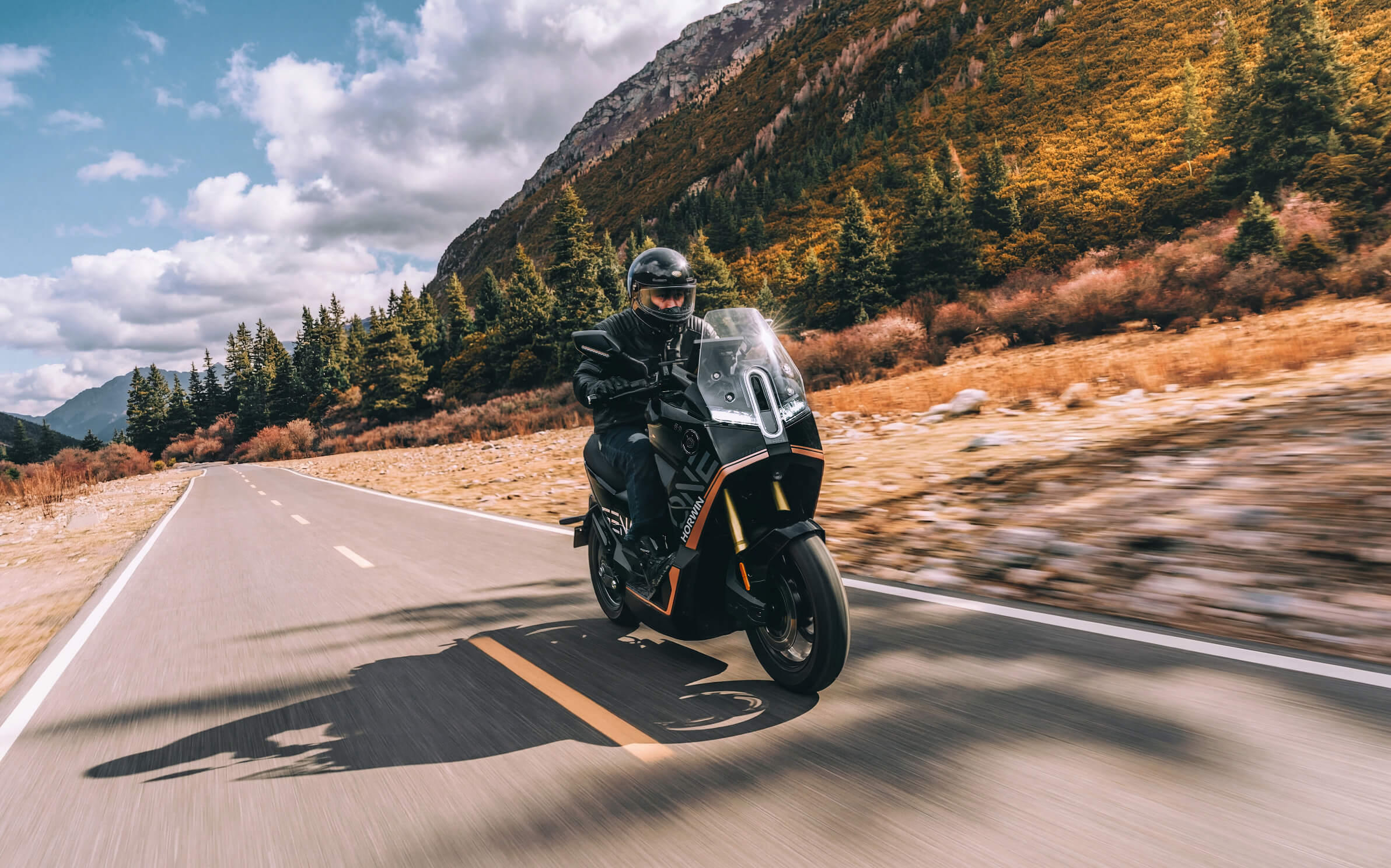
Placing the Senmenti ONE back in the market coordinate system, its product logic is actually quite clear: use the 400V three-electric platform and liquid-cooled center motor to support the power foundation of 74 kW peak and 35 kW continuous, use the "5+3+3" thermal management and ENCA algorithm to deliver on the promise of "persistent performance," and then use Bosch ABS, eTCS, four riding modes, multimodal interaction, and the APP ecosystem to complete intelligence and safety. 3.3 seconds to 100 km/h and a 200 km/h top speed are its calling card, 300 km city range and 30-minute fast charging are its daily confidence, while 115 km highway range and 285 kg weight are the physical realities it must face.
The performance ceiling of electric motorcycles is being continuously pushed higher, and the Senmenti ONE is one of the most aggressive products in terms of specs in this wave. But whether it can ultimately win over the public does not depend on the numbers at the launch event, but on the thermal degradation performance after mass-production delivery, the actual experience of the fast-charging network, and whether that "5+3+3" thermal management system truly "Keeps Calm And Carries On" during continuous aggressive riding in midsummer. The specs are already impressive enough; next, it is time to see the engineering execution.

Comments (2)