


For hotels competing for travelers in the U.S. market, visibility on Google can directly influence whether a guest books with you or an OTA. A traveler searching for a hotel in New York, Miami, Chicago, Las Vegas, or any other destination may encounter your property through Google Search, Google Maps, and Google’s hotel search experience before ever visiting an online travel agency.
That makes Google My Business for hotels an important part of a modern hotel marketing strategy.
Google now refers to Google My Business as Google Business Profile. Still, the goal remains the same: give travelers accurate information about your property, build trust through reviews and photos, and make it easy for them to visit your website and book directly.
For hoteliers using technology such as Ease My Hotel, an optimized profile can become an important part of a broader direct booking strategy, connecting Google visibility with your website, booking engine, rates, availability, and guest experience.
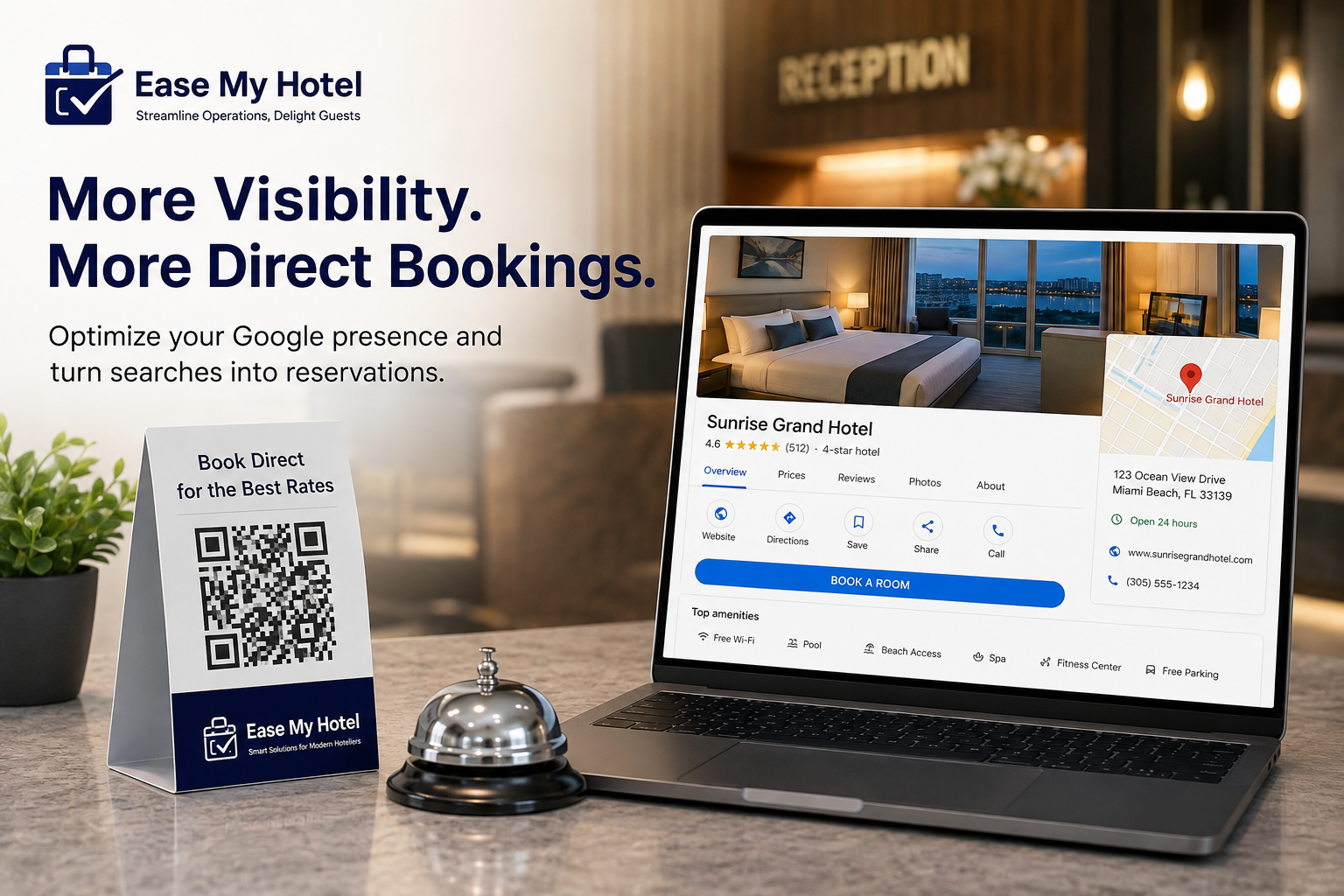
Why Google Business Profile Matters for Hotels
Your hotel’s Google presence is often one of the first places a potential guest evaluates your property.
When travelers search for a specific hotel or accommodations in a destination, Google can display information such as your address, website, photos, amenities, reviews, and booking options. Hotel results can also allow travelers to compare prices and access booking links.
This makes your profile more than a digital business card.
It functions as a hotel discovery channel, a trust-building asset, and a potential pathway to direct hotel bookings.
For example, imagine someone searches for “boutique hotels in Austin.” They may compare properties based on location, ratings, photos, amenities, and prices. A complete and attractive profile gives your hotel more opportunities to stand out during that decision-making process.
Google also states that hotel search rankings consider factors such as relevance, location, price, ratings, and reviews.
1. Claim and Verify Your Hotel Profile
The first step in optimizing Google My Business for hotels is making sure your property has a claimed and verified Google Business Profile.
Verification gives hotel owners greater control over important property information. Google specifically recommends keeping hotel details accurate and up to date, including amenities and other profile information.
Check that your:
- Hotel name is accurate
- Address is correct
- Website URL leads to your official hotel website
- Phone number is current
- Hotel category is appropriate
- Amenities are accurately represented
- Photos reflect the current property
- hotel information matches your website and other major platforms
Consistency matters because travelers expect the information they see on Google to match what they encounter when they visit your website.
An outdated phone number or incorrect amenity can quickly damage trust.
2. Optimize Your Hotel Description for Travelers
Your profile description should communicate what makes your property worth booking.
Instead of stuffing the description with keywords, focus on natural language that explains your location, property type, guest experience, and most valuable amenities.
For example, a hotel might naturally describe itself as a downtown property offering convenient access to restaurants, attractions, business districts, and transportation.
Use relevant hotel SEO keywords naturally when appropriate, including phrases related to your destination, property type, and guest needs.
Think about the language your customers actually use:
hotels near downtown, pet-friendly hotels, business hotels, family-friendly accommodations, luxury hotel, boutique hotel, or hotels near local attractions.
The goal is not to repeat these phrases endlessly. The goal is to make your profile useful to people who are genuinely looking for your type of property.
3. Make Your Hotel Photos Sell the Experience
A traveler cannot physically inspect your property before booking, so photographs have an important role in the hotel booking journey.
Upload high-quality images that show the experience guests can expect.
Consider including:
- Exterior and entrance
- Lobby
- Guest rooms
- Bathrooms
- Beds and room layouts
- Pool
- Fitness center
- Restaurant
- Meeting spaces
- Views
- Parking
- Nearby attractions
Your hotel photography should be current, realistic, and professionally presented.
Avoid relying exclusively on generic stock photography. Travelers want to see the actual property.
Think beyond simply showing rooms. Your images should answer the question: “What will staying here feel like?”
That can make your hotel listing optimization much more persuasive.
4. Highlight Amenities That Influence Booking Decisions
Amenities can become deciding factors when travelers compare hotels.
Google allows verified hotel profiles to manage hotel amenities and attributes through the Business Profile interface. Hotel highlights can also communicate features such as pet-friendly policies, free Wi-Fi, and free parking.
Make sure your property accurately communicates relevant amenities such as:
free Wi-Fi, free parking, pet-friendly rooms, breakfast, pool, fitness center, airport shuttle, EV charging, and accessible rooms.
Never add an amenity simply because competitors have it.
Accuracy is essential. A guest who books expecting free parking and discovers a paid parking policy may leave a negative review, damaging your hotel reputation management efforts.
5. Turn Reviews Into a Direct Booking Advantage
Reviews are one of the strongest trust signals available to a hotel.
A traveler comparing two properties may choose the hotel with stronger recent reviews even if the room rates are similar.
Create a simple system for requesting reviews after checkout. Your front desk, post-stay email campaigns, and guest communication strategy can all encourage satisfied customers to share genuine feedback.
When guests leave reviews, respond professionally.
Thank guests for positive feedback and address legitimate complaints constructively. Avoid argumentative responses.
A strong review profile can support local hotel SEO, improve credibility, and give potential guests confidence before they click your booking link.
6. Connect Google Visibility With Your Direct Booking Engine
Getting travelers to discover your hotel is only half the job.
The next step is making the booking process simple.
Your hotel booking engine should provide a fast, mobile-friendly path from discovery to reservation.
Google's hotel ecosystem can display booking links that take travelers to a website where they complete their reservation. Free booking links can also appear across Google's hotel search experiences when a property and its booking partner meet the relevant requirements.
This creates an important opportunity for hotels that want to reduce dependence on OTAs.
Your ideal path looks something like:
Google Search → Hotel Profile → Hotel Website → Booking Engine → Direct Reservation
Every additional step creates another opportunity for the traveler to abandon the booking.
That is why your direct booking engine should be fast, intuitive, secure, and easy to use on smartphones.
7. Keep Your Rates and Availability Accurate
A beautiful Google profile will not compensate for inaccurate pricing.
If a traveler sees one price on Google and a different price after clicking through to your website, confidence can disappear quickly.
Google recommends that hotel partners provide accurate prices, keep pricing information updated, and ensure that prices shown in feeds match the landing page experience.
For hotel operators, this makes hotel rate management, room availability, and real-time pricing extremely important.
This is where integrated hotel technology can make a difference.
Ease My Hotel helps hotels manage core operations through an integrated technology environment, giving hoteliers the tools to streamline reservations, distribution, and day-to-day hotel management.
8. Optimize the Booking Experience for Mobile Users
A significant portion of hotel research happens on smartphones.
A traveler might discover your property while commuting, exploring a destination, or planning a trip from a coffee shop. If your website takes too long to load or your booking engine is difficult to navigate on a small screen, that traveler can easily move to another property.
Your mobile hotel booking experience should make essential information immediately accessible.
Display:
- Room availability
- Rates
- Dates
- Cancellation policies
- Taxes and fees
- Room descriptions
- Payment options
- Contact information
Do not force customers through unnecessary pages.
The smoother the experience, the easier it is to convert hotel website traffic into direct reservations.
9. Use Google as Part of a Larger Hotel SEO Strategy
Google Business Profile should not operate in isolation.
Combine it with local SEO for hotels, an optimized website, content marketing, technical SEO, reputation management, and a strong booking engine.
Your hotel website should have dedicated pages and useful content around relevant traveler searches.
For example, a hotel in San Diego might create useful content around:
hotels near San Diego attractions, places to stay near downtown San Diego, San Diego business travel, and family-friendly hotels in San Diego.
This approach helps your property build visibility across different stages of the traveler's research process.
10. Track What Actually Produces Bookings
Optimization becomes much more effective when you measure results.
Monitor metrics such as:
- Google profile interactions
- Website clicks
- Phone calls
- Direction requests
- Booking engine visits
- Direct booking conversion rate
- Revenue from direct bookings
- Average booking value
- Cancellation rate
- hotel website conversion rate
- returning guest bookings
The objective is not simply to receive more profile views.
The objective is to generate profitable reservations.
A hotel may receive thousands of impressions but relatively few bookings if the website, rates, reviews, or booking process are weak.
A Practical Google Business Profile Checklist for Hotels
Before considering your profile optimized, make sure you have:
✓ Claimed and verified Google Business Profile
✓ Accurate hotel name, address, phone, and website
✓ Updated hotel amenities
✓ Professional and current hotel photos
✓ Strong, recent guest reviews
✓ Consistent review responses
✓ Accurate room rates and availability
✓ Functional direct booking links
✓ Mobile-friendly booking engine
✓ Clear cancellation and payment information
✓ Tracking for website and booking performance
Turn Google Searches Into More Direct Reservations
The modern hotel guest often researches before booking. Google can play a major role in that research by bringing together property information, reviews, photos, location details, prices, and booking options.
That is why Google My Business for hotels should be treated as part of your revenue-generating digital ecosystem—not simply a profile that you set up once and forget.
The strongest strategy connects Google Business Profile optimization, hotel SEO, online reputation, hotel rate management, direct booking technology, and guest experience.
For hotels looking to reduce OTA dependence and build a stronger direct-sales channel, the combination of Google visibility and a reliable hotel technology platform can create a more efficient path from search to reservation.
With the right strategy and technology from Ease My Hotel, your hotel can turn more Google searches into qualified website visitors, more direct booking opportunities, and ultimately more valuable guest relationships.
Comments (0)