


For hotels competing for attention online, appearing when travelers search for accommodation nearby can make the difference between an empty room and a confirmed reservation. This is where Google My Business for hotels becomes a powerful part of your digital marketing strategy.
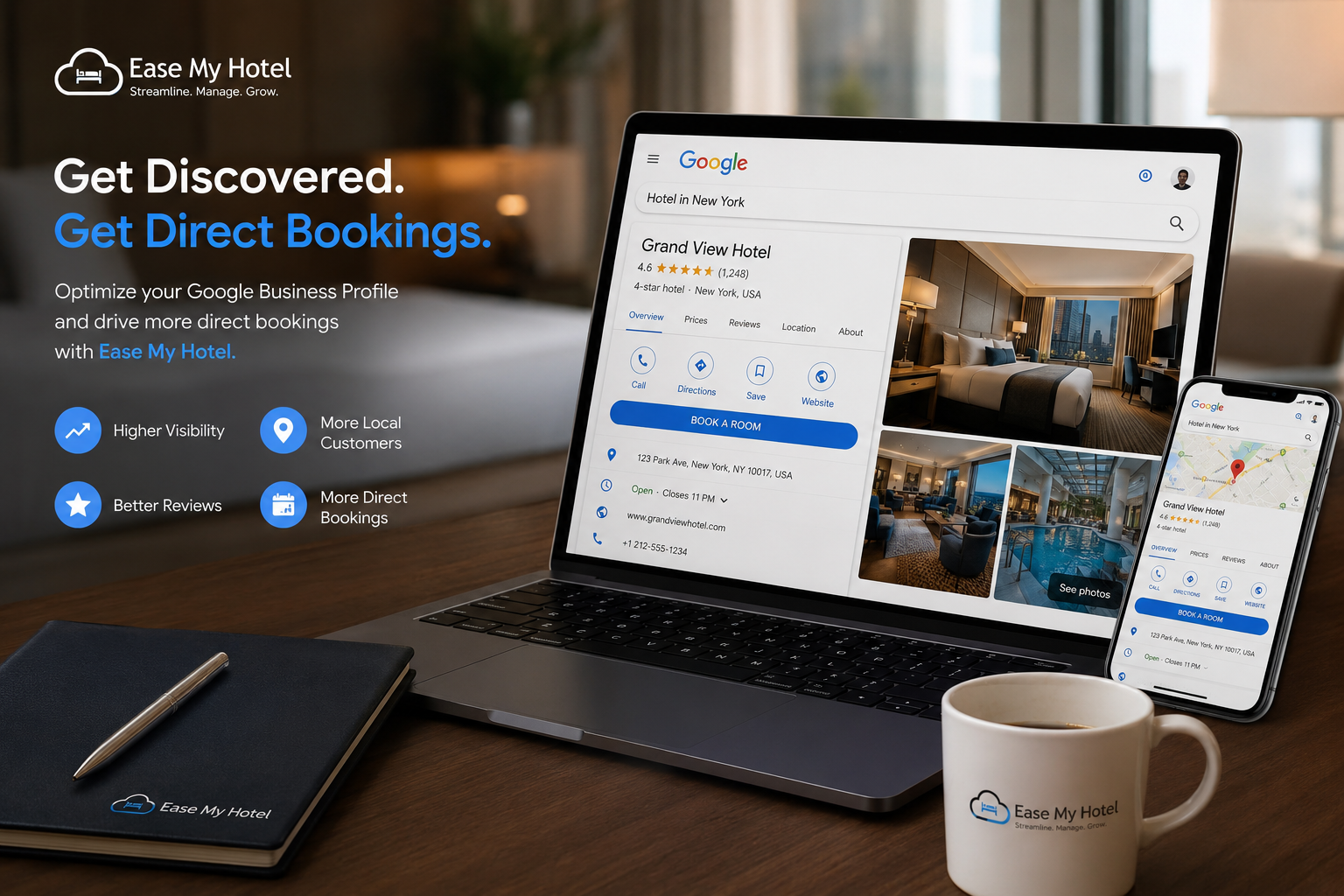
Today, Google Business Profile helps hotels manage how their property appears across Google Search and Google Maps. A well-optimized profile can showcase your hotel information, guest reviews, hotel amenities, photos, location, and booking options while helping potential guests move from discovery to reservation.
For hotel owners and managers looking to increase direct hotel bookings, reduce dependence on OTAs, and improve local SEO for hotels, optimizing your Google presence should be a priority.
With a connected hotel management platform such as Ease My Hotel, hotels can also streamline the operational side of reservations, availability, and guest management while focusing on generating more direct demand.
What Is Google My Business for Hotels?
Google My Business, now known as Google Business Profile, is Google's platform for managing a business's presence on Search and Maps.
For hotels, the profile can display essential information such as:
- Hotel name and address
- Website
- Phone number
- Photos
- Hotel reviews
- Guest ratings
- Hotel amenities
- Property highlights
- Location and directions
- Booking and pricing information
Google specifically provides hotel-focused Business Profile features, including the ability to manage amenities, attributes, hotel highlights, class ratings, and booking information.
For a traveler searching for a hotel near me, this information can provide an immediate snapshot of your property before they ever visit your website.
Why Google Business Profile Matters for Hotel Marketing
A strong Google profile does more than provide directions. It can become an important part of your hotel marketing strategy.
Imagine a traveler searches for “best hotels near city center.” They may compare several properties based on hotel ratings, photos, location, amenities, reviews, and available rates.
If your hotel profile is complete and attractive, you have an opportunity to capture that traveler at a high-intent stage.
This makes Google Maps marketing, local hotel search, and hotel SEO particularly valuable for properties targeting travelers who are ready to compare and book.
Google also provides hotel-specific booking information and performance data. Hotel profiles can show booking links, while hotel performance reporting can include booking-link clicks.
How to Optimize Google My Business for Hotels
1. Claim and Verify Your Hotel Profile
The first step is to claim and verify your official hotel Business Profile.
Google recommends creating or claiming the profile, selecting an appropriate business category, and completing the verification process.
Make sure your hotel name, address, website, and contact details are accurate and consistent with your official website.
Avoid adding unnecessary keywords to your business name. Instead, use your actual property name consistently across your website and online listings.
2. Complete Every Important Hotel Detail
An incomplete profile can make your hotel look less trustworthy.
Provide accurate information about your hotel location, services, amenities, property type, and other relevant details.
Google allows verified hotels to manage attributes through the Hotel Details section. Hotel highlights may also display features such as free Wi-Fi, free parking, and pet-friendly facilities.
Think from the traveler's perspective.
If someone is comparing your property with competitors, information such as free Wi-Fi, parking availability, breakfast, pet-friendly accommodation, swimming pool, or airport access can influence the booking decision.
3. Use High-Quality Hotel Photography
Your photos are one of the most important elements of your hotel listing optimization strategy.
Upload clear, professional images that accurately represent the property.
Consider including:
- Exterior photographs
- Hotel rooms
- Bathrooms
- Lobby
- Restaurant
- Pool
- Fitness center
- Conference facilities
- Views
- Nearby attractions
Your primary images should immediately communicate the quality and personality of your property.
High-quality hotel photos can strengthen first impressions and help travelers understand what they can expect before visiting your website.
4. Build a Strong Hotel Review Strategy
Reviews are critical to hotel reputation management.
Travelers frequently compare hotels based on guest experiences, ratings, and recent feedback. Encourage genuine guests to leave honest reviews after their stay.
However, don't stop at collecting reviews.
Respond professionally to both positive and negative feedback. Thank guests for positive experiences and address legitimate complaints constructively.
A thoughtful review response demonstrates that your hotel values guest satisfaction and actively listens to customers.
Never purchase fake reviews or manipulate ratings. Long-term trust is more valuable than a temporary increase in review volume.
5. Add a Direct Booking Path
One of the biggest opportunities with Google My Business for hotels is connecting travelers with a path to reservation.
Google's hotel ecosystem can display hotel booking links, rates, and availability. Free booking links can direct travelers to the hotel's website to book directly.
This is particularly important for hotels trying to increase direct reservations.
Instead of sending every potential guest to an OTA, your Google presence can help move qualified travelers toward your own booking engine.
Google states that hotel booking links can take travelers to a landing page where they can book the selected property, while free booking links can appear without a click charge.
Your hotel booking engine should therefore be fast, mobile-friendly, easy to understand, and capable of showing accurate room availability.
6. Keep Rates and Availability Accurate
Nothing damages booking confidence faster than inaccurate pricing.
If a traveler clicks through expecting one price but sees another price on your website, they may abandon the reservation.
Google explains that hotel rates and availability can be connected through Hotel Center and an appropriate integration partner. Since July 30, 2025, Google has required hotels to work with a partner for displaying rates through the relevant hotel rate systems.
This makes accurate hotel rate management, room availability, and booking data synchronization essential.
A hotel technology platform such as Ease My Hotel can help properties manage core hotel operations while supporting a smoother reservation workflow.
7. Optimize for Local Hotel Searches
Your profile should support the broader local SEO strategy for your hotel.
Think about the searches your target guests are likely to make:
- Hotels near me
- Hotels near airport
- Hotels near [landmark]
- Best hotels in [city]
- Luxury hotels in [city]
- Budget hotels in [city]
- Business hotels in [city]
- Family-friendly hotels in [city]
You should not stuff these phrases unnaturally into your profile. Instead, build a consistent online presence around your location, services, website content, reviews, and relevant hotel information.
Your website should also contain useful local landing pages, destination content, and location-specific information that supports your overall hotel search visibility.
Turn Google Searches Into Direct Hotel Bookings
Visibility is only the first step.
The real commercial objective is converting searchers into paying guests.
A successful hotel direct booking strategy connects your Google presence to a strong booking experience.
The process can look like this:
Google Search → Hotel Profile → Reviews & Photos → Rates → Hotel Website → Booking Engine → Direct Reservation
Every stage matters.
If your Google profile looks excellent but your website is slow, travelers may leave.
If your website is attractive but rates are unavailable, the traveler may choose a competitor.
If your rates are competitive but your reviews are poor, the traveler may hesitate.
This is why hotels should treat Google optimization, website performance, reputation management, and hotel technology as one connected system.
Common Google My Business Mistakes Hotels Should Avoid
Even established properties make mistakes when managing their Google hotel profile.
Avoid:
- Incorrect hotel information
- Outdated photos
- Missing amenities
- Ignoring guest reviews
- Broken booking links
- Inaccurate rates
- Poor mobile booking experiences
- Duplicate listings
- Keyword stuffing
- Sending every traveler to an OTA
- Failing to monitor profile performance
Google's own hotel guidance emphasizes keeping property information current and managing hotel details, amenities, reviews, photos, rates, and booking links appropriately.
Measure What Your Google Profile Is Actually Producing
Optimization becomes more effective when you measure results.
Monitor metrics such as:
- Google Business Profile views
- Search visibility
- Google Maps interactions
- Website clicks
- Phone calls
- Direction requests
- Booking-link clicks
- Direct bookings
- Conversion rate
- Revenue from direct channels
Google provides hotel-specific performance information, including booking clicks and price comparison performance.
Combine this data with your website analytics and hotel booking engine analytics to understand whether increased visibility is translating into revenue.
How Ease My Hotel Supports a Stronger Hotel Booking Strategy
Getting discovered on Google is important, but hotels also need efficient technology behind the scenes.
Ease My Hotel provides an all-in-one hotel management solution designed to streamline areas such as reservations, operations, booking management, and guest experience.
When your hotel management software, website, booking engine, and online marketing strategy work together, it becomes easier to turn online demand into completed reservations.
The goal isn't simply to rank higher.
The goal is to attract the right traveler, provide the information they need, create confidence through reviews and photos, and make booking as simple as possible.
Final Thoughts
Google My Business for hotels is much more than a basic online business listing. It is a valuable part of your hotel SEO, local search marketing, reputation management, and direct booking strategy.
A complete profile, accurate hotel information, compelling photos, strong reviews, relevant amenities, reliable rates, and a seamless booking experience can help your property compete more effectively for high-intent travelers.
Most importantly, don't treat your Google profile as a “set it and forget it” marketing channel. Keep information updated, monitor reviews, check booking links, review performance, and continually improve the guest journey.
With the right combination of Google Business Profile optimization, hotel marketing, and hotel technology such as Ease My Hotel, your property can turn more local searches into meaningful website traffic, direct reservations, and long-term guest relationships.
Comments (0)