


Business analytics has become one of the most sought-after career paths as organizations increasingly rely on data to guide business decisions and improve performance. Employers are no longer looking for candidates who simply understand analytics tools—they want professionals who can interpret data, identify Business Analyst Online Course opportunities, and contribute to business growth. High-potential business analytics candidates distinguish themselves by combining technical expertise with business knowledge, strategic thinking, and a proactive approach to problem-solving.
Strong Command of Analytics Tools and Data Interpretation
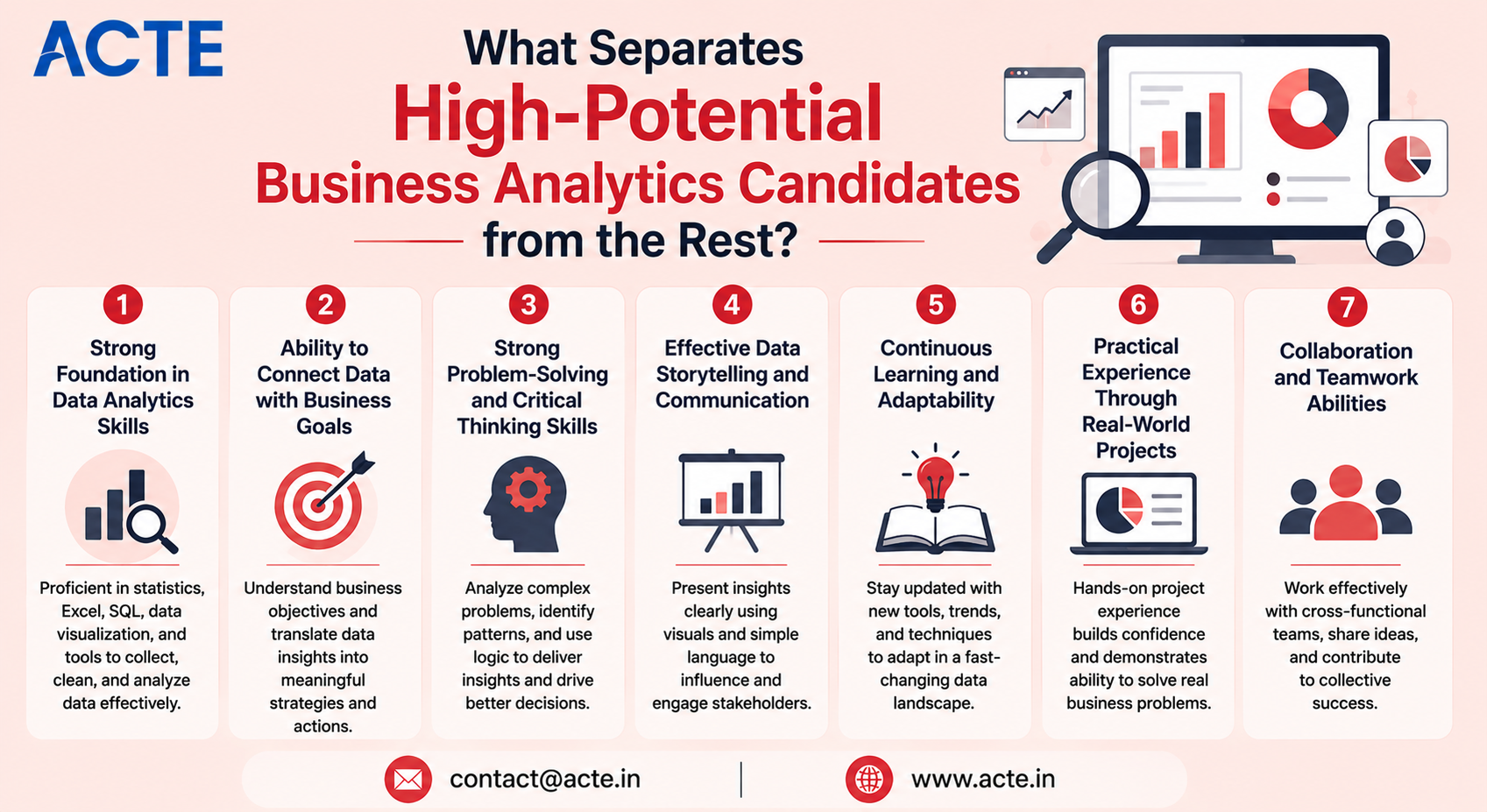
A solid technical foundation is essential for every business analytics professional. High-potential candidates are proficient in tools such as SQL, Python, Excel, Power BI, and Tableau, allowing them to collect, analyze, and visualize data efficiently. Beyond technical proficiency, they understand how to interpret analytical results and extract meaningful insights. Their ability to transform raw data into valuable business information enables organizations to make informed and confident decisions.
Business Acumen That Drives Better Decisions
Technical skills alone cannot guarantee success in business analytics. Exceptional candidates possess a clear understanding of how businesses operate and how different departments contribute to organizational success. They analyze data within the context of business objectives, customer expectations, and market trends. This broader perspective helps them recommend solutions that improve operational efficiency, strengthen customer relationships, and support long-term business growth.
Analytical Thinking with a Solution-Oriented Mindset
High-potential candidates approach challenges with curiosity and structured thinking. Instead of focusing only on identifying problems, they concentrate on finding practical, data-driven solutions. They examine trends, evaluate different scenarios, and use logical reasoning to support their recommendations. Their Business Analyst Course in Chennai ability to think critically enables organizations to reduce risks, uncover new opportunities, and make better strategic decisions.
Effective Communication and Insight Presentation
Business analytics is as much about communication as it is about analysis. High-potential professionals know how to present complex findings in a clear, concise, and meaningful way. They use dashboards, reports, and visualizations to simplify information for decision-makers who may not have technical expertise. By Business Analyst Course in Bangalore translating data into compelling business stories, they help stakeholders understand insights quickly and take informed action.
Commitment to Continuous Learning
The field of business analytics continues to evolve with innovations in artificial intelligence, machine learning, cloud computing, and automation. High-potential candidates recognize that continuous learning is essential for long-term success. They regularly update their technical skills, explore emerging technologies, earn professional certifications, and stay informed about industry developments. Their adaptability allows them to remain competitive in a rapidly changing business environment.
Practical Experience and Collaborative Skills
Employers value candidates who can demonstrate their abilities through real-world experience. High-potential business analytics professionals build practical expertise by working on projects involving data visualization, predictive analysis, business reporting, and performance measurement. They also collaborate effectively with cross-functional teams, communicate openly with stakeholders, and contribute to shared business objectives. Their Business Analyst Course in Hyderabad ability to combine technical knowledge with teamwork makes them dependable professionals in any organization.
Conclusion
High-potential business analytics candidates stand out because they offer far more than technical proficiency. They combine analytical expertise, business understanding, problem-solving abilities, communication skills, and a commitment to continuous improvement. By applying data strategically, adapting to new technologies, and gaining practical experience, these professionals become trusted contributors who help organizations make smarter decisions and achieve sustainable growth.
Comments (0)