


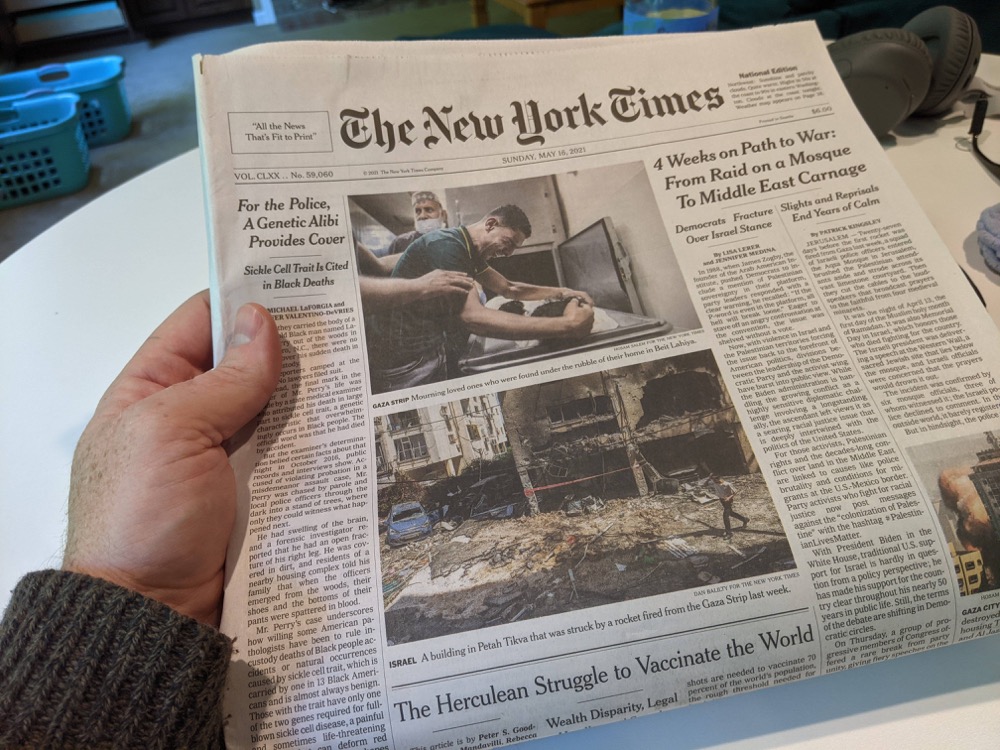
The news presents a particular reading challenge. Articles are designed to be skimmed: the inverted pyramid structure puts the most important information first, headlines are engineered to convey the story's gist independently, and the body of the article often consists of supporting details that many readers never reach. This design is not accidental. It reflects accurate assumptions about how most people read news. But deep reading of important news content produces qualitatively different understanding than skimming, and the gap between them matters more than most people realise.
What news reading typically produces
Studies of news reading behaviour, including eye-tracking research and comprehension assessments, consistently find that most news readers extract only a fragment of the information present in articles they read. The headline and first paragraph capture most readers' full attention. The remaining content is scanned or skipped. For straightforward stories, this is often sufficient: the essential fact was in the first paragraph, and the rest was elaboration.
For complex stories, this reading pattern produces significant misunderstanding. Nuance is in the body. Qualifications, counter-arguments, context and evidence are typically presented in the paragraphs that follow the lead. A reader who extracts only the lead of a nuanced policy analysis, a court ruling summary or a scientific finding report, is not just missing information. They are forming a simplified mental representation that may be directionally misleading. [B]Headline comprehension is not story comprehension[/B>.
The structure of effective news reading
Effective news reading for complex stories involves three phases. The first is orientation: reading the headline, the first two paragraphs and the final paragraph to establish the story's main claim, its most important evidence and its broader implication. This takes less than a minute and allows an informed decision about whether the full story warrants deeper engagement.
The second phase is full engagement for stories that pass the orientation filter: reading the complete article with attention to the specific evidence used, the sources cited, the qualifications applied and the context provided. This is the phase where most of the complexity and nuance of a well-reported story lives. The third phase is active processing: producing a brief summary of what the story argued and what its key evidence was, which confirms comprehension and builds retention.
The source quality problem
Deep reading of news also involves attention to source quality, which shallow skimming does not support. A claim attributed to "experts" is different from one attributed to three named researchers at a specific institution. A statement that "studies suggest" is different from one citing specific peer-reviewed research. These distinctions are present in the body of well-reported articles and invisible in their headlines.
Developing the habit of asking, while reading a news article, "who says this, and what is the basis for it?" produces significantly more reliable understanding than accepting claims at face value. This critical reading stance requires full engagement with the body of the article, not just its opening. The cognitive web extension tool that makes deep engagement with web-based content faster and more structured supports this kind of active, critical news reading.
Managing time in a high-volume news environment
The practical challenge is time. A professional who needs to track developments across multiple topics cannot read every relevant article in full. The solution is not to skim everything but to read fewer things in greater depth. Highly selective full reading of the most important stories, combined with rapid summarisation of secondary content, produces better understanding than attempting comprehensive shallow coverage.
A rapid text summariser used for the content that does not warrant full reading reduces the time burden of secondary coverage without eliminating it entirely. The professional who reads three important stories fully and skims twenty others through their summaries is better informed than one who skims all twenty-three or who reads five important stories at the expense of the others.
The long-term case for deep reading
Deep reading of news builds something beyond individual story comprehension: it builds domain knowledge that makes subsequent stories in the same area faster and easier to understand. A reader who has deeply engaged with ten complex stories on climate policy has the context to process the eleventh in a fraction of the time it took for the first. Deep reading is not only a better approach to individual stories. It is an investment in the background knowledge that makes all future reading in a domain more efficient.
Comments (0)