Dreams of Violets Creators on How Their AI-Generated Film Was Made
(Photo by Fountain 0 Studios)
When it was announced an AI movie that cost $2,000 to make was debuting at Tribeca Film Festival, more than a few eyebrows were raised. After all, the use of AI in filmmaking continues to be a hot debate, one that elicits every emotion from excitement and curiosity to skepticism and, for some, outrage.
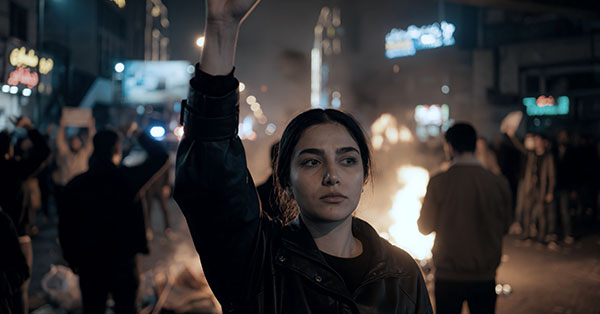
According to the movie’s creators, Dreams of Violets, a 75-minute fictionalized docudrama set in Tehran during the January 2026 protests, is the first fully AI-generated, feature-length film to be accepted at a major film festival. The debut project from new AI production company Fountain 0 uses journalistic reports and thousands of images and videos from actual protesters on the ground, and relies on proprietary technology and AI models like Kling AI for things like video generation and world modeling. Fountain 0’s second movie is set to be announced at the end of the month.
Despite its AI billing, producers and brothers Ash and Pooya Koosha are adamant that the movie is ultimately a human story, one whose emotional core is intended to shed light on the Iranian government’s violent crackdown on protesters and is informed, in part, by their own experiences in Iran.
“AI films are not intentional. [Dreams of Violets] is very intentional. That’s why I don’t like to say this is an AI film,” Ash Koosha, CEO of Fountain 0, tells Rotten Tomatoes. “It’s just a film because I knew I’m taking a risk making this film. It might not go anywhere, but if it does, if it goes down as one of the first AI films in history, 50 years from now when people look back and study AI films, they will hear the voices of those victims again and again and again. That’s the least I could do for those people.”
Below, the first-time filmmakers discuss how AI was (and wasn’t) used in the creation of Dreams of Violets, their reaction to criticisms, the impact they hope AI will have on filmmaking, and why they felt they needed AI to make this movie.
Rotten Tomatoes: Tell us about the development of Dreams of Violets. Where did the idea of using AI to create a film begin, and why did you want to specifically tell this story?
Ash Koosha: I was always ready to have an excuse to use my AI background and AI knowledge since a decade ago, but it always felt like an experiment or something that is incomplete until the January 2026 events happened in Iran. Something clicked, which was I wanted to sort of write a story and turn it into a piece, and none of the mediums available, including a YouTube video, or a post, or a blog, were sufficient to tell this story and to basically inform people of some of the events that I thought were important. Suddenly I just had this decision. It was a hard decision to basically use the AI knowledge that I have and tell that story through the medium of film — basically movies, because many people might have a problem with using the term ‘film’.
(Photo by Fountain 0 Studios)
RT: When people hear AI-generated, they often imagine you press a button and all of a sudden you receive a finished movie. Can you walk us through, in practical terms, how this film was actually made from idea to a full-length feature film?
AK: I think most people think that is the case, where you have these technologies suddenly removing a lot of the human processes and the work that we do to tell these stories, and I think that’s wrong. With Dreams of Violets, the only AI element that is fully generated is in fact the visuals, the video, and the reason for that is the locations and the worlds are just impossible to recreate. Even if you have a budget — which I doubt anyone can de-risk this kind of story and go to Iran and to shoot without getting arrested and prosecuted — the worlds are so incredibly rare and hard to visualize that I had to use AI for that component. But [for] the rest of the film, it started with a script, with a screenplay, [and] with an idea. I blocked it like you would a traditional film. I decided what timeline I’m gonna use, what kind of decoupage and mise-en-scene I’m gonna use for each block [and] for each sequence. There was a lot of work done before even touching AI. Also the process afterwards, which is the music, the soundtrack, the sound mix, the editing, the pacing, correction of the film, and the coloring of the film. All of this stuff comes before and after you press that button on an AI model.
RT: When you’re in the phase of actually using AI, what does that look like?
AK: Without going into some of the proprietary systems that are still in development — I’m using those internally to create new methods and new tools for filmmaking — I can say that preparation of the pre-video process is the most important and the most artistic process. You have to imagine a world, the people in there, the way they look at each other, the way objects are basically designed and placed, the way motion happens. All of this happens in collaboration with AI, rather than letting AI decide what to do with your scene’s physics or with the scene’s logic. In cinema, I think the logic is in the hands of a few people, mainly the director and the cinematographer. The logic of the scene often is decided through a preparation of physical production, and then you get the right take. Here, it’s kind of translated into some digital preparation that I, as a director, have to then tell the model, ‘Let’s shoot it.’ The model becomes the camera, becomes the world, and becomes the performance.
(Photo by Fountain 0 Studios)
RT: To that point, in a traditional production, a director works with actors, cinematographers, production designers, editors, lighters, gaffers, and countless people to shape a film through collaboration. In this process, what does directing or filmmaking actually mean in practice?
AK: In [terms] of vision, it’s the same. The director, most of the time, has seen the film in their head so from that perspective; it doesn’t change. Using an AI model means that instead of going on set, you have to build that reality within your studio well before you hit the AI model. And the reason 99% of the AI output out there is useless and worthless, to me at least as an audience, is because that preparation, that intent and vision, simply doesn’t exist. With each [new AI] film, I’m hoping we’re going to invent new roles for the gaffer, for the lighting guy, for the sound guy, because if you don’t have on-set experience or edit room experience, you will never be able to operate these models correctly. It’s a shame that due to the political advertisement, whatever is out there that has scared people from AI, we are not giving these models to the right people to operate them. Those are often the scared folks and the people who hate on it based on just news [headlines]. Through a real human story, [we are looking] to invent and create new opportunities and jobs and see if this is a viable progression for cinema and augmentation for cinema, rather than a replacement for what there is already.
RT: You’re pointing to the skepticism that some people in the entertainment industry have about AI. Some people are also very curious to see how the technology evolves and how it will impact the art of filmmaking, but also types of films that we see. There’s an active debate happening right now about authorship, labor, and training data. Where do you see Dreams of Violets sitting within that broader conversation?
AK: I think all of those criticisms and skepticism are valid, and the reason we did this is because we believe in many of those criticisms ourselves. We want to find answers through actually doing the traditional route of filmmaking. Otherwise, we would have just put stuff on YouTube and tried to do social media marketing. We are trying to find where the errors are or where the opportunities are that are going to impact people positively. What I personally want to do is bring AI research through my art experience and art practice and say, ‘Hey, there are new areas of questions that we can’t answer that are in fact beneficial.’ AI’s not going to go anywhere. I don’t think this is ever going to go back to where we were 10 years ago, so we might as well be the people and inspire other people to come in and have these conversations through real projects.
(Photo by Fountain 0 Studios)
RT: What is something that this technology still cannot do that audiences may assume that it can?
AK: Compositionally and in terms of motion we still have a long way to go. People think that the model has a lot of control, so if I just talk to it, it will respond. I think that’s the fallacy. We’re nowhere close to experiential intelligence, machine intelligence. Experiential means that [the AI model] has a reason to return with a good shot of video to you.
Pooya Koosha: When digital cameras came around, nobody believed in that. There was a huge backlash with it. But eventually, even that got improved. Seeing how post-production was such an important role in this, we quickly figured out that with AI, the same thing is happening as well. It’s not just one click and then you just get some beautiful shot out of the model. It’s a lot of human input, human decision making, and a lot of taste that goes into it. You need to actually go back and forth, you need to work with it to get the look. We did actually a lot of post-production polygrading and manipulating the footage to make it actually much more cinematic.
RT: Can you point to a specific scene or moment that feels clearly authored by you?
AK: Except for a few very specific resemblances of some things that we have put in the film intentionally as a documented voice, for example, everything else I’ve seen in my head. It’s there because I had seen that scene flow in such a way. Thirty minutes into the production [of the film], I went back and changed about 15 minutes of scenes in terms of location and narrative, and this is just impossible to do in films. The way I’m even saying this, ‘I was 30 minutes into the film,’ [is incredible] because you usually shoot the film, and that’s it. You can’t get your A-list actor to come back on set. The agents will not pick up your phone again. So this was a privilege to be able to correct the film in terms of accuracy, in terms of emotions, and that is my unique take.
[Pooya and I] have seen it with our own eyes, and we’ve heard those things from interrogators. There’s a scene where there’s an interrogation, and that reminds me of the way it happened to us. And because it’s a lived experience, it becomes almost like a canvas where I’m excited to just put what I know.
(Photo by Fountain 0 Studios)
RT: Can you talk a little bit more about your personal experiences?
AK: Myself and Pooya, we were in music in Iran when we were young, and we got prosecuted only for the fact that we were in a band and just played a concert. It was all over the news 20 years ago. After that, we made a documentary about it, and when we left Iran, we basically got exiled because we got a call, like, ‘You can’t come back or you’re gonna go straight to prison or worse.’ And that film, No One Knows About Persian Cats, won a Cannes award. This is a film [in which] we risked telling a lie in Iran. When we were on set shooting that film in Tehran, we were on the back of a motorcycle, the camera following us. We had a fake permit. Now I look back, if they had arrested us back then, it would be straight-up execution. We would be gone. And we still did that. The reason now I’m not gonna do that again is because we’ve done it once. We know that if you go on the streets and make a docudrama on the streets, you’re risking your life. Years later, I kind of got reminded of the same things, like maybe I’m now mature enough to be that director like Bahman Ghobadi was 20 years ago, and this is my way of starting this new venture of a film studio. But the first [film], the flagship, I thought it should be about the struggle.
RT: When people hear a feature film was made for roughly $2,000, some people are going to hear opportunity and some people are going to think of it as a threat. How do you respond to both reactions?
AK: There are so many stories that you can’t simply sign off a loan or an investment to make, including this one that we made. The disparity in cinema is where you have the best worldbuilding and all these amazing, impossible stories told by the big studios, the big-name directors, whereas I think with this budgeting, you can have an indie filmmaker mindset, and you don’t have much of a risk trying to have a stab at some mythology or some space movie or the next Star Wars.
This is an experimental sandbox. For [our] next film, we have now licensed 10 faces and voices. We will take their biological presence, put it in a film, and they get a share in the profit of the film. That’s an experiment [to] even get the contracts correctly on this. It’s our job as the people in this industry and with our background to make a film and test out how [this model] works. Without [execution], it would just be a podcast debate. It’s time to move on from the discourse and let people come in.
I want to be very careful saying this, but a lot of the cabling and preparation on set are mundane jobs. [With AI films], the lowest level person is so creative. That’s the demand of the AI model because the AI model will work a lot better if everyone is using their creative force. If I wasn’t a big fan of [Andrei] Tarkovsky and Paolo Sorrentino, I don’t think I would have ever been able to get what we got out of the model. It’s just impossible, and we’re here to prove that it’s not the case that everyone is just suddenly gonna press the button.
(Photo by Fountain 0 Studios)
RT: You mentioned there’s already another film in the works. Can you share any details about it?
AK: We’re going to announce the trailer at the end of this month, but it’s a fantasy movie. It’s a huge story. I think most humans will have known this story at some point in their life.
RT: If audiences are still talking about Dreams of Violets five years from now, what do you hope they’re talking about: the story itself or its place in the evolution of filmmaking?
AK: The primary goal is that [the protesters’ stories] will be highlighted, but I think hopefully we will find these new types of stories, and the jobs and the intention has basically grown past just one film. And it’s something that we’ve expanded responsibly.
PK: Because of the firsthand experiences that [Ash and I] had, we’ve seen brutality and we’ve seen dictatorship. I would say it is a monumental piece of art that is going to stay in history and it will speak for the fallen lives. Five years, 10 years from now on, no matter which side of the history you are on, how you think about it, if you think that it was fair, if it wasn’t fair, people have lost their lives for no reason just because they wanted to protest. And I think this is just something that would keep the voices for the generations to hear.
This interview has been edited and condensed for clarity.
Find Something Fresh! Discover What to Watch, Read Reviews, Leave Ratings and Build Watchlists. Download the Rotten Tomatoes App.