The Woman Who Found a New Way to Tell Iran’s Story
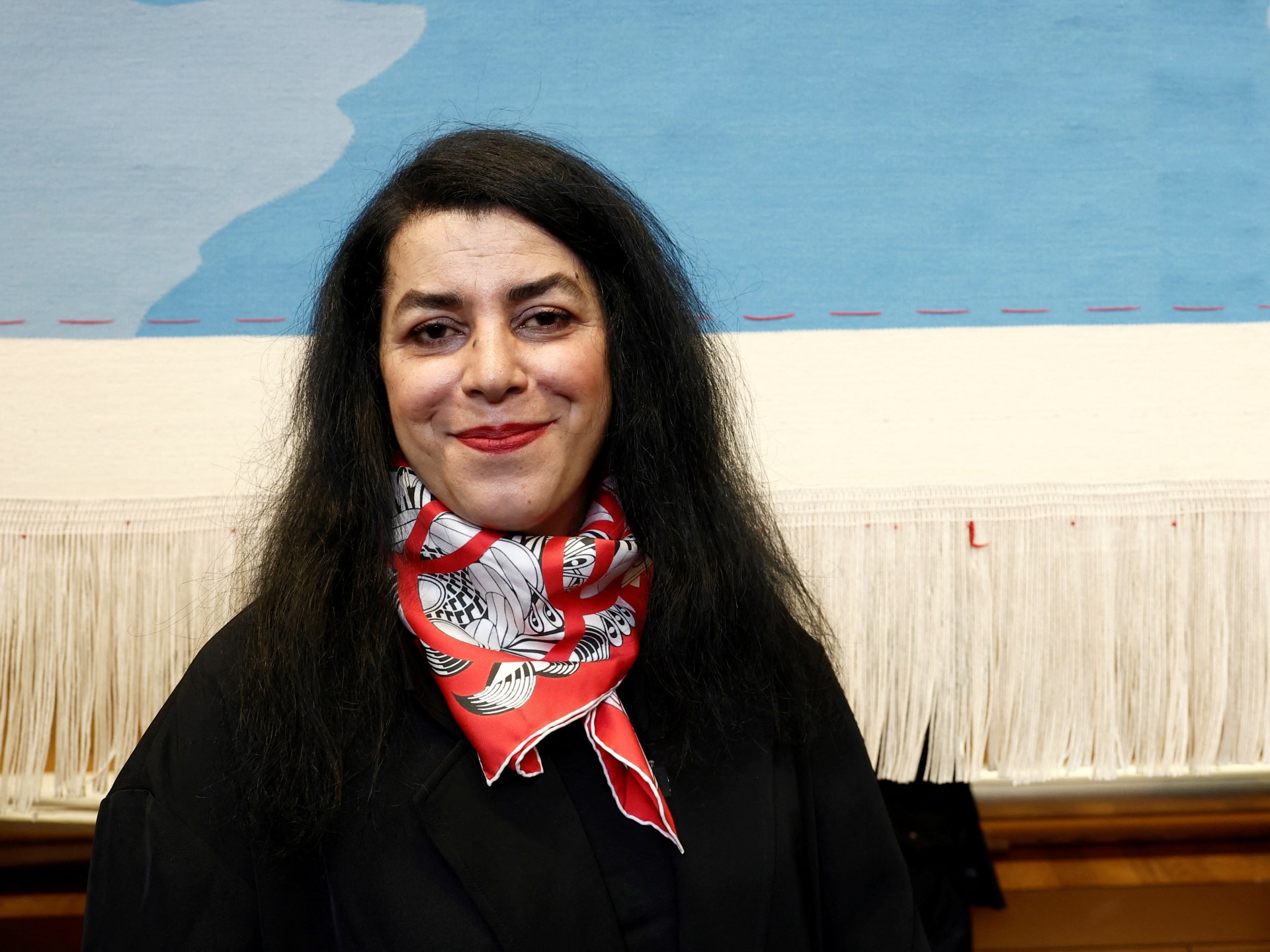
Marjane Satrapi, the French-Iranian graphic novelist and film director most famous for the comic series Persepolis, died Thursday morning at 56. She leaves behind a literary and artistic legacy that is both storied and unique.
She told her own coming-of-age story in Tehran during the Islamic Revolution in her funny and heart-wrenching graphic novel Persepolis. The first of the book’s two volumes covers her pre-teen and early teenage years, chronicling the leftist resistance efforts of her parents and uncle, the social changes enacted with the start of theocratic rule, and the rising oppression that quickly and irreversibly transformed every aspect of life as she once knew it. The second volume follows her travails in Austria, where her parents sent her for her protection. We watch her attempts to attend a Catholic school, to fall in love, and to find an identity among a group of quixotic, alternative teenagers.
Persepolis introduced American audiences to surprising and unfamiliar images of Iranian life, and the miseries that the regime had wrought on its own people.
The book ends with a return to her family in Iran, where she attends university and marries. Together, the graphic novel and the 2007 film adaptation (which Satrapi herself directed) form a bildungsroman set against the backdrop of one of the most significant historical events of the last 50 years. First published in Paris and translated into English soon after, Persepolis was read widely in the Western world, garnering awards and acclaim from Time, The Guardian, and more, and found extensive use in classes in American public schools.
Satrapi’s book has done a lot to re-orient the perception of the Iranian revolution worldwide. Once predominantly viewed through the angle of Mohammad Reza Shah Pahlavi’s exile, the Iranian hostage crisis, and Jimmy Carter’s missteps, Persepolis introduced American audiences to surprising and unfamiliar images of Iranian life, and the miseries that the regime had wrought on its own people. We see post-revolutionary Iranian teachers hastily revise their curricula according to the new Islamic standards. Meanwhile, Satrapi’s parents, struggling to keep a semblance of normalcy, smuggle posters of Kim Wilde and Iron Maiden for their daughter through border security. Above all, we witness the shocking violence and intimidation meted out to women who dare to show resistance.
When Satrapi gets to Austria, one might think that the narrative is approaching a happy ending. But she refuses to pander to her reader. She shows how she was thrust into a school with a new language, forced to contend with an adversarial group of nuns, a promiscuous roommate, and a friend group obsessed with radical thought and all sorts of drugs. Her attempts to ingratiate herself in this drastically different world generate some of the more amusing and gripping anecdotes of the story, a tale of a young woman’s struggles to fit in that many readers are able to relate to regardless of political and social background.
Satrapi is in a state of ambivalence similar to what she experienced as a small child, which reveals a key truth about any kind of life in any place in the world: Happiness can, perhaps, be achieved, but in much different, slower, and nonlinear ways than initially expected.
Satrapi’s tiny tragedies – her romantic heartbreaks, her expulsion from school, her near-fatal bronchitis accrued from wandering around without a place to sleep – contrast compellingly with what she has missed while outside Iran, which she learns from her father upon her return home. The imprisonment and executions undertaken by the Revolutionary Guards, the destruction wrought on entire populations by chemical weapons – how is it possible to speak of teenage angst in the same register as that? To balance the political and the personal with equal weight is always a near-insurmountable task, yet Satrapi never undersells one or the other. It is this success that makes Persepolis such a remarkable achievement.
The book’s great strength as a memoir is its refusal to allow for happy endings. There are moments of promise and hope. She marries a capable young man named Reza, with whom she undertakes an exciting architectural project at university, but the marriage ends in amiable divorce and the project is rebuffed by their superiors. By the end of the narrative, Satrapi is in a state of ambivalence similar to what she experienced as a small child, which reveals a key truth about any kind of life in any place in the world: Happiness can, perhaps, be achieved, but in much different, slower, and nonlinear ways than initially expected.
After publishing Persepolis and directing its critically-acclaimed film version, Satrapi went on to direct a few comedy-drama films and a 2019 biopic of Marie Curie. She stayed an active political voice, supporting the Mahsa Amini protests in late 2022 and creating an anthology of art and narrative on the topic, titled Woman, Life, Freedom. Her husband, Mattias Ripa, died last year. She will be profoundly missed.




Comments (0)