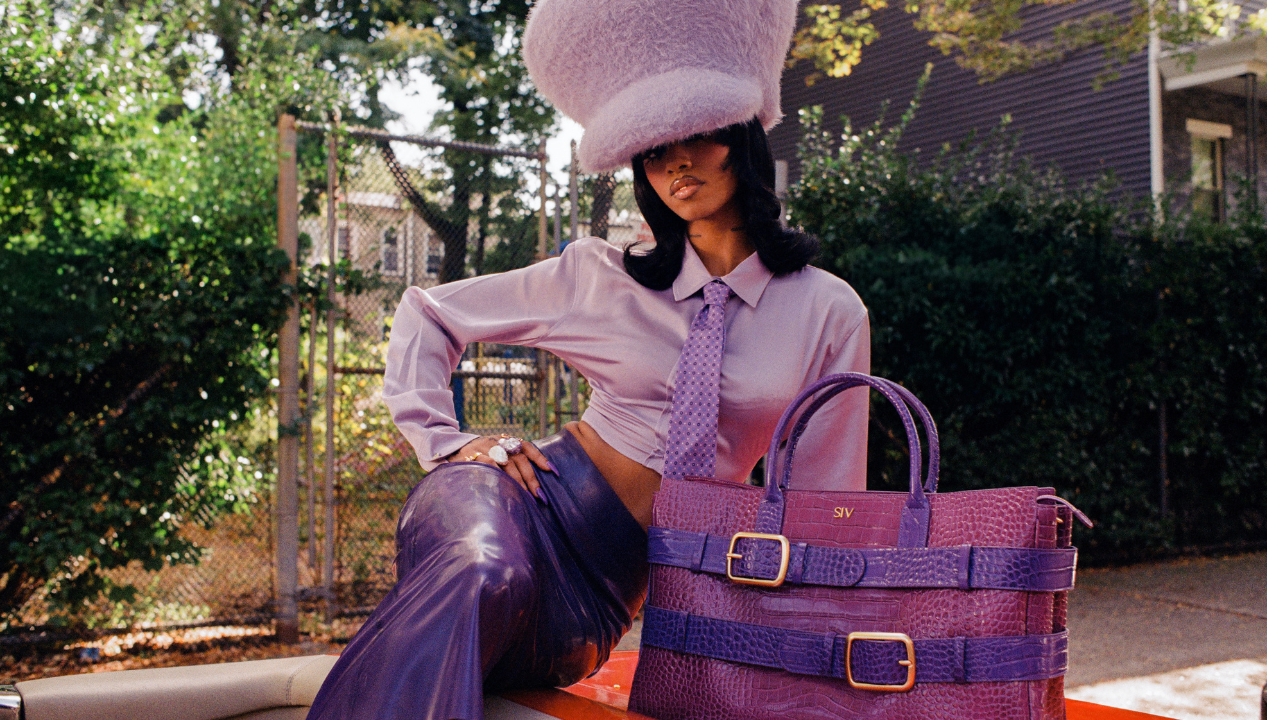
GRAZIA Exclusive: Sierra Rena Debuts The ‘SLICKBACK’ Handbag with Guidance from June Ambrose
Photography by Cole Hanauer
Sierra Rena has never moved without intention, and her return to design is no exception. In the past few years, the creator and stylist has built a visual vocabulary rooted in instinct and ambition — selling out drops in under 48 hours, styling herself with a conviction that reads as both armor and art, and building a brand that feels entirely self-authored. Her return to design demanded something with weight. With lineage. With story.
Enter the “SLICKBACK” — her first handbag under SIV and the opening colorway of a new accessories era taking shape behind the scenes. The piece emerges as a culmination of heritage, character study, and personal mythology: a saturated purple drawn from A Pimp Named Slickback of The Boondocks, and from her late uncle, who, as Rena remembers, “filled every celebration of his life with the color purple. I just knew the first bag had to live in those shades.”
Photography by Cole Hanauer
Photography by Cole Hanauer
Moreover, the hue isn’t merely aesthetic — it’s philosophy. Rena explains that “purple balances maximalism and elegance so beautifully,” a fitting frame for a designer who has long merged theatrical flair with emotional resonance.
And if the bag signals something bold, the woman standing beside her affirms its significance.
When June Ambrose — the architect of some of pop culture’s most era-defining fashion moments — recognizes a young creative’s potential, it doesn’t register as endorsement. It reads as succession.
Ambrose remembers the moment Rena’s work first caught her attention. She’d stumbled upon Rena online and immediately saw a spark of familiarity: the confidence, the self-styling, the clarity. Rena, she recalls, had been “styling herself with such conviction… it reminded me so much of my early days.” What impressed her even more was the sum around that spark — “her bold personality, her entrepreneurial spirit, and her ability to build a brand with intention.”
Together, Rena and Ambrose stand as two ends of a powerful continuum: one a trailblazing force who expanded what Black women could look like — and lead like — in fashion, the other a rising designer with a vision sharpened by instinct and inheritance.
A Bag With a Life of Its Own
Photography by Cole Hanauer
Photography by Cole Hanauer
To Ambrose, the bag feels almost animate — its proportions “exaggerated in the most sophisticated way,” its silhouette “bold but still elegant, almost architectural.” She describes the color story as “confident and cinematic,” the kind of tone that “announces itself before you even enter the room.”
What emerges is both a power accessory and a personal artifact; a re-entry into design that carries Rena’s past and future in the same breath.
Writing Themselves Into the Center
Photography by Cole Hanauer
Photography by Cole Hanauer
Rena and Ambrose speak with refreshing directness about creating in an industry where Black women often shape culture but are too rarely positioned at the center of its ownership.
For Rena, the response is rooted in the work. “I’m letting my work speak for itself… It comes from having confidence, doing the work, staying educated, being unique, and keeping my authenticity at the center of everything.” Ambrose frames the dynamic with characteristic clarity. Black women, she insists, “have always been the architects of culture… We’re no longer just the inspiration, we’re the ownership.”
However, both believe visibility is not aesthetic — it’s structural. Rena sees it in the creatives she surrounds herself with. “My values are reflected in the team I have,” she says, a nod to the intentionality guiding her ascent.
Ambrose expands the concept into an entire operating system. “It’s not just the spotlight — it’s the blueprint,” she notes. True visibility requires owning your designs, your story, and your seat at the table. “We are the CEOs of our life.”
For the Ones Coming Next
Photography by Cole Hanauer
Photography by Cole Hanauer
Rena is acutely aware of the young Black creatives watching her in real time. Her hope is that her trajectory widens the frame rather than occupies it. “I really hope it inspires them to know that there are Black women in this industry doing the damn thing — and that they can do it too.” Passion, confidence, and a sense of one’s uniqueness, she believes, can take anyone further than they imagine.
Ambrose echoes the mission with her own rallying cry, hoping this moment proves that Black creatives “don’t have to wait for permission… your creativity is currency and you deserve to profit, lead, and be celebrated within the culture you help create.”
And Rena, with her trademark candor, acknowledges the quiet scrutiny that often accompanies early success. “I don’t really look at support as something I get — I look at it as something I earn,” she says. “A lot of people watch quietly before they even say anything, before they even like your picture on Instagram.”
The SLICKBACK is more than a debut. It’s a declaration — of ownership, of lineage, of two Black women, Sierra Rena and June Ambrose, shaping fashion’s next chapter on their own terms. It is the beginning of a design era rooted in presence, power, and the kind of creative inheritance that refuses to be overlooked.
Photography by Cole Hanauer
Creative Direction and Styling by Sierra Rena
Hair by Brittany Taplin
Makeup by Naezrah
GRAZIA Exclusive: What to Wear to Thanksgiving This Year, According to Viral Fashion Creator Ro Brahmand
GRAZIA USA Fall/Winter Cover Star: Havana Rose Liu
GRAZIA Exclusive: Inside Christine Chiu’s Dazzling Return to Paris Haute Couture Week — An Exclusive Fashion Diary
Spotify House 2025: GRAZIA Goes Inside Nashville’s Hottest Country Music & Fashion Event, Exclusive Artist Interviews
GRAZIA Exclusive: From the Red Carpet to the Race Track, Odell Beckham Jr. Brings Heart & High Style to the French Riviera
GRAZIA Exclusive: Getting Ready with Pritika Swarup for the 2025 Cannes Film Festival Closing Ceremony